Reporting: Nektaria Psaraki
For decades, people have been losing their lives inside Greek police stations and migrant pre-removal detention centres. Nevertheless, Greece has no comprehensive and reliable public record systematically documenting how many foreign nationals have died in custody, who they were, where exactly they were held and under what circumstances they died.
“We often say that people who die are treated cynically, as mere statistics. In Greece, they are not even treated as statistics,” says Adrianne Fili, a researcher at the University of Oxford, speaking to TPP.
The University of Oxford’s research initiative, conducted as part of the Medicalising Immigration Detention project, funded by the Wellcome Trust, seeks to address this gap. The researchers gathered information from police records, international organisations, media reports, NGO reports, testimonies from detainees, accounts from former employees of the healthcare services operating in pre-removal detention centres (PRO.KE.KA.) through AEMY (Health Units S.A.), the public-benefit company responsible for providing healthcare services, and other independent sources.
The result is a database documenting at least 112 deaths of foreign nationals in police and administrative detention in Greece between 2000 and 2026. It is important to stress that this represents a minimum documented figure, rather than the total number of deaths that may have occurred. This will be explained in more detail below.
The database has been published on the Detention Landscapes platform in Greek, English and Arabic. The platform was launched in April 2024 in response to the fact that detention, as a central component of asylum and deportation procedures across Europe, exposes vulnerable people to inhumane and systematic forms of violence that take place inside closed facilities.
Detention Landscapes maps and documents human rights violations inside detention facilities. The database was developed by researchers from the University of Oxford’s Border Criminologies network, in collaboration with the organisations Mobile Info Team and Border Violence Monitoring Network, and provides evidence to support legal accountability.
The platform presents profiles of more than 100 detention facilities across Greece and archives over 120 testimonies from survivors describing appalling living conditions, serious negligence, and the lack of basic services inside closed facilities. It also features interactive 3D reconstructions of major detention centres, including the Attica Aliens Directorate on Petrou Ralli Street, the Pre-Removal Detention Centres of Amygdaleza, Corinth, and Xanthi, and the Samos Closed Controlled Access Centre (CCAC). Finally, it documents more than 130 human rights violations, alongside hundreds of supporting reports, conventions, photographs, and videos.
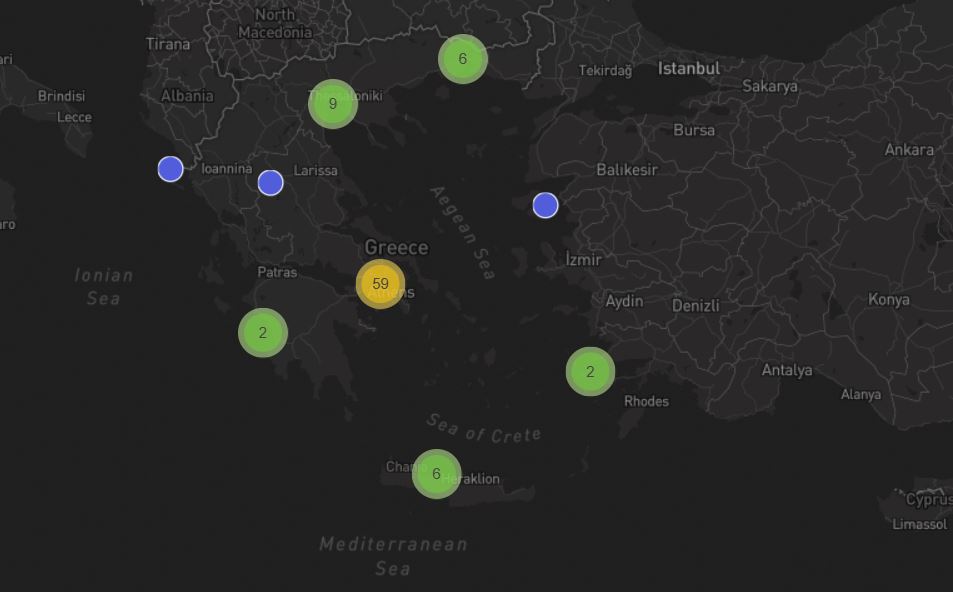
Today, the platform is being expanded to include the deaths documented over the past 26 years.
Which deaths are included in the research?
The main criterion for including a case is that the person must have been a foreign national and must have been in police or administrative custody at the time of death.
The database includes:
-
- Deaths in police stations and police detention cells.
-
- Deaths in Pre-Removal Detention Centres for Foreign Nationals (PRO.KE.KA.).
-
- Deaths during transfers to or from detention facilities, where the transfer takes place under police supervision.
-
- Deaths in hospitals, provided that the person remained in police custody at the time of death.
-
- Deaths of foreign nationals who had been arrested or detained on criminal grounds, as well as those held in administrative detention for immigration-related reasons.
By contrast, the database excludes deaths in prisons (even where individuals were awaiting transfer to an administrative detention centre or deportation), deaths in open refugee accommodation facilities, and deaths occurring after a person had been released from prison or detention, even when health problems had emerged or worsened during their confinement.
Cases in which it was impossible to confirm that the deceased was a foreign national are also excluded.
The figures: 112 documented deaths over 26 years
The 112 deaths represent a minimum documented figure. The researchers themselves point out that there are people whose names they have been unable to recover, deaths whose circumstances remain unknown, and other cases that may have left no publicly accessible record whatsoever.
| Year | Recorded deaths |
|---|---|
| 2001 | 2 |
| 2002 | 1 |
| 2003 | 11 |
| 2004 | 3 |
| 2005 | 1 |
| 2006 | 3 |
| 2007 | 3 |
| 2008 | 1 |
| 2009 | 1 |
| 2010 | 4 |
| 2011 | 2 |
| 2012 | 2 |
| 2013 | 8 |
| 2014 | 8 |
| 2015 | 4 |
| 2016 | 3 |
| 2017 | 2 |
| 2018 | 4 |
| 2019 | 4 |
| 2020 | 6 |
| 2021 | 8 |
| 2022 | 3 |
| 2023 | 10 |
| 2024 | 7 |
| 2025 | 7 |
| 2026 | 4 |
| Total | 112 |
The records of the Hellenic Police played a central role in compiling the documented cases. Researcher Stergios Magkriotis describes to TPP a prolonged back-and-forth exchange of emails with the police, which ultimately resulted in the researchers receiving an incomplete file, full of inconsistencies and lacking detailed information about the circumstances of death, the dates, the locations and even the personal details of the deceased.
“The numbers are a long way apart. We tried to cross-check the information provided by the police against media reports that corresponded to the dates of death, whether from Greek news outlets or announcements by organisations. Even then, there were discrepancies. For example, the Hellenic Police reports that 11 deaths occurred in 2003. That figure is not reflected in other sources,” he points out.
The researchers also used information submitted by the Hellenic Police to the European Committee for the Prevention of Torture and Inhuman or Degrading Treatment or Punishment (CPT), concerning the deaths of foreign nationals in custody between 2022 and 2025.
The researchers supplemented the database with media reports, announcements by grassroots groups, NGO publications, reports from independent monitoring bodies such as the CPT and the Greek Ombudsman, as well as a limited number of testimonies from detainees.
The research reports that 34 deaths documented by journalists, civil society organisations and monitoring bodies were absent from the police statistics.
The police did not respond to the researchers’ additional requests for clarification regarding the discrepancies. Following an intervention by the Greek Ombudsman, they once again refused to provide a more detailed breakdown of the aggregated figures, citing the excessive administrative and bureaucratic burden that such a process would entail. In other cases, the police provided only the year and the region in which the death had occurred. For 25 cases, virtually no further information was available.
Most deaths occurred in police stations
Of the recorded deaths, 81 occurred in police stations, where there is no medical staff, while 27 took place in pre-removal detention centres.
| Type of detention facility | Number |
|---|---|
| Police stations | 81 |
| Pre-Removal Detention Centres for Foreign Nationals (PRO.KE.KA.) | 27 |
| Special facilities for the detention of irregular migrants | 2 |
| Other official detention facility | 1 |
| Unrecorded location | 1 |
| Total | 112 |
Causes of death
The recorded causes of death vary considerably depending on the source. According to information provided by the police authorities, the breakdown of the 112 cases is as follows:
| Cause of death according to the authorities | Number | Percentage |
|---|---|---|
| Suicide | 44 | 39.3% |
| Medical causes | 20 | 17.9% |
| Sudden death | 9 | 8.0% |
| Undetermined cause | 2 | 1.8% |
| Unknown cause, with reference to previous physical abuse | 1 | 0.9% |
| No information available | 36 | 32.1% |
| Total | 112 | 100% |
The picture changes when information gathered from NGOs, media reports, testimonies and other independent sources is examined.
| Category according to other sources | Number | Percentage |
|---|---|---|
| Suicide | 35 | 31.3% |
| Medical causes, with allegations of medical negligence | 16 | 14.3% |
| Medical causes | 5 | 4.5% |
| Physical abuse | 2 | 1.8% |
| Unknown cause, with reference to previous physical abuse | 1 | 0.9% |
| No information available | 53 | 47.3% |
| Total | 112 | 100% |
Non-governmental sources document 35 suicides and 16 cases in which medical causes are linked to reports or allegations of medical negligence.
In a further five cases, medical causes are cited without any corresponding allegations of medical negligence. Two deaths are recorded as resulting from physical abuse, while in one additional case previous physical abuse is reported, although the cause of death has not been established.
The most significant finding, however, is that in 53 cases — 47.3% of the total — the aforementioned sources contain no available information about the cause of death.
In 32 cases, it was not even possible to establish the deceased person’s nationality. Albanian and Pakistani nationals constitute the largest documented groups, with 13 deaths each.
In most cases, the recorded cause of death is not based on an official autopsy report, as such reports are rarely made public, but rather on announcements by the police or other sources.
Medical staff virtually non-existent
The database also records whether medical personnel were present at the detention facility where the deceased person was being held.
| Presence of medical personnel | Number of cases |
|---|---|
| No | 84 |
| Yes, with limited availability | 27 |
| Yes | 1 |
| Total | 112 |
In 84 cases, or 75% of the total, there were no medical personnel at the detention facility. In 27 cases, medical staff were present but their availability was limited, while only one case records medical personnel being present without this qualification.
As a general rule, medical staff are available in pre-removal detention centres, but not in police stations or other detention facilities. Even in pre-removal centres, however, the presence of medical teams is limited. For this reason, the researchers do not regard the nominal presence of medical personnel as proof that detainees have genuine and timely access to healthcare.
In pre-removal detention centres, healthcare is officially provided by the public-benefit company AEMY (Health Units S.A.), with funding from the European Union. However, testimonies from detainees describe difficulties in accessing doctors, requests for medical assistance that are ignored or delayed, and police officers acting as intermediaries between detainees and healthcare services.
“Every death in custody is the state’s responsibility”
Adrianne Fili makes it clear, first and foremost, that every death in custody is the responsibility of the state.
Most of the recorded deaths are linked to the lack of medical care, whether in terms of access to mental health services — resulting in deaths by suicide — or access to doctors and medication in cases involving physical illness. Employees of AEMY reported that police officers obstructed detainees’ access to doctors, even when medical staff were available.
“Either there are no doctors at all — there is no medical or nursing staff in police stations, where most of the deaths occur, precisely because the detention cells are designed for stays of only a few days, not months, despite the fact that people are being held for as long as five months — or, even when doctors are available, there are serious problems with access. Every visit to a doctor requires police intervention.
“As a result, we see cases in which a detainee had been complaining about a health problem for some time, only to die after a period of time. The cause of death is then recorded as natural causes, while an alternative source indicates that it was a death resulting from negligence. Most of these deaths could have been prevented,” she explains.
Most of the recorded suicides took place in police stations. As Adrianne explains, the researchers documented cases of migrants who died by suicide after being held for four or five months in a police detention cell, isolated from psychologists and any form of healthcare.
“When the approach is to leave people locked up in appalling conditions, how can we not raise questions about the authorities’ responsibility when a suicide occurs?” she asks.
Adrianne cites the example of the Dafni Police Station. According to the research findings, detainees are held in a basement, without even having the ability to speak to the police officers on duty.
“We received testimonies saying that when detainees need something, they wave their hands and make gestures towards the cameras. If someone attempts suicide, how can the authorities ensure that they are able to intervene?” she asks.
“The narrative of manipulation is central to how suicide attempts are treated”
Researcher Stergios Magkriotis adds that they know of cases in which suicides occurred following a second rejection of an asylum application or a deportation decision, often after a vicious cycle of detention.
“The administrative process also plays a role in pushing people towards this point,” he comments.
He also notes that former employees of pre-removal detention centres reported that suicide attempts inside detention facilities are often regarded by management and the authorities as manipulative behaviour. As a result, they are not treated with the seriousness they deserve.
Adrianne adds that the notion of “manipulation” is a central narrative. The Council of Europe’s Committee for the Prevention of Torture (CPT) has even asked Greece to present a specific protocol for dealing with such incidents, as no such protocol exists.
“The Hellenic Police responds that there is not enough staff to deal with these incidents. The CPT’s response is: ‘Find the staff’,” she says.
Systematic use of violence as a consequence of the central political directive: “Make their lives hell”
With the exception of a number of high-profile cases, the research was unable to directly link other deaths to physical violence inflicted by police officers.
“That does not mean it has not happened. We know that police violence exists. We have testimonies describing physical violence, but there is a serious problem with documenting the circumstances surrounding deaths. Even in the case of Kamran, which is a relatively well-known and recent case, the Greek Ombudsman’s report does not say that he died as a result of being beaten. It refers to ‘police misconduct’, which can mean any number of things.
“We can therefore imagine what happens in other cases where the deceased is recorded as unidentified, or where there is no access to information. Most deaths come to light because the victims have relatives who are looking for them, or because lawyers take up their cases. Cases involving specific allegations of direct police violence are relatively few. However, given the serious gaps in the recording and investigation of deaths, as well as the repeated allegations of police violence inside detention facilities, we cannot know with certainty how many cases may have involved violence as a contributing factor,” Adrianne Fili notes.
Nevertheless, through interviews with detained refugees, the research documents the systematic use of violence by police officers.
“The perpetrators appear to be ordinary police officers on duty. But when there is a political directive telling them to ‘make their lives hell so that they won’t come here’, this naturally trickles down to lower-ranking police officers, who know that they enjoy impunity.
“In our research, we have collected testimonies describing repeated incidents of police violence and the isolation of detainees at the Aliens Directorate in Petrou Ralli. Among other things, there are allegations that detainees were taken to the rooftop of the second floor, where they were allegedly beaten. Serious allegations of sexual violence against migrant women in the basement of the same facility in 2020 have also been made public,” she adds.
Medical violence – AEMY healthcare professionals unable to file complaints
Stergios, however, reminds us that there is also medical violence as a form of systematic abuse.
“The logic of ‘there’s nothing wrong with him, just give him a paracetamol’ is another form of systematic violence, one that can also lead to deaths,” he points out.
The interviews with former AEMY healthcare workers employed in detention centres were particularly revealing.
“They described a very difficult working environment. People cannot bear working there. They consistently struggle to fill vacant positions when there are shortages of doctors and interpreters,” he explains.
Adrianne adds that healthcare professionals have no properly established internal mechanism through which they can report incidents. The researchers also recorded one testimony from a healthcare worker who said: “I wanted to report an incident of violence, but they wouldn’t even listen to me.”
She also highlights the shortage of medication, which has contributed to deaths, while also creating the conditions for a black market in medicines.
“In our research, we have collected testimonies from both former detainees and employees concerning the informal sale of medication, including psychiatric drugs, inside detention centres. These are allegations that require further investigation, but they highlight a broader problem: serious deficiencies in access to medication and psychiatric care. The presence of a psychiatrist and the provision of appropriate treatment are essential to protecting detainees’ health,” she stresses.
At the same time, however, there are detention centres where no healthcare personnel are present at all.
If migrants and refugees need to be transferred to a hospital for examinations or treatment, they must be accompanied by police officers, and police vehicles must be available. On many occasions, the police, citing staff shortages, fail to meet detainees’ requests for hospital transfers.
It is also worth noting that AEMY healthcare professionals, where they are available, remain at detention centres only during daytime hours. If anything happens outside those hours, patients have to wait.
According to the company’s financial statements, AEMY employees have filed claims against the company amounting to more than €350,000 in total, relating, among other things, to overtime and hazardous or harmful working conditions.
Six illustrative cases of deaths
Behind the figures are people with different stories.
One particularly striking case is that of 37-year-old migrant Mohammad Kamran, who was found dead and severely beaten inside the Agios Panteleimon Police Station in 2024.
The administrative investigation resulted in a minor disciplinary penalty being imposed on one police officer, while four others were referred to the First-Level Disciplinary Board. The criminal investigation remained ongoing, while the police refused to provide further information, citing the confidentiality of the proceedings.
The Greek Ombudsman identified evidence of disciplinary offences. The investigation revealed irregularities during his eight-day detention, indications of previous injuries and the absence of CCTV cameras inside police stations, a factor that made the investigation more difficult.
1. Mohammed Hamoud – Rethymno, 2004
Mohammed Hamoud, a 42-year-old Syrian national, died in January 2004 while in police custody in Rethymno.
According to media reports, he was arrested together with another Syrian national during a police check. The two men were allegedly beaten by police officers both during their arrest and after being taken to Rethymno Police Station.
Hamoud reportedly informed the police officers that he needed medication for a heart condition. He was later transferred to Rethymno Hospital, where he was pronounced dead.
The authorities recorded the cause of death as medical causes. Other sources reported that physical abuse may have aggravated his health condition.
According to the database entry, no further charges were brought against the police officers involved.
The case is not included in the statistics provided by the Hellenic Police.
2. Mohammed Hasan – Corinth Detention Centre, 2013
Another case that raises questions about access to healthcare is the death of Mohammed Hasan, an Afghan national, in 2013.
According to reports, while being held at Corinth Detention Centre, Hasan had been complaining to the police for several months about severe chest pain. He was transferred to a hospital and, according to the available information, died 20 days after being transferred from the detention centre.
His death was classified by other sources as resulting from medical causes, with allegations of medical negligence.
NGOs, the Greek Ombudsman and SYRIZA, which was then in opposition, called for the case to be investigated.
His death is not included in the relevant police statistics provided in response to the freedom of information request.
3. Mohammed Ashfaq – Pre-removal detention centres, 2014
Mohammed Ashfaq, a 23-year-old Pakistani national, died in June 2014 after spending a total of 25 months in pre-removal detention centres pending deportation.
According to reports, he had repeatedly requested medical care for a respiratory condition over the course of several months before his death. He reportedly died at the Red Cross Hospital.
Official sources do not record a specific cause of death. Other sources, however, link his death to medical causes and possible medical negligence.
As of 4 December 2014, a preliminary investigation into the circumstances of his death was underway at the Ampelokipoi Forensic Medicine Service.
Following his death, a mass hunger strike began at Amygdaleza Detention Centre.
This case, too, is absent from the statistics provided by the Hellenic Police.
4. Fata Abdul – Thessaloniki, 2015
Fata Abdul, a 23-year-old Yemeni national, died by hanging in November 2015 while being held in a special detention facility in Thessaloniki.
According to reports, he was receiving psychiatric care.
Some sources state that he had been held in solitary confinement for a month before his death, while the police maintained that this was not the case.
According to the same reports, the police delayed announcing his death for three days.
His death is not included in the statistics on suicides of foreign nationals in police stations provided by the Hellenic Police.
5. Hashir Latif – Amygdaleza, 2025
Hashir Latif, a 30-year-old Pakistani national, died in 2025 following a suicide attempt at Amygdaleza Pre-Removal Detention Centre. He had been declared brain-dead before his death.
According to the database entry, he had been held at Amygdaleza for six months and had previously spent 18 months in another detention centre.
He reportedly suffered from serious mental health problems.
The investigation into his case had been pending before the Greek Ombudsman since 8 August 2025.
His death is not included in the statistics on deaths in custody submitted to the CPT.
Limited access for independent bodies and intimidation of migrants
The documentation of deaths is also hampered by the limited access granted to independent bodies and non-profit organisations to detention facilities.
Furthermore, detainees’ ability to communicate with the outside world and report violations is severely restricted.
The researchers document practices that may discourage detainees from reporting incidents of abuse or informing others about their conditions of detention.
These include:
-
- The confiscation of mobile phones in police detention cells.
-
- The destruction of mobile phone cameras.
-
- The confiscation of phones as a punitive measure in certain detention centres.
-
- Limited access to Wi-Fi and phone-charging facilities.
-
- Restricted visiting hours.
-
- The remote location of certain facilities.
-
- Verbal threats and the monitoring of detainees’ messages by police officers in order to identify their contacts with organisations.
Dehumanisation – There is no way to reform the system
Systematic, transparent and publicly accessible accountability for people who have lost their lives while under state control is entirely absent.
According to the researchers, the purpose of the database is to provide a foundation for further investigation, the pursuit of accountability and ensuring that these people do not remain anonymous or forgotten.
“Here, human lives are not even numbers. They are not recognised even as statistics. We are talking about an entirely different biopolitical approach,” Stergios comments.
“We cannot even know how many people have died, let alone their histories,” he adds.
“This is precisely why we speak of state responsibility. It is a conclusion that the lack of transparency leads you to,” Adrianne notes.
As the interview drew to a close, we asked the researchers to put forward their recommendations.
Their answer was unequivocal: “There is no way to reform the system.”
“I have been working on the issue of immigration detention since 2011, and I am quite pessimistic about what can actually be improved within this framework. For us, the solution is not simply to improve conditions, but to put an end to these detention facilities altogether.
“Our research shows that the logic of control and punishment affects even the provision of healthcare. Healthcare professionals have described difficulties in expressing objections or reporting problems, while there are also testimonies of adverse treatment and staff transfers involving employees who challenged prevailing practices.
“When detention itself operates within a framework of deterrence and punishment, it is difficult to expect that adding more healthcare services or issuing new recommendations will address the underlying problems,” Adrianne Fili concludes.
The police did not respond to the researchers’ additional requests for clarification and further information, citing either workload pressures or the principle of confidentiality governing ongoing investigations.
“We urge anyone with information about already documented or new cases to contact us and share what they know”
“We have heard in interviews with formerly detained people that deaths and medical emergencies are frequent in detention, but not always reported on. Even within detention centres, it can be hard for people to receive reliable information about deaths due to the infrastructure of the centres which intentionally separates people and the restrictions on use of mobile phones in some facilities”, researcher Alice Troy-Donovan tells TPP.
“All of this leaves open the possibility that the actual number of deaths is far higher that what has been reported so far. We see this as an evolving project and call on people with knowledge about existing or new cases to bring this to our attention so we can update the archive and help ensure accountability for state-induced deaths”, she concludes.