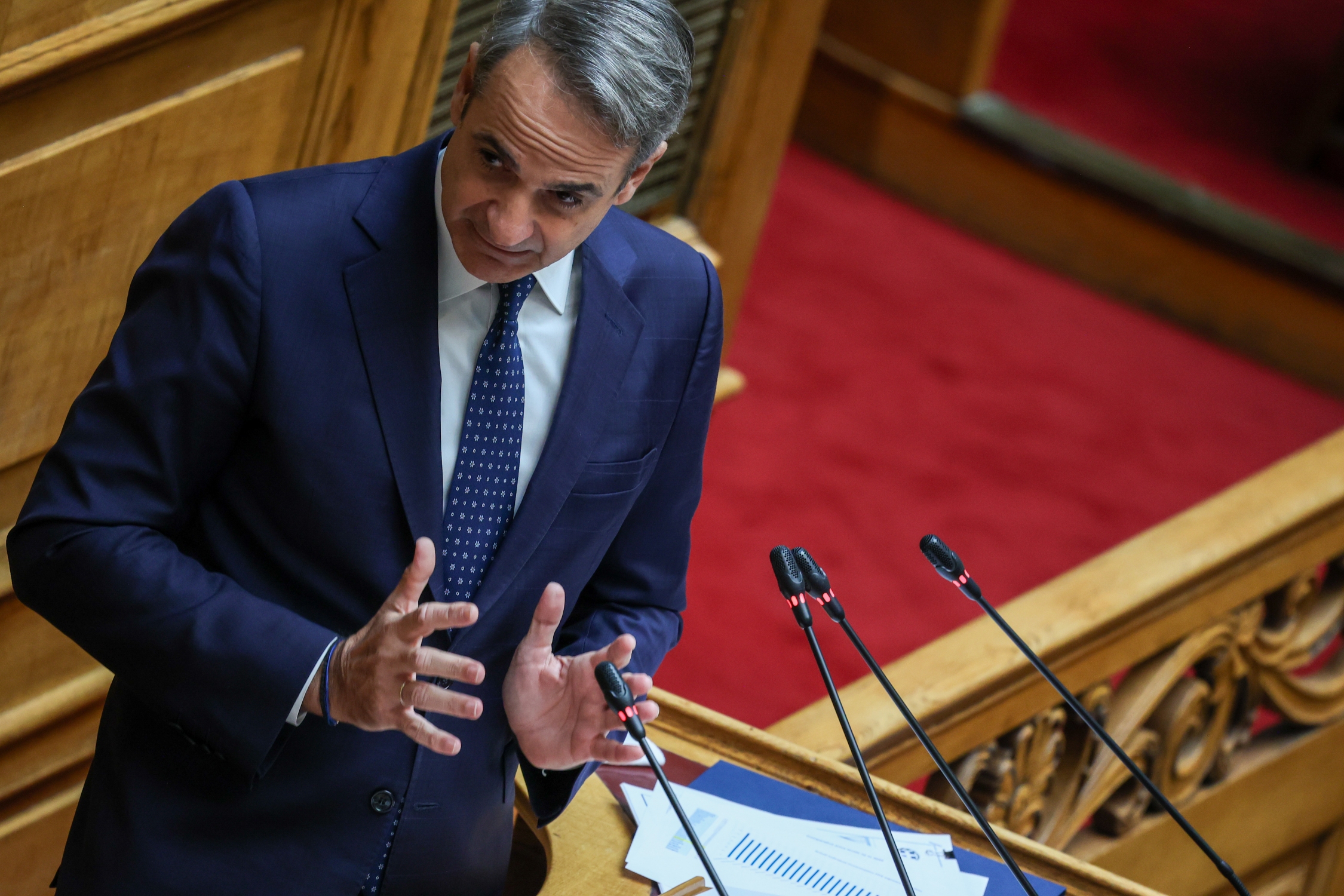
Responding to a question from PASOK during a parliamentary question-and-answer session known as ‘Prime Minister’s Hour’, Mitsotakis painted an idealised picture of the country’s economic situation and claimed that the data presented by the opposition were ‘misleading’. Trying to deflect responsibility, he declared: ‘I am not the wizard Harry Potter.’
PASOK leader Nikos Androulakis, by contrast, highlighted a 34% increase in the cost of living in recent years, particularly for food, the fact that half of households cannot afford a holiday, the pressure on small and medium-sized businesses struggling with debt and energy costs, and the rising production costs faced by farmers. ‘Your propaganda clashes with reality every day, no matter how much money you distribute to your communication arms,’ he said.
Mitsotakis devoted much of his intervention to defending government policy on prices and incomes, arguing that Greece has weathered recent crises better than other EU member states and that his administration has protected living standards more effectively than its critics claim.
‘Imported’ inflation and food prices
Once again, Mitsotakis argued that price rises in Greece are largely ‘imported’, attributing inflation mainly to external shocks. ‘Inflation is an international phenomenon and our concern is how we can deal with it,’ he said.
He traced the roots of the current wave of inflation to the pandemic, which froze economic activity, and then to Russia’s invasion of Ukraine, which pushed up energy and commodity prices worldwide. ‘The roots of the price increases go back in time,’ he insisted, underlining his claim that the government cannot control international factors.
On food prices, the prime minister argued that Greece ‘has approximately the same inflation as Europe’, citing a cumulative increase of 37.6% for Greece compared with 40% on average in the EU. He also presented OECD figures according to which Greece ranks fourth in the world in terms of food inflation, with a rate of just 1.4% in September.
‘It is a myth that Greece has the most expensive electricity’
Mitsotakis also sought to counter criticism over energy prices. He insisted that ‘it is a myth’ that Greece has the most expensive electricity in Europe.
‘Greece is in 18th place in Europe in terms of the price of electricity,’ he said, adding that Germany has higher prices. According to the prime minister, high energy costs are not a uniquely Greek problem but part of a broader European reality.
‘Rising income is the answer’
Defending his government’s response to the cost of living crisis, Mitsotakis argued that ‘permanent income growth’ is the best answer to high prices.
He said the minimum wage has increased by 38% in recent years, from €650 to €880, and is expected to reach €950 by 2027. ‘Simple mathematics says that the minimum wage has increased more than inflation,’ he claimed, adding that the increase affects private sector workers as well as those in the public sector.
Referring to bank deposits, Mitsotakis stated that household deposits have increased by €38 billion over the past six years, while unemployment has fallen from 18% to 8%. ‘The general picture shows that Greece has improved its position compared with the past,’ he said, arguing that the government has taken decisions that support people’s incomes through wage rises and tax cuts.
‘I am not Harry Potter’
Attempting to fend off criticism, the prime minister repeated that he could not magically solve all problems.
‘When I listen to you, I have the impression that I was elected prime minister in Luxembourg and that we have led Greece to a much, much worse position,’ he said, accusing Androulakis and the opposition of doom-mongering and insisting that citizens no longer believe in ‘fantastical’ promises. ‘The times when you could trade seaweed for silk ribbons are over,’ he added, arguing that his government is delivering ‘real reforms’ with visible results.
Mitsotakis reiterated that Greece is still carrying the legacy of a decade-long crisis that delayed its recovery. He criticised those who, in his words, try to present the country as ruined. ‘Greece has emerged from the crisis and is gradually improving,’ he said, claiming that the government is working hard to make up for lost ground and to boost incomes.
Although he conceded that high prices remain a serious problem, the prime minister appeared confident that his government’s policy, centred on income support and growth, will be sufficient to tackle it.
Androulakis: mockery and ‘painkiller’ measures
PASOK leader Nikos Androulakis launched a strong attack on the government over high prices and the soaring cost of living.
‘Society is outraged,’ he said, describing the measures announced by the government as ‘painkillers’ and ‘mockery’ that fail to address the root causes of the crisis. He argued that ‘political change’ is the only way to restore ‘dignity’ and ‘hope’ for the public.
Androulakis cited specific figures to illustrate the pressure on households. On food, he said that ‘in four years, prices have increased by 34%’ and that beef, which used to cost €12–€13 per kilo, now costs €18–€19. He added that ‘one in three households spends more than 40% of its income on housing’, while ‘half of families cannot even afford a week’s holiday’.
‘Everyday life has become unbearable for a large part of society,’ he argued, accusing the government of either failing to understand this reality or choosing to ignore it.
‘You protect and support oligopolies’
Androulakis accused the government of inaction in the face of profiteering by oligopolies and middlemen. ‘You protect them and support them,’ he said, arguing that the government has taken no effective measures to curb excessive profits and the exploitation of citizens by powerful interests.
He mocked government initiatives as a ‘parody’, pointing to ‘coloured invoices’ and ‘letters to Brussels that lead nowhere’. He said these measures ‘have the same weight as Mr Velopoulos’s “Jesus letters”’, referring to the far-right Greek politician who has marketed supposed letters from Jesus to his supporters.
Androulakis called on the government to ‘get serious’ with communication tricks while, in reality, it has done nothing substantial to tackle high prices.
Referring to the gap between producer prices and supermarket prices, he stressed that ‘products are three times more expensive by the time they reach the shelf, and you allow this to happen’. He accused the government of failing to curb the profit margins of middlemen and of ‘allowing the monopolies to throw a party’. He also questioned why the government took down the ‘e-katanalotis’ (i.e. e-consumer) website, an online tool that had helped consumers compare prices.
In his second intervention, Androulakis responded to the prime minister’s criticism that PASOK has voted for many government measures. ‘We vote for measures we consider correct,’ he said, adding that ‘when PASOK is in government, we will implement our own measures’. He called on the government to assume its responsibilities and prove that it cares about citizens rather than just the interests of the powerful.
‘All government choices create new social inequalities’
Androulakis concluded that the government’s decisions ‘create new social inequalities’. After underlining what he described as a failure to tackle high prices and profiteering, he demanded concrete answers on the fines imposed on companies and on the government’s stance towards monopolies.
He also highlighted what he called a major failure on social housing, saying the government had ‘achieved nothing’ and had ignored PASOK’s proposals, which were based on European practice. On interest rate reductions, he described the measures as ‘a mockery’, arguing that wages remain stagnant and that Greece is still ‘second from last’ in the EU for the average wage, according to Eurostat data.
______________________________________________
Are you seeking news from Greece presented from a progressive, non-mainstream perspective? Subscribe monthly or annually to support TPP International in delivering independent reporting in English. Don’t let Greek progressive voices fade.
Make sure to reference “TPP International” and your order number as the reason for payment.