This year’s commemorations take place under draconian security measures. Around 5,000 police officers from all major riot and rapid-response units, including MAT, DIAS, DRASI and OPKE, have been deployed. Drones and helicopters are also in use.
It has been 52 years since tanks smashed through the Polytechnic’s gates and snipers shot unarmed students. Speaking to us, Antonis Davanelos, who was inside the Polytechnic on 17 November 1973, underlined the crucial role played not only by the students but also by the city’s working class: people who put up barricades in the surrounding streets to stop the tanks reaching the campus. People who resisted injustice and repression.
For two days, thousands of people of all ages have been visiting the Polytechnic courtyard to honour those who fought for democratic rights and freedoms. The gates opened at 9 a.m. and were scheduled to close at 1 p.m., so that preparations could begin for the traditional afternoon march to the US embassy, due to start at 4.30 p.m.
Fifty-two years on, political organisations, trade unions and student groups are calling for mass participation in the anniversary mobilisations, stressing that the demands of that time remain relevant.
Athens under heavy police guard
The centre of Athens has once again been turned into a ‘fortress’. Some 5,000 officers from riot and special units are deployed on foot around the Polytechnic and other university sites, near the US and Israeli embassies, at key public buildings and across the wider Exarchia district.
Drones and police helicopters are transmitting live images to the Hellenic Police operations centre, monitoring rooftops in Exarchia in particular. According to state broadcaster ERT, thorough searches are being carried out in areas where there is intelligence about possible ‘munitions of war’.
Police sources say officers from the Anti-Terrorism Service and the National Intelligence Service (EYP) are also involved, while plain-clothes officers are monitoring ‘critical points’ in central Athens and conducting ‘preventive checks’.
Armoured water cannon vehicles, known as ‘Aiantes’, are on standby.
Traffic restrictions include a ban on stopping and parking from 6 a.m., and a gradual shutdown of traffic in the city centre from midday until the end of the day’s events.
Magda Fyssa pays tribute at the Polytechnic
Among those who visited the Polytechnic this morning was Magda Fyssa, mother of anti-fascist rapper Pavlos Fyssas, who was murdered by a member of the neo-Nazi organisation Golden Dawn.
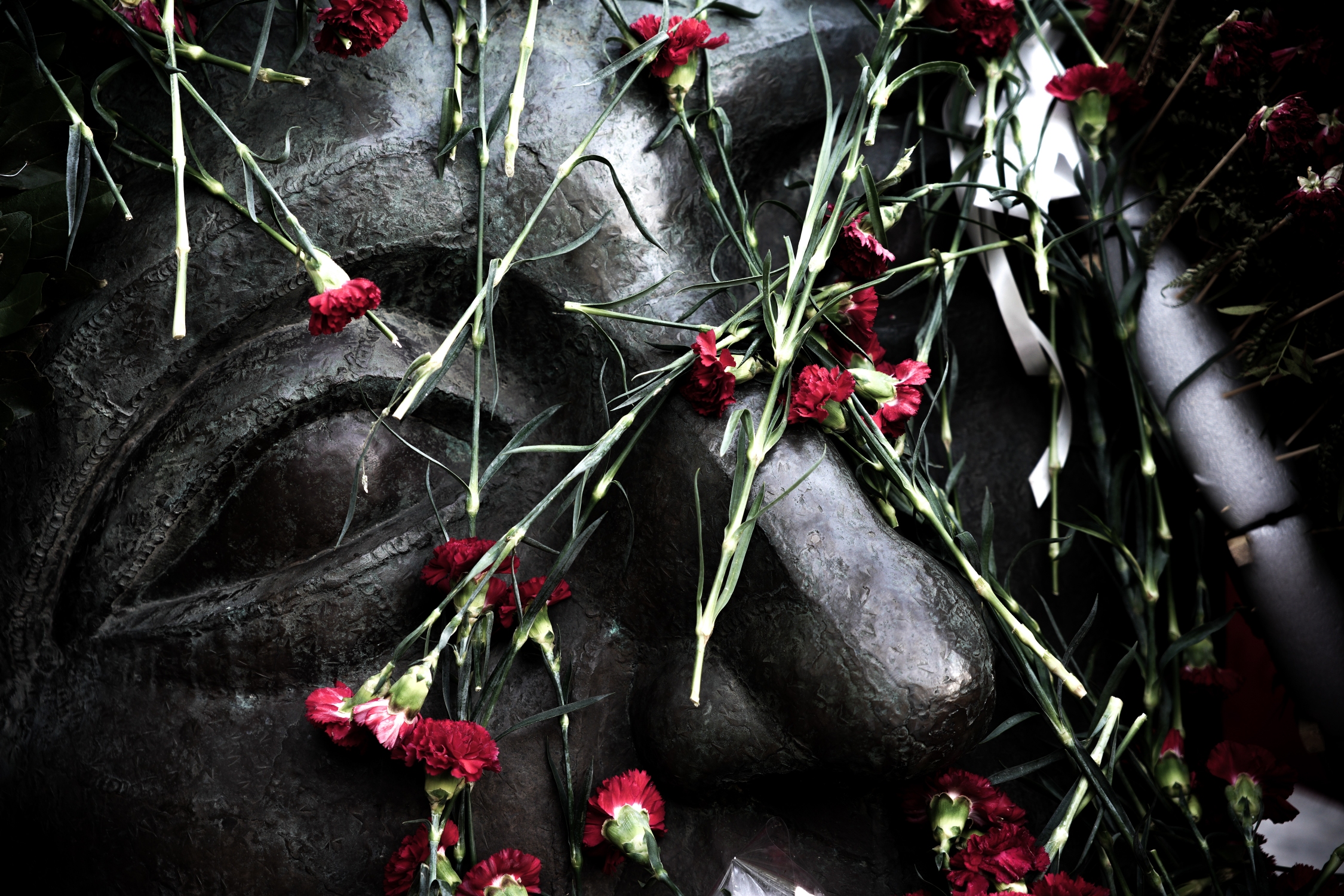
Fyssa, who has become a symbol of the anti-fascist struggle in Greece, laid flowers in memory of those who stood up to the junta. From early in the day, a steady stream of people, political organisations, trade unions and parties arrived to honour the fighters of the November 1973 uprising.
The Cultural Association ‘Pavlos Killah P’ wrote in a statement: ‘17 November 1973 – honour and glory to the people who fought for us to be free today.’
The Polytechnic’s gates were closed at 1 p.m. as pre-march assemblies and preparations began for the long afternoon demonstration to the US embassy. As every year, large crowds had visited the historic site in the morning to lay flowers and pay tribute.
Famellos: ‘The messages of November are alive’
Political leaders were present throughout the morning. The president of SYRIZA–Progressive Alliance, Socrates Famellos, stated:
‘Fifty-two years later, we honour the memory of the dead of the Polytechnic, of the young people who resisted, who raised their heads, who expressed the need of a people for political freedom.
‘We honour the struggle of the fighters of the anti-dictatorship struggle against the junta of colonels that tortured, imprisoned, exiled and led to the betrayal of Cyprus.’
Famellos stressed that the slogans of November 1973 remain current:
‘The messages of November are alive: for bread, education, freedom; against poverty and low incomes; against the encroachment on public goods such as education and health. For a Greece that has democracy and the rule of law and is free from entanglement and corruption. These are contemporary demands for popular sovereignty, national independence and social justice.’
He concluded:
‘The young men and women of November at the Polytechnic in 1973 sent a clear message: our rights are won through struggle, and democracy demands struggle and sacrifice.
‘The Polytechnic is alive and calls us to new, undying struggles.’
Varoufakis: ‘From the youth, the spark of popular revolt’
The secretary of MeRA25, Yanis Varoufakis, also visited the Polytechnic and said:
‘Fifty-two years ago, the youth of this country instilled in us the timeless hope that a people who seem timid, unable to defend themselves, defeated, can from one moment to the next, prompted by a spark lit by their youth, rise up and overthrow the regime that deprives them of their livelihood, their education, their freedom.
‘Today, 52 years later, youth is once again called upon to provide the spark of popular uprising in a Greece that is being sold out to the US and NATO – you saw the Mitsotakis–Zelensky caricatures – a Greece in which the people cannot cope, in which education is suffering, where freedom “looks and sighs”.
‘This is how we honour the Polytechnic, the youth of ’73: by supporting the struggles of today’s youth, who are called upon to keep the hope of rebellion alive.’
Doukas: ‘The message of the Polytechnic lives on in the struggle for a just Athens’
The mayor of Athens, Haris Doukas, laid a wreath at the Polytechnic and underlined that the message of dignity and courage from 1973 remains alive in the daily struggle for a just and humane city.
In his statement, Doukas said that the slogan of the 1973 uprising, ‘People, people, now or never’, was not simply a chant but a demand for dignity and a life without fear.
He stressed that democracy is won by people with a collective vision and courage, and highlighted the importance of keeping this legacy alive in Athens through the daily struggle for a humane, just and peaceful city for all.
Konstantopoulou: ‘It is our obligation to fight every anti-democratic policy’
Zoe Konstantopoulou, president of the Course of Freedom party, also took part in the wreath-laying ceremony to mark the 52nd anniversary.
‘Today we honour a great anniversary against the junta. We honour those young men and women who fought, the people who stood up against the junta,’ she said.
She continued:
‘As we face a government that includes deniers of the dead of the Polytechnic, people who supported the junta, we feel the duty to fight like the young people of that era.’
Concluding her message, Konstantopoulou added:
‘Immortal are those who gave their lives, honour to those who fought so that we could have democracy. It is still our obligation today to fight every anti-democratic, every authoritarian, every totalitarian policy. And that is what we will do.’
______________________________________________
Are you seeking news from Greece presented from a progressive, non-mainstream perspective? Subscribe monthly or annually to support TPP International in delivering independent reporting in English. Don’t let Greek progressive voices fade.
Make sure to reference “TPP International” and your order number as the reason for payment.