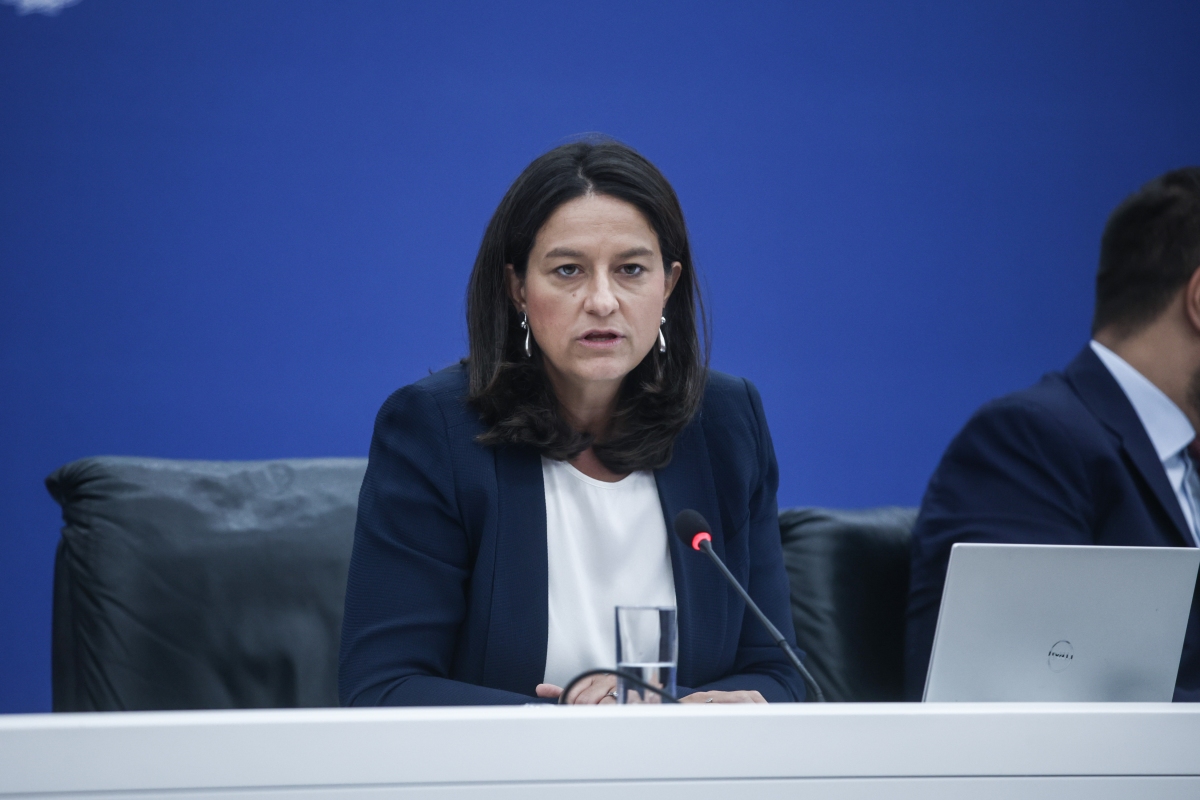
Speaking at a press conference at the ministry, Ms Kerameus framed the accord as a framework for stability and predictability that will extend collective protection to more employees. She said the agreement would allow ‘many more employees’ to be covered by collective labour agreements, bringing ‘important benefits for them, but also for businesses’.
Critics pointed out that Greece currently has low collective-bargaining coverage. Under the Mitsotakis government the share of employees covered by collective agreements has been around 24 per cent, while the EU target in a 2024 directive is 80 per cent, the opposition noted.
What the agreement says
The ministry said the social agreement rests on three main axes.
-
Facilitating expansion. The agreement reduces the threshold for extension from 50 per cent to 40 per cent. It creates a new route to expand collective labour agreements when they are co-signed by recognised national social partners, and it allows the General Confederation of Greek Workers (GSEE) to conclude or co-sign sectoral agreements on an ancillary basis, if invited to do so. The government also promised to simplify registration procedures for organisations so they can be entered in the relevant registers, strengthening the basis for future extensions.
-
Protection after expiry. The terms of an expired collective labour agreement will continue to apply during a three-month extension and thereafter until a new collective or individual agreement is concluded. The memorandum-era rule on partial retroactivity, which has been in force since 2012, will be abolished and replaced by full retroactivity. Staff hired during the three-month extension will also be covered.
-
Faster dispute resolution. The agreement promises speedier procedures at the labour arbitration body OMED. A three-member committee will carry out a preliminary verification of the conditions for unilateral recourse to mediation and arbitration. The second level of OMED arbitration will be abolished in order to accelerate disputes, although judicial review of arbitration decisions will remain possible.
SYRIZA response
SYRIZA’s labour sector leader, G. Gavrilos, said the government had finally acknowledged its ‘institutional failure’ to protect collective bargaining. He argued that the measures announced did not remove the wider problem of a labour market that, he said, the government had allowed to become precarious through laws favouring individual contracts and longer hours.
Mr Gavrilos asked how the government intended to protect federations’ autonomy and whether it would restore a stronger role for sectoral collective bargaining. He also demanded clarity on the future of the national general collective agreement, which he described as a central mechanism for ensuring immediate and real increases to the minimum wage.
‘In a labour market that has become a jungle for most workers, what we heard today does not convince anyone,’ he said. ‘The only way forward is to repeal all the anti-labour laws of New Democracy and strengthen free collective bargaining.’
The ministry said the agreement followed seven months of consultations with national social partners and, it claimed, marked the definitive end of memorandum restrictions on collective bargaining.
New Left MP and former labour minister Efi Achtsioglou also responded
Referring to the fatal workplace accident in which a 50-year-old STA.SY employee died that same day, Ms Achtsioglou said work accidents and incidents were rising and that the government, which recently approved a law allowing a 13-hour working day, bore ‘absolute responsibility’ for the deterioration.
Ms Achtsioglou argued that the agreement announced by the ministry did not represent a genuine reinstatement of collective labour agreements. She said neither the principle of the most favourable regulation nor the unilateral recourse to arbitration, which she said New Democracy abolished on returning to government, were being restored. On the contrary, she said, the regime that effectively abolished collective agreements remains in place.
In detail, Ms Achtsioglou argued:
collective labour agreements remain in a repealed status, since employers can refuse to sign them and employees have no right to unilaterally resort to arbitration to force negotiations;
the regime of abolition persists because a range of exceptions allow firms to adopt company agreements with weaker terms that will prevail over sectoral deals;
the definition of the minimum wage is not included in the national general collective labour agreement.
She warned that the government’s choices had left more than 75 per cent of workers without coverage by collective agreements, with wages stagnant while housing costs soar. ‘Greece is officially in last place in the EU in real average wages,’ she said.
______________________________________________
Are you seeking news from Greece presented from a progressive, non-mainstream perspective? Subscribe monthly or annually to support TPP International in delivering independent reporting in English. Don’t let Greek progressive voices fade.
Make sure to reference “TPP International” and your order number as the reason for payment.