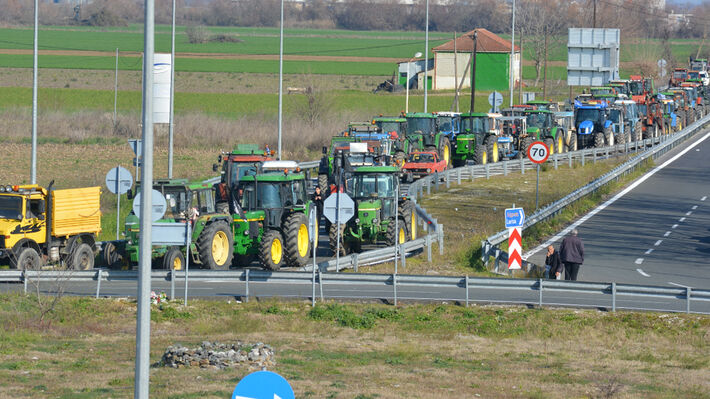
The Panhellenic Committee has requested two delegations: a 25-member farmers’ committee and a 10-member committee representing livestock farmers, fishermen and beekeepers. The government responded by proposing two committees of 20 members each — a move farmers describe as “pretentious” and deliberately aimed at legitimising groups that have distanced themselves from the Panhellenic Committee. According to them, the goal is to undermine those who insist on all demands being met, portraying them as “intransigent”.
For now, farmers are awaiting official clarification from the government. They emphasise that if their proposed composition and numbers are not accepted, they will withdraw from the meeting.
The talks, if held, are expected to focus on energy costs — electricity and diesel — an issue that farmers describe as critical to their survival. Expectations, however, are low: government sources insist there is no room for further support beyond the measures already announced.
Farmers will also raise the new EU–Mercosur agreement, which has triggered strong concern in northern Greece. Producers fear that imports of cheaper rice and cereals will depress domestic prices, intensifying pressure on already struggling farms. Despite the interim agreement’s approval, they demand political intervention to protect Greek production and incomes.
Additional issues on the table include the E9–Land Registry interconnection, which has excluded many farmers from subsidies due to unresolved ownership data — affecting particularly those cultivating leased land.
After the meeting, farmers plan to return to the blockades and reassess their stance. For now, roads remain open, tractors stay positioned on highways without obstructing traffic, and customs posts at Evzones, Promachonas and Niki are operating normally.
“They want to divide us”
Representatives of the Panhellenic Committee accuse the government of “turning a blind eye” to blocs that have broken away — such as the Green Lantern bloc and certain groups from Crete — some of whom have already met with Deputy PM Kostis Hatzidakis.
Kostas Anestidis, from the Malgara blockade, told OPEN:
“I see the government is making fun of us. It wants to split us. We should say a resounding ‘no’ and stay on the streets.”
Similar statements were made by Iordanis Ioannidis, press secretary of the United Farmers Federation of Larissa, who said the government is creating “communication bubbles” and acting in terms that farmers cannot accept.
“No meeting unless our terms are respected”
Multiple representatives repeated the same position: unless the government accepts the composition of the committees as proposed by the Panhellenic Committee, no representative will attend.
“We will determine our stance, but our general position is that we will not go under these conditions,” Rizos Maroudas told Action24.
“We are waiting for Maximos’ response,” said Socrates Aleiftiras from the Larissa blockade. “If our request is not accepted, we may decide not to go.”
Panagiotis Kalogiannis, from the Nikaia blockade, stressed that the meeting “has not been finalised”, noting that the government changed terms after farmers had already submitted their list.
“If the government does not accept our terms for the composition, no one will go,” said Costas Papadakis, president of the Agricultural Cooperative of Thebes.
______________________________________________
Are you seeking news from Greece presented from a progressive, non-mainstream perspective? Subscribe monthly or annually to support TPP International in delivering independent reporting in English. Don’t let Greek progressive voices fade.
Make sure to reference “TPP International” and your order number as the reason for payment.