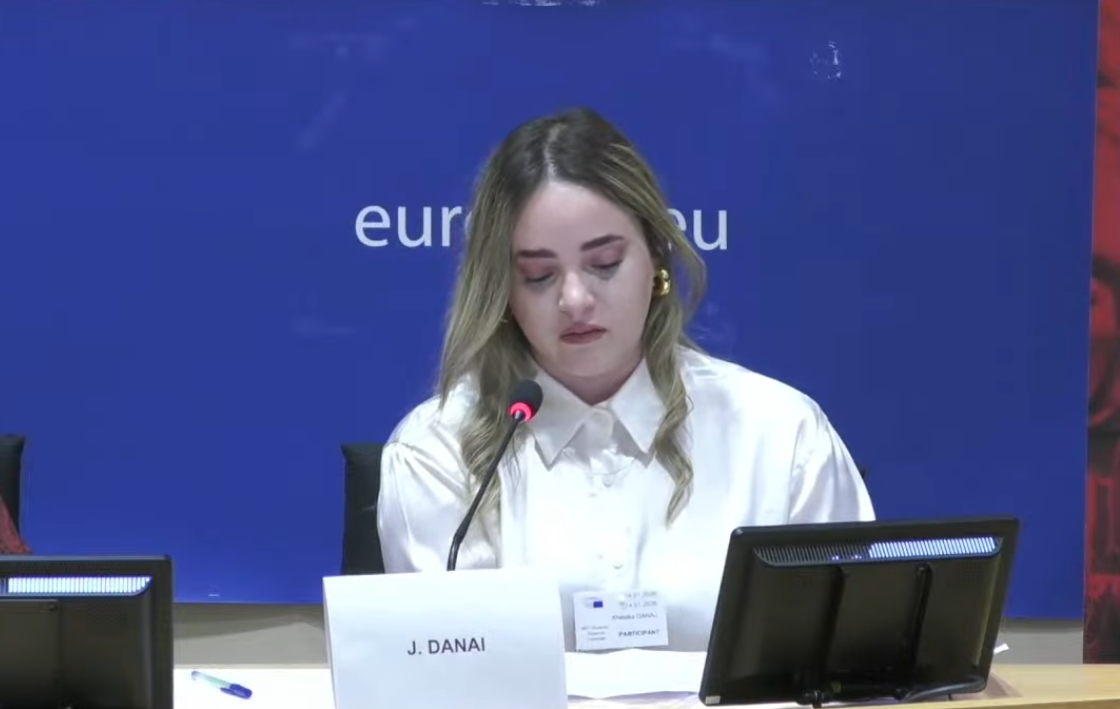
Speaking at the event titled Femicide: 8+1 stories in the European Parliament, Danai said that the state had failed to protect her mother despite repeated warnings. ‘The children of femicide are not collateral damage. They are victims too,’ she said.
The event was organised by the vice-president of the Left group in the European Parliament and SYRIZA MEP Kostas Arvanitis, in cooperation with the non-profit organisation Become a Human.
Addressing the European Parliament, Danai said she was speaking not only for her mother, but for all children left behind after femicides. She described her mother as a woman who had endured hardship but never lost her strength, describing her as ‘a shining star’.
Danai said her mother had repeatedly reported her former partner to the police and judicial authorities and had warned that she was afraid. She stated that her mother had filed multiple complaints and had sought protection, but was repeatedly reassured that no immediate action was required. According to Danai, despite threats and reports of stalking, the perpetrator remained free.
She said that on the day before the killing, a court process relating to her mother’s complaints was under way, but her mother was never informed about it or about the perpetrator’s status. ‘She went to sleep not knowing she was in immediate danger,’ Danai said. The following day, her mother was stabbed to death in the street.
Following the killing, Danai and her underage brother were left without support. She said that at the age of 20 she was forced to assume parental responsibilities, stating that this outcome was the result of state failure. She argued that repeated complaints without risk assessment, victim information and immediate protection are insufficient, and said that the system effectively waits for the worst to happen.
Danai also referred to additional obstacles linked to racism, stating that her family’s origin and nationality continue to create difficulties in everyday life.
She called for mandatory and immediate information for victims at every stage of criminal proceedings, uniform European risk assessment protocols, immediate protective measures when threats are documented, and institutional and financial support for children left behind after femicides.
The event also featured interventions by parents and relatives of other femicide victims.
Yiannis Topaloudis and Koula Armoutidou, parents of Eleni Topaloudi, spoke about repeated state failures before and after their daughter’s murder in Rhodes.
Alexandra Makou, mother of Garyfallia Psarrakou, who was murdered by her partner in Folegandros, stressed that gender-based crimes must be explicitly named and recorded in order to be prevented. She called for the legal recognition of the term ‘femicide’ and a common European framework for prevention and accountability.
Eleni Kremastioti, mother of Erato Manolakelli, said separation from a violent partner is the period of highest risk for women, yet protection mechanisms remain inactive. Angeliki Berdou, mother of Polyxeni Berdou, described femicide as the result of systemic failure, including the failure to disarm perpetrators in positions of authority and protect victims.
Several speakers called for mandatory removal of weapons from uniformed personnel in cases of domestic violence, independent monitoring mechanisms, and psychosocial assessments for those authorised to carry weapons.
Despina Kalea, mother of Kyriaki Griva, who was murdered outside a police station after seeking help, said gender-based violence is often treated as a nuisance rather than an imminent threat to life. She called for binding European protocols and mandatory police intervention when women seek protection.
Emmanuel Athanasiou, cousin of Efi Tsichlaki, referred to what he described as serious judicial failures in his cousin’s case, including an initial ruling of suicide and subsequent intimidation of the family.
In a statement after the event, Arvanitis said the testimonies highlighted the structural nature of femicide and renewed calls for the term to be recognised as a legal category in Greece and at EU level. He said the event reinforced demands for a coordinated European framework to address gender-based violence.
______________________________________________
Are you seeking news from Greece presented from a progressive, non-mainstream perspective? Subscribe monthly or annually to support TPP International in delivering independent reporting in English. Don’t let Greek progressive voices fade.
Make sure to reference “TPP International” and your order number as the reason for payment.