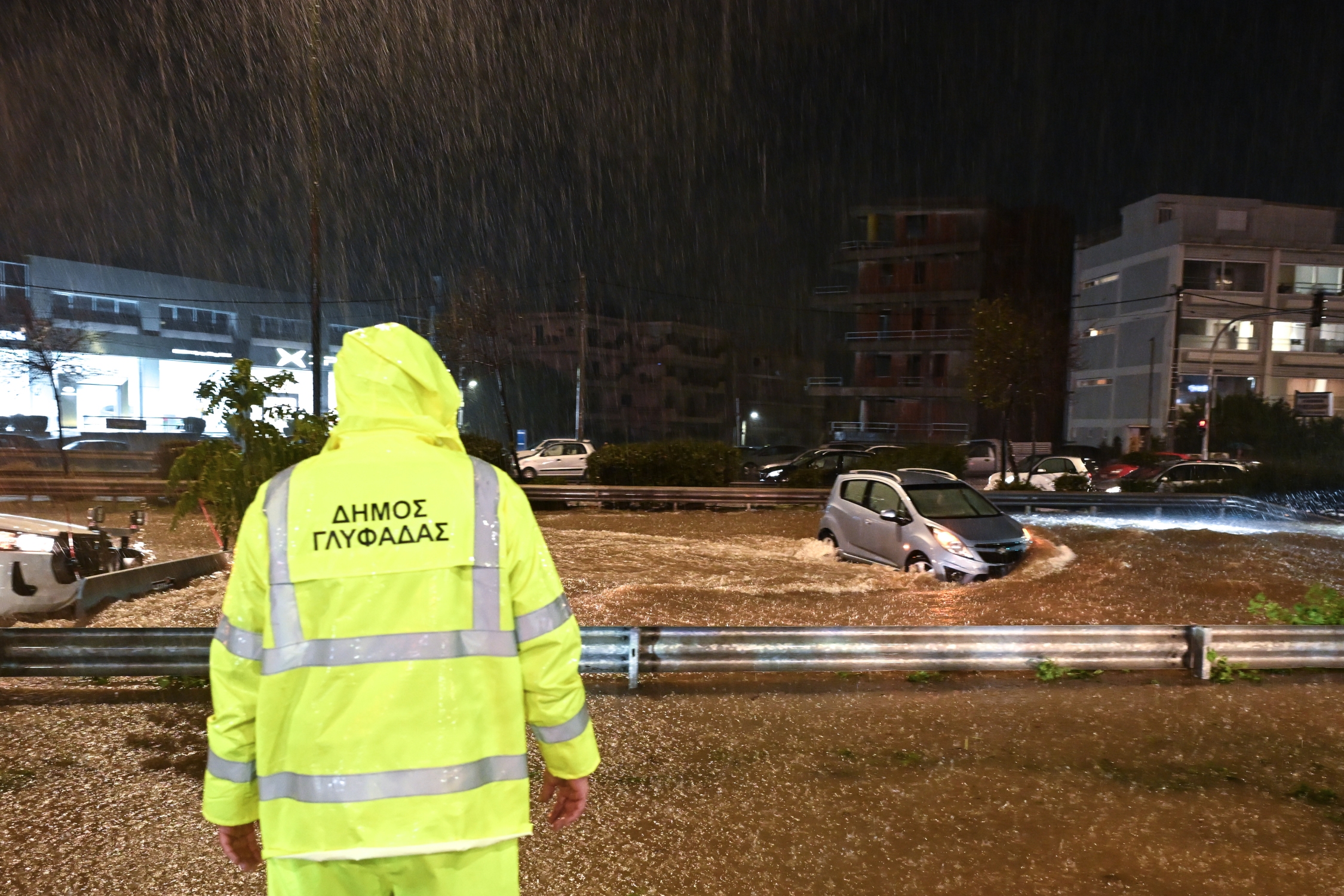
The severe weather that struck the country left behind human losses and widespread destruction, with flooding, infrastructure damage and hundreds of emergency calls to the Fire Department. Two people lost their lives, while large areas of Attica and other regions were severely affected.
The first fatal incident occurred in Ano Glyfada, where a 56-year-old woman lost her life after being struck by a car that had been swept away by rushing floodwaters. The woman was hit and trapped beneath a second vehicle at 14 Kyrillou Methodiou Street, as the roads turned into torrents. Firefighters rescued her unconscious and transported her to the Asklepieion Hospital in Voula, where she was pronounced dead.
Just a few metres away, another woman was saved at the last moment, when two citizens jumped into the raging water and managed to pull her to safety, risking their own lives. Video footage captured the extreme danger prevailing on the streets at the time.
A second fatality was recorded in Paralio Astros, Kynouria. A 53-year-old coast guard lost his life while on duty after being swept away by a powerful wave at the port. According to information, as the weather appeared to be subsiding, the coast guard attempted to ensure that all boats were properly secured. When he noticed that one vessel was inadequately tied, he slipped while trying to secure it, struck his head and fell into the sea, where he was carried away by the waves. He was recovered unconscious and later pronounced dead.
The southern suburbs of Attica were among the areas hardest hit, particularly Glyfada, Vari, Voula and Vouliagmeni. Major road axes such as Karamanlis, Poseidonos and Vouliagmenis avenues were flooded, while an overflow of a sewer pipe on Poseidonos Avenue further aggravated the situation. Rivers including Kifissos, Ilissos, Podoniftis and Pikrodafni reached dangerously high levels, causing concern in areas such as Maroussi and along Kifisias Avenue.
Ano Glyfada was at the epicentre of the disaster. Antheon Street and surrounding roads were transformed into violent streams, carrying tonnes of water, mud, stones and debris from the mountain. Dozens of vehicles were swept away, pinned against fences and poles, or buried under rocks and soil. In several cases, debris accumulated beneath parked cars, lifting them off the road. Daily life in the area was brought to a standstill, with streets submerged in mud.
Municipal crews and residents have been working since early morning to clear the area, while heavy machinery continues to operate to reopen Antheon Street. Despite some improvement, traffic remains hazardous, as debris has not yet been fully removed.
According to the president of the Fire Officers’ Union, Kostas Tsigas, the phenomenon has subsided in Attica and is now moving north-northeast. In Attica alone, the Fire Department received 670 calls within one day, while nationwide the number of calls reached approximately 1,000, mainly from Western Greece and the Peloponnese. Of these, 470 concerned water pumping, while others related to fallen trees and citizen rescues.
In Attica, 183 firefighting crews were deployed in areas including Vari, Glyfada, Agia Paraskevi and Kallithea, carrying out water pumping operations in basements and properties. From 07:30 on Wednesday to 06:30 on Thursday, the Operations Centre received 910 calls and carried out 318 water pumping operations, 32 tree removals, 61 transfers of citizens to safe locations and 10 object removals. An additional 238 calls were received by the Emergency Response Centre, resulting in 11 rescues and 364 reports of flooding.
Precautionary messages were sent via 112 to several areas. Shortly before midnight, residents of Rafina were warned due to the risk of overflow of the Megalo Rema and were instructed to move towards Rafina City Hall. The overflow was ultimately avoided, with water levels stabilising. Earlier, a similar message was sent to the Goritsa area of Aspropyrgos due to the overflow of the Agios Ioannis stream. As water levels receded, residents were allowed to return to their homes. In Agios Dimitrios, three houses were evacuated due to flooding.
Landslides were reported in Oropos, particularly in Agioi Apostoli, leading to road closures, while subsidence of the road surface was recorded in Nea Makri. In Grammatiko, a driver was trapped inside her vehicle following road subsidence and was rescued by firefighters and taken to hospital with minor injuries. Four people were rescued in Kalamos, while extensive damage was also reported in Nea Makri and Oropos.
Severe weather also disrupted transport and communications. Twelve flights bound for Athens were unable to land at Eleftherios Venizelos Airport, with aircraft diverted to Thessaloniki, Chania, Kos and Chios. Train services were disrupted on the Chalkida–Athens line, while Metro Line 1 services were interrupted between Tavros and Faliro due to water inflow. Problems were also reported on Tram line 7. Suburban rail services have since been restored.
Despite overall improvement, traffic diversions remain in place on several roads, including Irini Street in Nea Makri, the coastal road towards Agioi Apostoli in Oropos, sections of Poseidonos Avenue near Agia Marina in Nea Makri, and other affected routes.
Severe flooding was also recorded in Hydra, Pyrgos and parts of the North Aegean. Schools remain closed in Mytilene, Chios and Samos, while schools in Attica are operating normally.
______________________________________________
Are you seeking news from Greece presented from a progressive, non-mainstream perspective? Subscribe monthly or annually to support TPP International in delivering independent reporting in English. Don’t let Greek progressive voices fade.
Make sure to reference “TPP International” and your order number as the reason for payment.