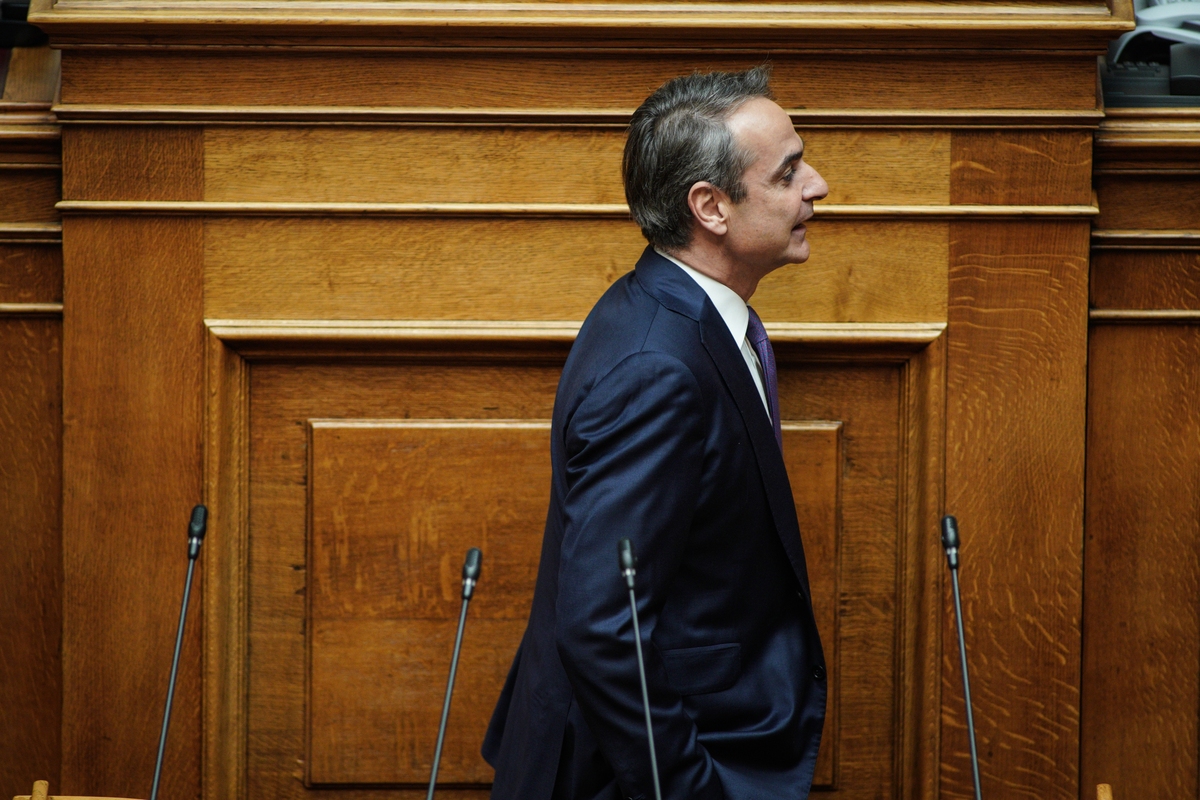
The meeting took place at the Maximos Mansion on Tuesday, chaired by prime minister Kyriakos Mitsotakis, with deputy prime minister Kostis Hatzidakis and education minister Sofia Zacharaki in attendance.
According to official announcements, coordination of the reform will be undertaken by a ‘National Dialogue Group’ chaired by the rector of the University of Piraeus, Michalis Sfakianakis. The group will include three deans and scientific advisers, responsible for monitoring all pillars of the reform.
A legislative committee has already been formed to draft the institutional framework of the new system and to determine implementation details, the responsibilities of the bodies involved and the operation of the question bank.
The process, which will be initiated through parliament’s committee on educational affairs, is scheduled to last nine months and will be structured around five thematic pillars, ranging from educational content and school life to infrastructure and governance.
Weighting across all three years of the lyceum
The ‘measurable performance’ for admission to higher education institutions will depend on all three years of the lyceum and will be calculated through coefficients that will count towards the final national exam result. The proposed distribution is:
-
1st year of lyceum: 15%
-
2nd year of lyceum: 35%
-
3rd year of lyceum: 50%
It has been stated that the final coefficients, as well as which subjects will count, will be determined through a national dialogue involving student, teacher and parent organisations, with assurances of ‘transparency, balance and consultation before the implementation of the system’.
The reform includes three main institutions:
-
The Question Bank, which will collect and organise exam topics with the stated aim of uniform, objective evaluation at national level.
-
The National Examinations Authority, responsible for organising and supervising the system and ensuring its reliability.
-
The National Body of Assessors, to ensure quality, objectivity and transparency in evaluation procedures and the universal application of rules in all schools.
Implementation is planned to begin in the 2027–28 school year and will apply to students who will then be in the first year of the lyceum, described as those born in 2012, who would graduate in 2030.
Mitsotakis: ‘We want to listen more and talk less’
Mitsotakis said the meeting was ‘not to announce decisions, but essentially to open a discussion’ on education, which he argued should ‘transcend ideological boundaries and electoral cycles’ and ‘transcend party calculations’.
‘We do not want to prejudice anyone. We want to listen more and talk less,’ he said, describing the process as the start of a ‘major national dialogue’. He said the aim would be to reach a legislative initiative by the end of the year, ideally backed by more than one party. ‘This would not be a success for the government, I think it would be a success for Greece as a whole,’ he added.
He argued that the lyceum should not be ‘a sterile place of preparation for university entrance’, but should have ‘its own distinct autonomy’ and equip students with skills regardless of their future path.
Education minister: ‘Clear answers’ for families and students
Zacharaki said there was ‘plenty of time’ for participation in a process that, she said, should produce ‘very clear answers to parents and especially children’ about what to expect in the coming years. She referred to strengthening the school-leaving certificate with ‘public and free tools’, citing examples such as a state language certificate, a state IT certificate and new digital skills.
She also referred to issues such as infrastructure, continuous training and evaluation, and addressing phenomena including over-marking, to ensure a ‘better and more faithful depiction of children’s capabilities’. She said there would also be a public digital consultation, stating that education issues ‘cannot be held in closed rooms’.
Sfakianakis: ‘Education policy must be a national policy’
Sfakianakis said the aim should be to put education ‘on solid tracks’ and to reach a system ‘governed by evaluation’ that is ‘effective, fair, and stable’. He said the reform should have the broadest possible consensus to avoid education policy changing with every change of government. ‘Education policy must be a national policy,’ he said.
Student associations: ‘It will remain on paper’
The Athens Student Coordinating Committee reacted strongly to the announcements, saying the new system would turn schools into an ‘examination centre’ and significantly increase pressure on students. It said the ‘national baccalaureate’ would deepen social and economic inequalities by increasing reliance on private tutoring and placing additional financial burdens on families.
‘We do not want our dreams to be measured in euros,’ it said, arguing that education should not depend on families’ financial capacity.
In a longer statement, students said they do not want ‘all our years at school to be parroting, stress and exams’, and argued that the reform would mean even more pressure and ‘huge amounts of money’ spent on tutoring: ‘In other words, pay or there is no high school diploma…’
They said they would organise school assemblies and mobilisations, calling for a ‘blockade’ against what they described as the ‘politics of profit’, and demanding ‘a creative school, not an examination centre’, with activities, excursions and modern books.
The coordinating committee called on school representatives to organise assemblies and proposed sit-ins in secondary schools on 26 and 27 February. It also called for participation in a student rally at Propylaia on 26 February under the slogan: ‘Do not think about bringing the national baccalaureate.’
______________________________________________
Are you seeking news from Greece presented from a progressive, non-mainstream perspective? Subscribe monthly or annually to support TPP International in delivering independent reporting in English. Don’t let Greek progressive voices fade.
Make sure to reference “TPP International” and your order number as the reason for payment.