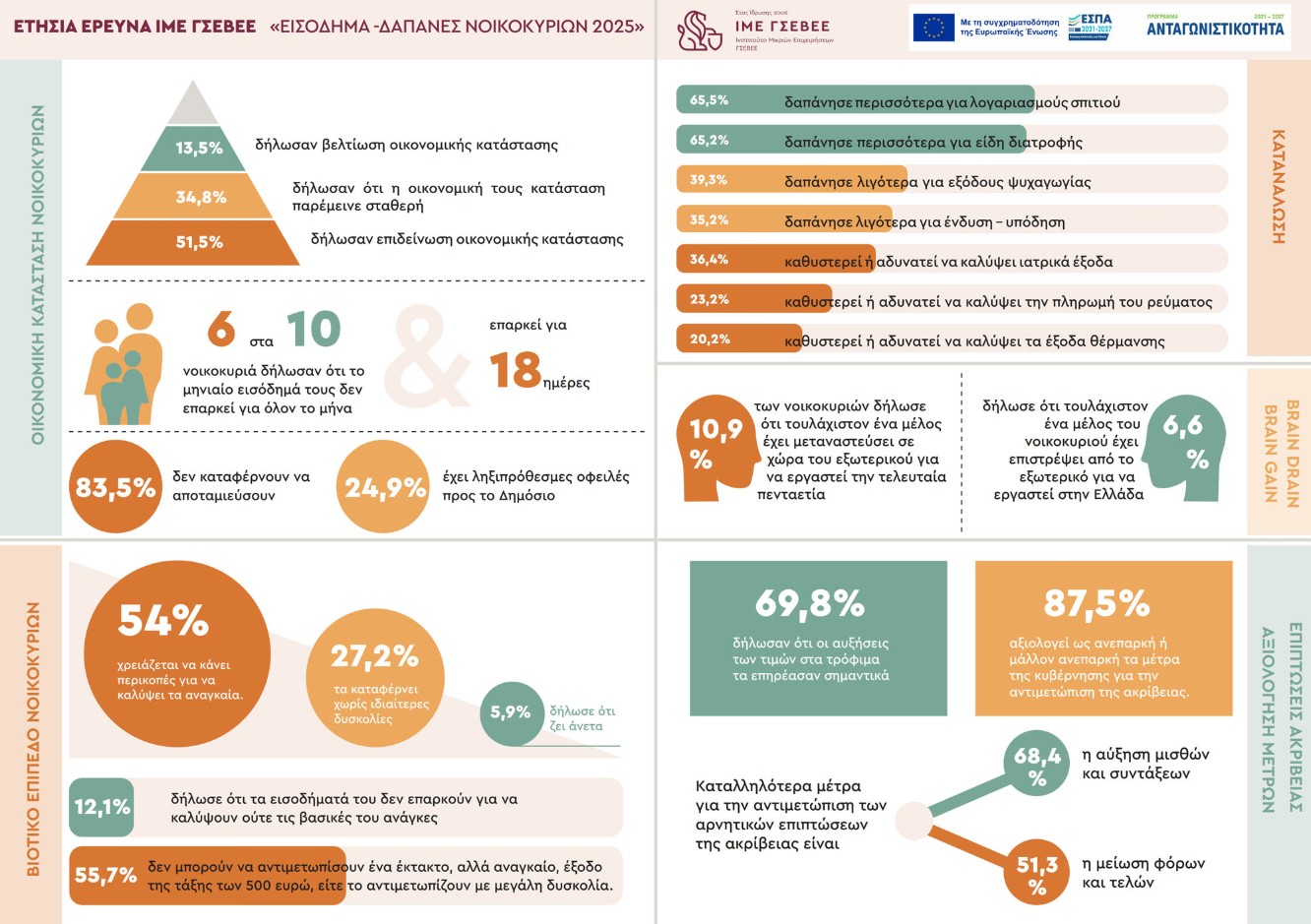
According to the findings, financial difficulties are no longer confined to lower-income groups, but are increasingly affecting the middle strata as inflationary pressures accumulate and households’ resilience is gradually exhausted.
Income adequacy is at a record low. Six in ten households said their monthly income is not sufficient to last until the end of the month, covering on average only 18 days. More than half said they are forced to cut back even on basic needs, while the inability to save is described as almost universal.
The survey also points to continued high costs for food, energy and fuel as factors further compressing disposable income, with households reducing spending on entertainment and clothing.
It adds that inequality remains stark, with lower-income groups and single-person households facing the greatest difficulties. Pessimism about the future is also increasing, with almost one in two respondents expecting their financial situation to worsen over the next year.
IME GSEVEE assesses existing measures to address the cost-of-living crisis as insufficient and argues for structural interventions, including wage increases, tax relief and effective price controls, aimed at strengthening household income and financial security.
Among the headline findings, the survey says 54% of households are cutting back even on basic needs, while 12.1% said their income is not sufficient even for the absolute essentials. It also found that 55.7% of households are unable, or have significant difficulty, in dealing with an unexpected expense of €500.
______________________________________________
Are you seeking news from Greece presented from a progressive, non-mainstream perspective? Subscribe monthly or annually to support TPP International in delivering independent reporting in English. Don’t let Greek progressive voices fade.
Make sure to reference “TPP International” and your order number as the reason for payment.