Report: Nektaria Psaraki
From rescue work to prosecution
It was 2018. In the Katia area of Mytilene, then 20-year-old Irish national Sean Binder and Syrian refugee Sara Mardini were on duty in a silver Cherokee SUV as members of Emergency Response Centre International (ERCI), scanning the sea through binoculars in case a boat in distress appeared.
Mardini had fled the war in Syria in 2015, crossed into Turkey and, with her sister Yusra, made the crossing to Mytilene before travelling on foot to Germany, where she was granted asylum. She later returned to Greece to volunteer, saying she wanted to provide the help she had once needed herself.
During their shift, a vehicle from the Mytilene Security Service approached and the officers searched the SUV. Under the licence plates, they said they discovered a sticker bearing the army’s coat of arms. Binder and Mardini were arrested on the spot on suspicion of forgery, on the claim that the sticker was intended to mislead the authorities into believing the vehicle was an official army car, despite the organisation’s name being visible across the vehicle, from the doors to the bonnet.
A preliminary investigation followed. A further 22 humanitarians were called in for statements, and the investigator and prosecutor later brought charges including forgery, money laundering, forming a criminal organisation, espionage, migrant smuggling and facilitating entry in 2016. Mardini, Binder and Karakitsos, as ERCI coordinator, were remanded in custody along with another defendant involved in managing the organisation’s donations.
From police thriller to public smear
The case quickly took on the shape of a police thriller. The Greek police and media outlets that adopted the official narrative circulated reports, citing police sources and the case file, claiming that a criminal organisation of NGO members had been dismantled in Mytilene. The defendants were accused of using ‘encrypted’ communications and ‘wireless spying’ to participate in a migrant-smuggling ring from Turkey to Greece, money laundering and forgery through the use of military symbols. The 24 faced the prospect of prison sentences exceeding 20 years.
The prosecution, critics argued, sent a clear message: that civil society organisations involved in rescue work would be treated as suspects. In the wake of the arrests and prosecutions, civil society operations on the island receded, while the Coast Guard remained at sea amid numerous complaints of crimes against refugees, including pushbacks.
What had been presented as a sophisticated criminal case, the defence argued, collapsed under scrutiny during an 11-hour hearing in the packed courtroom of the Three-member Criminal Appeals Court of the North Aegean, where the felony charges were tried. The misdemeanour cases had already fallen apart three years earlier.
Eight years later, the court delivered the final verdict.
In court, the allegations unravel
Much of what was presented as incriminating evidence, witnesses said, was either routine rescue practice or publicly available information.
The alleged ‘wireless spying’ referred to monitoring public maritime VHF channels 12 and 16, which vessels are required to monitor. The supposed ‘encrypted messages’ were, the defendants said, WhatsApp group chats involving more than 400 participants, used to share reports of boats in distress near the beaches of Mytilene and to coordinate practical needs such as medical assistance and supplies, including blankets, dry clothes and shoes. The charge of ‘facilitating entry’ was linked to the sharing of images and reports of refugee boats in distress, including posts circulated on Facebook and by the Aegean Boat Report. Donations to ERCI were presented as ‘money laundering’. And the migrant-smuggling allegation was described by the defence as incoherent, with one lawyer saying she still could not explain to her client why he was being accused of acting as a boat driver transporting people from Turkey to Greece.
Despite what the defence characterised as the indictment’s threadbare and contradictory claims, the defendants’ lawyers called witnesses and submitted extensive documentation, contesting each allegation, including suspicions that the organisation had been receiving advance intelligence about boats departing from Turkey and withholding it from the Coast Guard.
‘There was a need for self-organisation’
Rescue worker Jason Apostolopoulos described the broader context of that period: a situation that had overwhelmed the state’s capacity, with thousands of refugees and migrants arriving daily. He told the court that a glance across the sea from Lesvos at the time could reveal dozens of boats arriving together, while the island, he said, had only two or three ambulances.
He spoke of the rapid self-organisation that followed, with locals, fishermen, NGOs and hundreds of volunteers from abroad mobilising to save lives and provide basic support on the shore: water, food and first aid.
‘Everything had to be done on the beach,’ he said. ‘When you have severe hypothermia in Skala Sykamias, broken arms and legs in Korakas, and the island with only two ambulances, you understand that all the organisations had common networks with common information so that you could quickly say, “I want blankets in Skala, or a doctor somewhere else.”’
Asked whether there was advance information about boats, he said there was no reliable “other side” intelligence. Information came primarily from sea monitoring with binoculars; from public pages that published distress signals, such as Alarm Phone and Aegean Boat Report; and from refugees themselves, calling to say that relatives were on a boat. He added that there were cases where unknown individuals sent locations from Turkish waters, but said the information was unusable both because rescue teams had no operational jurisdiction there and because it came from unknown sources who could join or leave open groups at will.
Prompted by a question from Mardini’s lawyer, Zacharias Kesse, Apostolopoulos rejected the claim that the defendants were helping refugees evade the authorities at sea. ‘At that time, there was absolute coordination and cooperation with the Coast Guard. They themselves were calling us for assistance,’ he told the court. He said there was no reason to build a network designed to bypass the authorities, given that, as he put it, refugees were being rescued and then went to the authorities. He added that the UN High Commissioner for Refugees was in the same communication groups, and that it later emerged that members of the Coast Guard and the police were also present.
He said it had been a surprise to see ERCI prosecuted, describing it as the organisation that, in his view, had the closest relations with the Coast Guard, and noting that Karakitsos, as coordinator, had been known to have good contacts with Coast Guard officials. The defence also referred to a recorded exchange in which Karakitsos replied to a message containing a location from Turkey by saying, ‘this information does not concern us’.
‘The trafficking charge destroyed my life’
Taking the stand, Mardini told the court she had joined ERCI because she understood the reality refugees faced.
‘I arrived in Lesvos in 2015. When we were coming, we called the Coast Guard and they told us to go back where we came from,’ she said. ‘I knew the situation, I experienced it, I wanted to help.’
She said she returned to Greece in 2016 and joined ERCI, working first as an interpreter because she speaks Arabic. ‘At first I worked on the coast, where the boats arrived, and I helped with communication, and then I helped in the camp as an interpreter,’ she said. The groups in which the defendants communicated, she told the court, included information about shifts, boats in danger, and practical needs such as food, medicine and supplies.
‘I want to make it clear that I am shocked. I lost my home 10 years ago. The trafficking charge destroyed my life. It is unacceptable for someone who has experienced the hardship of being a refugee to be accused of this,’ she said. Referring to the other defendants, she added: ‘As a refugee, I had a very bad life. And the people sitting behind me right now helped me a lot.’
‘We couldn’t bother the Coast Guard for every rumour’
Binder told the court that he had come to Greece in 2017 as a trained rescuer and EU citizen, believing he had a duty to help. He joined ERCI in 2017 and described his main responsibilities as an eight-hour shift monitoring the sea in Katia’s area with binoculars. If they spotted a boat, he said, they would either take part in a rescue or provide assistance on land.
He said Karakitsos coordinated the organisation during his first three months, and that he later took on the role on an interim basis. Binder told the court he also believed ERCI should not operate in isolation, and described how the organisation expanded its contacts with other volunteers and groups to share information.
Questioned by the court about why they did not forward every report to the Coast Guard, Binder said: ‘We couldn’t bother the Coast Guard for every unconfirmed piece of information that came in. We only shared the valid ones so as not to create unnecessary panic.’ He described checking reports that turned out to be harmless, and others that proved urgent. ‘If we informed the Coast Guard about every piece of information like that, we would end up like the lying shepherd…,’ he said.
The sticker under the plates
Karakitsos told the court he had arrived in January 2016 intending to stay 15 days, but remained for two years. He said one of his first steps was to contact the authorities and provide his speedboat licence. He described the rescue conditions at the time, including boats arriving with women, children, disabled people and pregnant women who, he said, sometimes gave birth shortly after landing. He added that many volunteers from around the world came to the organisation, including those who treated the work as part of university placements.
He said much of the information about boats came from Tommy Olsen, the founder of Aegean Boat Report, and described his contacts with a Coast Guard official, saying he shared information as it reached him. He told the court that he had asked how to handle information coming from Aegean Boat Report and said he had been told to continue receiving it because it was a way to save lives.
He described communicating via VHF channels with both the Coast Guard and ERCI captains, and said the organisation did not take people onto its boats on its own initiative unless it was asked to, or if Frontex had no capacity. Asked specifically about the sticker found under the SUV’s licence plates, he said it made no sense: ‘It’s inconceivable how the army sticker was found under our licence plates, and why they even unscrewed them.’
He also spoke about Mardini’s decision to return to Greece after being granted asylum. ‘What can I say: a 20-year-old girl who had been through this nightmare arrived in Berlin and instead of enjoying her new life and starting her studies, she came back to help. I haven’t seen that in 10 years in the refugee camp,’ he said.
The remaining defendants
Other defendants then addressed the court: a lawyer who said he had never set foot in Mytilene until the day he testified, and who said he had signed two authorisations while briefly acting as a legal representative; Palestinian volunteer Ihab Abbasi, who said he did not belong to ERCI but to Médecins Sans Frontières, and who had sent a screenshot of a location shared by Alarm Phone on Facebook; a volunteer from Campfire who said they had helped with basic necessities such as soap; and Aris Vlachopoulos, who described giving water, food and his towel to refugees after seeing a boat pass while he was on the beach, later establishing Attika to collect basic supplies.
The Dutch pensioner Pieter Witteberg told the court that, after losing his son, he came to help during the refugee crisis. He described it as a way to repay what he said he saw as a debt to humanity, recounting his family history as Jews who had fled as refugees in 1938 and found safety in the Netherlands. Another defendant described becoming a volunteer after noticing a lack of women helping women on the beaches.
One defendant involved in ERCI’s external communications and donations, Alexou, said her life had been defined by trying to do the right thing, and spoke of plans for postgraduate study in the United States. In tears, she told the court: ‘My whole life I’ve been trying to do my best. I was an honours student, I represented my department, I wanted to do a master’s degree in America, I’ve been trying my whole life to maintain my integrity. Please, I trust your judgement, help end all of this.’
Acquittal and aftermath
The prosecutor told the court that none of the alleged offences had been proven and recommended acquittal, prompting relief throughout the courtroom.
The defence lawyers criticised the fact that the case had ever been sent to trial. Zacharias Kesses questioned why the Mytilene Security Service had pursued a case in an area of responsibility that, he argued, fell under the Coast Guard’s jurisdiction. He described the case file as an 87-page narrative designed to impress rather than to uncover the truth.
Evita Papakyriakidou said the justice system could not explain ‘to an average citizen eight years later’ why they were in such a position. She argued that the indictment accused the same person of both facilitating entry and trafficking, while failing to provide coherent reasoning for claiming he had transported people without a right to enter.
Ioannis Naziris, Alexou’s lawyer, said the prosecution had inverted reality:
‘We have lost all meaning. We are confusing solidarity with evil and crime with humanity,’ he told the court. ‘Nothing can give them the years that were lost and the shattered dreams. All they can expect is an acquittal without asterisks.’
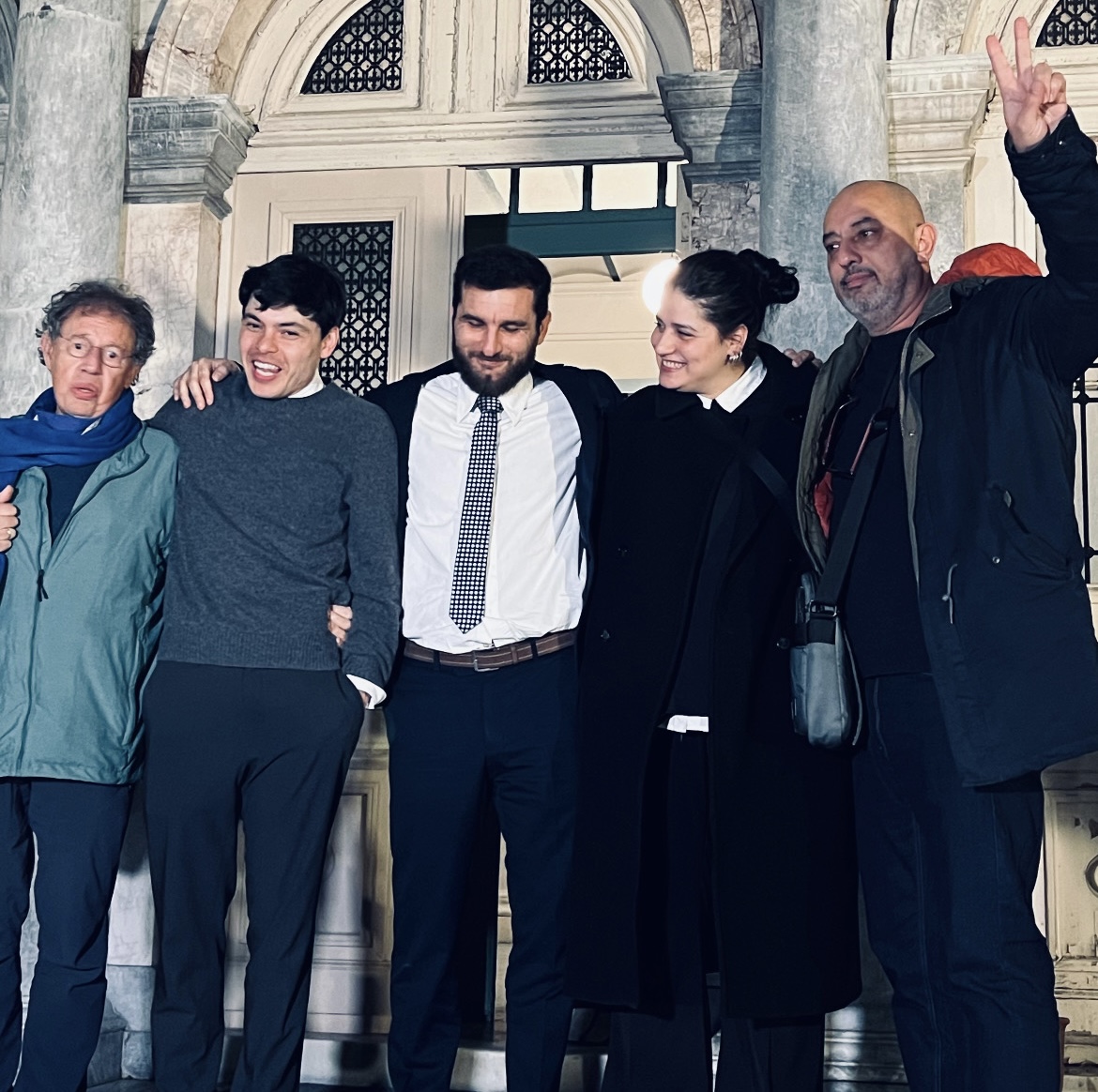
The judges ultimately sided with the prosecutor and found all 24 defendants not guilty. The courtroom erupted in cheers, smiles, embraces and tears.
Outside court, the defendants thanked supporters who had stood by them throughout the eight years and called for the restoration of civil society assistance on the coasts.
‘If there are people out there who want to do what we did, we encourage them to come forward because we did nothing illegal. If helping people is a crime, then we are all criminals,’ Mardini said.
The lawyers welcomed the verdict but condemned the length of the process, saying it took eight years for the defendants to be cleared. They said the underlying motive had been to criminalise humanitarian aid and remove organisations from the field, and said they did not rule out pursuing accountability for those responsible for what they described as an unjust prosecution.
Apostolopoulos described the verdict as a major victory, saying it should mark a return to the sea to help people, document abuses and bring them to light.
‘Those who help refugees risk 20 years in prison, while those who drown them walk among us,’ he said.
After the acquittal, the defendants followed through on a promise Binder had made on social media: ‘If we win, we swim.’ They celebrated with a winter swim on the Mytilene coast where, as they put it, it had all begun.
______________________________________________
Are you seeking news from Greece presented from a progressive, non-mainstream perspective? Subscribe monthly or annually to support TPP International in delivering independent reporting in English. Don’t let Greek progressive voices fade.
Make sure to reference “TPP International” and your order number as the reason for payment.