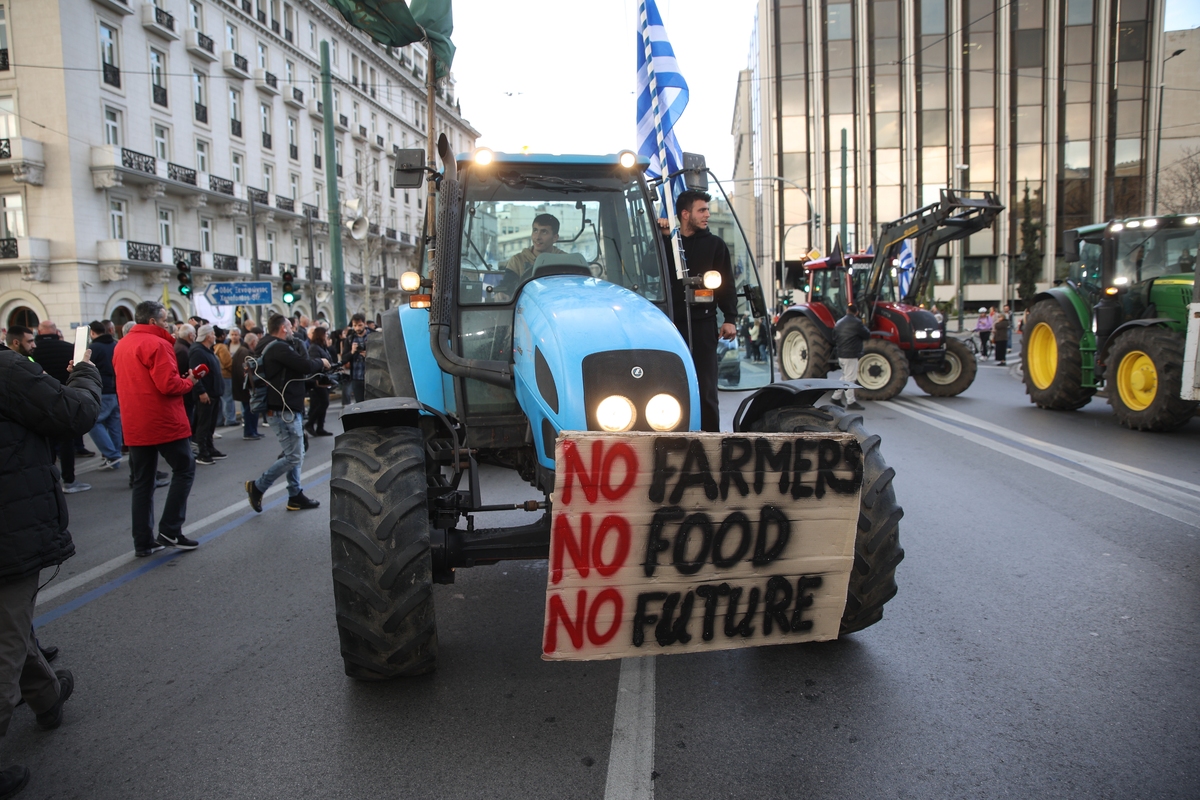
The intervention was made by the KKE’s representatives in the European Parliament, Kostas Papadakis and Lefteris Nikolaou-Alavanos, who denounce the procedures currently under way despite the agreement remaining effectively ‘frozen’ following mass farmer mobilisations.
According to the KKE, efforts to promote the agreement have intensified in recent months. The party argues that the deal primarily serves the interests of large EU industrial monopolies seeking access to new markets, as well as shipping groups anticipating increased profits from the transport of goods. At the same time, it warns that, in combination with the Common Agricultural Policy, the agreement directly threatens the income and survival of thousands of farmers, further undermining domestic agricultural production.
The question highlights that agricultural and livestock production in Mercosur countries is dominated by large, highly concentrated corporations. These companies, the KKE notes, reduce costs through the exploitation of cheap labour, extensive environmental destruction – with deforestation of the Amazon cited as a characteristic example – and the use of pesticides and hormones that are banned in the European Union. The Commission’s assurances regarding ‘compliance clauses’ are dismissed as pretextual, with the KKE arguing that effective controls on vast quantities of products produced under such conditions are practically impossible.
Particular reference is also made to the debate over the supposed ‘protection’ of protected designation of origin (PDO) and protected geographical indication (PGI) products. According to the KKE, this discussion functions in a disorienting way. The New Democracy government, it argues, invokes the issue to conceal its support for major export-oriented business groups, while the majority of Greek farmers remain exposed to competition from imported products of questionable quality. SYRIZA is also criticised, with the KKE noting that although the party now denounces the agreement, it supported it in 2019 while in government, advancing the same arguments about safeguarding PDO products.
The KKE further condemns what it describes as the European Commission’s attempt to ‘dismember’ the EU–Mercosur agreement in order to bypass national parliaments and the requirement for unanimity. Under pressure from member states such as Germany, the party claims, there is an effort to implement the agreement immediately, ignoring even a pending referral to the European Court of Justice. Objections raised by other countries, including France, are described as being driven exclusively by the defence of their own business interests.
On this basis, the KKE’s MEPs have asked the Commission the following questions:
‘Given that controlling Mercosur products is technically and practically impossible, how does the Commission guarantee that food originating from deforested areas of the Amazon, produced by workers employed under miserable conditions and using hormones or pesticides that the EU itself has deemed dangerous, will not end up on the plates of ordinary families?
‘How do you position yourself on the demand not to implement the agreement, respecting the will of the overwhelming majority of farmers, and so that legal “windows” are not used to circumvent the European Parliament’s decision to refer it to the Court of Justice?’
______________________________________________
Are you seeking news from Greece presented from a progressive, non-mainstream perspective? Subscribe monthly or annually to support TPP International in delivering independent reporting in English. Don’t let Greek progressive voices fade.
Make sure to reference “TPP International” and your order number as the reason for payment.