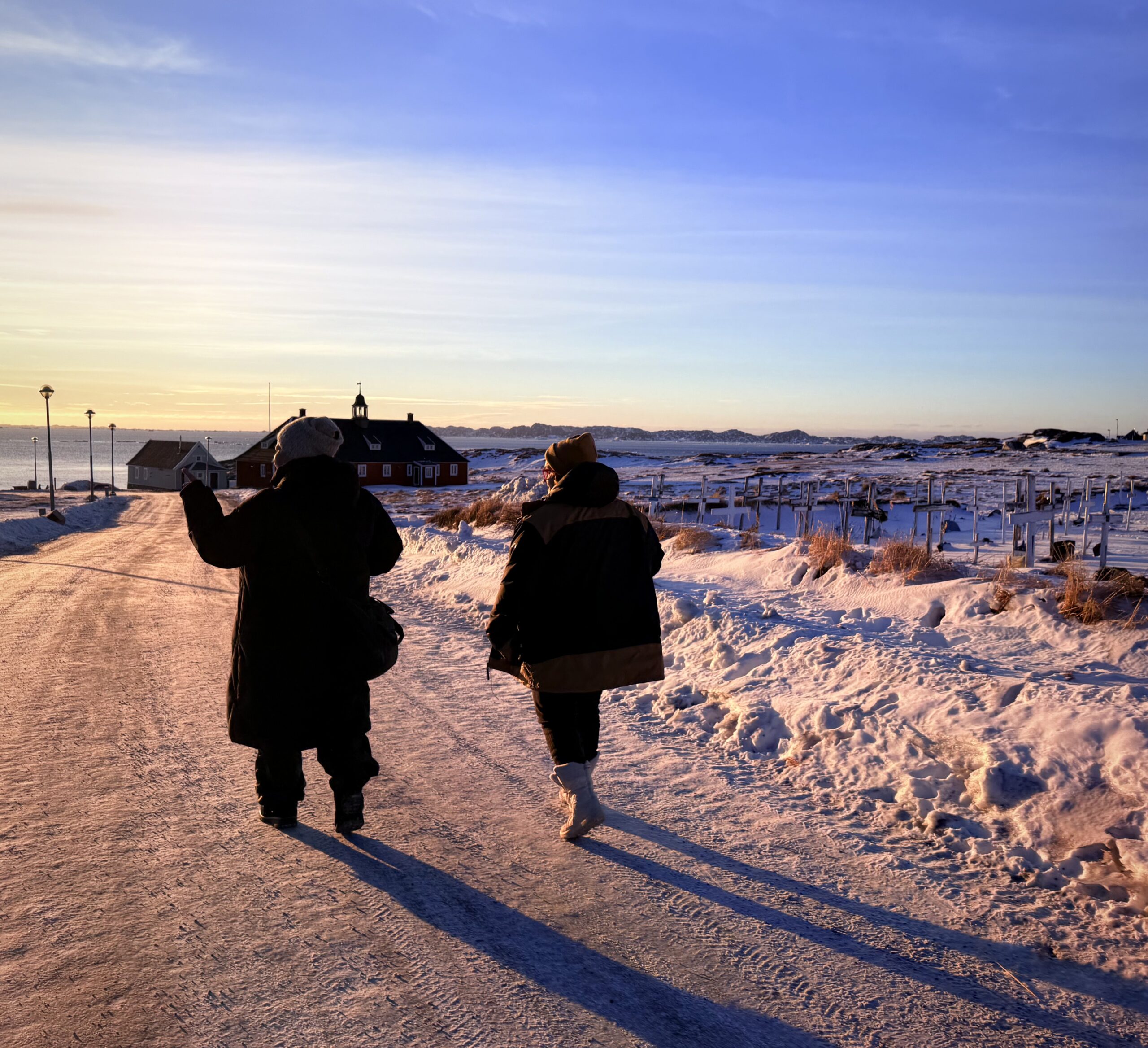
She speaks English slowly.
‘I have a Danish name too,’ she tells me. It is Sorin Petersen.
‘But everyone calls me Amarok.’
Since she was a child, she explains, she felt close to the sled dogs. She liked to drive them, to disappear with them across the ice. She played with them and sometimes, when they barked, she barked back. At school, the children who wanted to be Danish mocked her. They called her Amarok. Wolf.
It hurt her then. Later, she understood it differently.
‘It is an honour,’ she says. ‘It is strength. And it became my name. My name is Wolf.’
Amarok speaks of colonialism not as history but as something written into bodies. She is speaking for her people, the Inuit, and for thousands of women whose lives were permanently altered by the Danish state.
Between 1960 and 1992, around 4,500 Inuit women and girls were subjected to forced sterilisation without their knowledge or consent. Some were 12, 13 or 15 years old. They were schoolgirls. The policy was explicit. The growth of the Inuit population was seen as a threat to Danish sovereignty over Greenland. Denmark did not want a repeat of Iceland, which it had ‘lost’ once population dynamics shifted.
‘They colonised us and our bodies,’ Amarok says.
For decades, Inuit women fought to have the crime recognised. It took not only their persistence but also international pressure – including renewed geopolitical attention on Greenland during the presidency of Donald Trump – for Denmark to formally acknowledge what had happened.
Even then, the language fell far short of the crime. The Danish prime minister, Mette Frederiksen, apologised for what she called the ‘IUD scandal’, for ‘systematic discrimination by the Danish healthcare system’, and for the ‘physical and psychological harm’ suffered because the women were ‘Greenlanders’. Not Inuit. Greenlanders of Danish descent have never been subjected to such policies.
The Danish Ministry of Health, which oversaw the programme, prefers to describe the sterilisations as a ‘dark historical chapter in our common history’. Compensation is to be offered from April 2026. Women may apply. They may be entitled to it. Their claims will be examined by the same Danish institutions that for decades denied responsibility and avoided naming the crime.
The word used by Greenland’s former prime minister, Mute Egede, is far more accurate: genocide.
It is difficult not to ask whether any apology would have been offered at all had Greenland not briefly become a geopolitical object of desire, or had 143 Inuit women not waged a long and exhausting struggle for recognition.
Forced sterilisation was only one part of a broader colonial project.
In 1951, Denmark launched what it officially called ‘the Experiment’. Twenty-two Inuit children, around six years old, were taken from their families and transported to Denmark. The aim was to make them Danish, to give them a Danish education, and to use them as the nucleus of a future Greenlandic elite. Selection was carried out by Danish officials and Lutheran priests. The criteria were simple: young, healthy, able-bodied, orphans.
They were not orphans. In Inuit society, where family structures are extended and collective, there is no equivalent concept.
A year later, 16 of the children were deemed ‘unfit for study’. They were returned to Greenland but placed in an orphanage in Nuuk rather than reunited with their families. Of the six who remained in Denmark, most died young, as adolescents or adults, struggling with severe mental health problems.
One of them was Amarok’s uncle.
‘He is buried somewhere in Denmark,’ she tells me, repeating it as if trying to grasp the distance. ‘He stayed in Denmark.’
When the full scale of the tragedy became widely known, Greenland’s then prime minister, Kuupik Kleist, demanded an official apology in 2009. Denmark refused. The Danish prime minister at the time, Lars Løkke Rasmussen, dismissed the episode as an ‘unfortunate event’ and urged people not to make a fuss.
‘History does not change,’ he said. ‘The colonial period is over. Let us be satisfied that times have changed.’
But have they?
According to Nanyaguak Høghland, founder of the NGO SILA360, the structures of colonial power remain firmly in place. She encounters systemic racism in Danish welfare and judicial institutions on a daily basis. Inuit children, she says, continue to be removed from their families at alarming rates, judged by standards that treat Inuit parents as inherently unfit.
Language is the first barrier. Danish social workers often visit Inuit homes without interpreters and without speaking Inuit themselves. Psychological and psychometric tests are designed around Danish cultural norms. Their results are then used to justify the removal of children.
The pattern echoes the Experiment. Children are transferred to Denmark, placed in institutions or with Danish families. They lose their language, their identity, their family ties.
SILA360 emerged directly from this reality. In 2019, Høghland defended a pregnant Inuit woman who was being pressured to give up her child for adoption immediately after birth. The justification was that she was ‘unsuitable’. In practice, this assessment was based on misunderstandings created by the absence of a translator.
‘They see a bottle of wine and decide you are an alcoholic,’ Høghland says. ‘Because that is the stereotype they have about Inuit.’
Children are often taken on the basis of a social worker’s ‘gut feeling’, with no objective observations recorded. If a report labels parents as alcoholics, the claim is rarely questioned. When cases reach a Danish judge, parents may have less than an hour to defend themselves, often without a lawyer. Documents are in Danish and are not translated. Many parents do not fully understand the accusations against them.
This is the system that decides what is ‘in the best interests of the child’.
Høghland describes it as a continuation of cultural genocide. Inuit are portrayed through orientalist stereotypes as uncivilised and incapable of parenting. The result is the slow erosion of Greenlandic language and culture. Children taken to Denmark rarely return. Contact with their heritage is severed.
The apology Denmark eventually issued in 2020 came only after Greenland once again entered the global spotlight. The harm, however, has never ended.
‘We are not history,’ Amarok says quietly. ‘We are still here.’
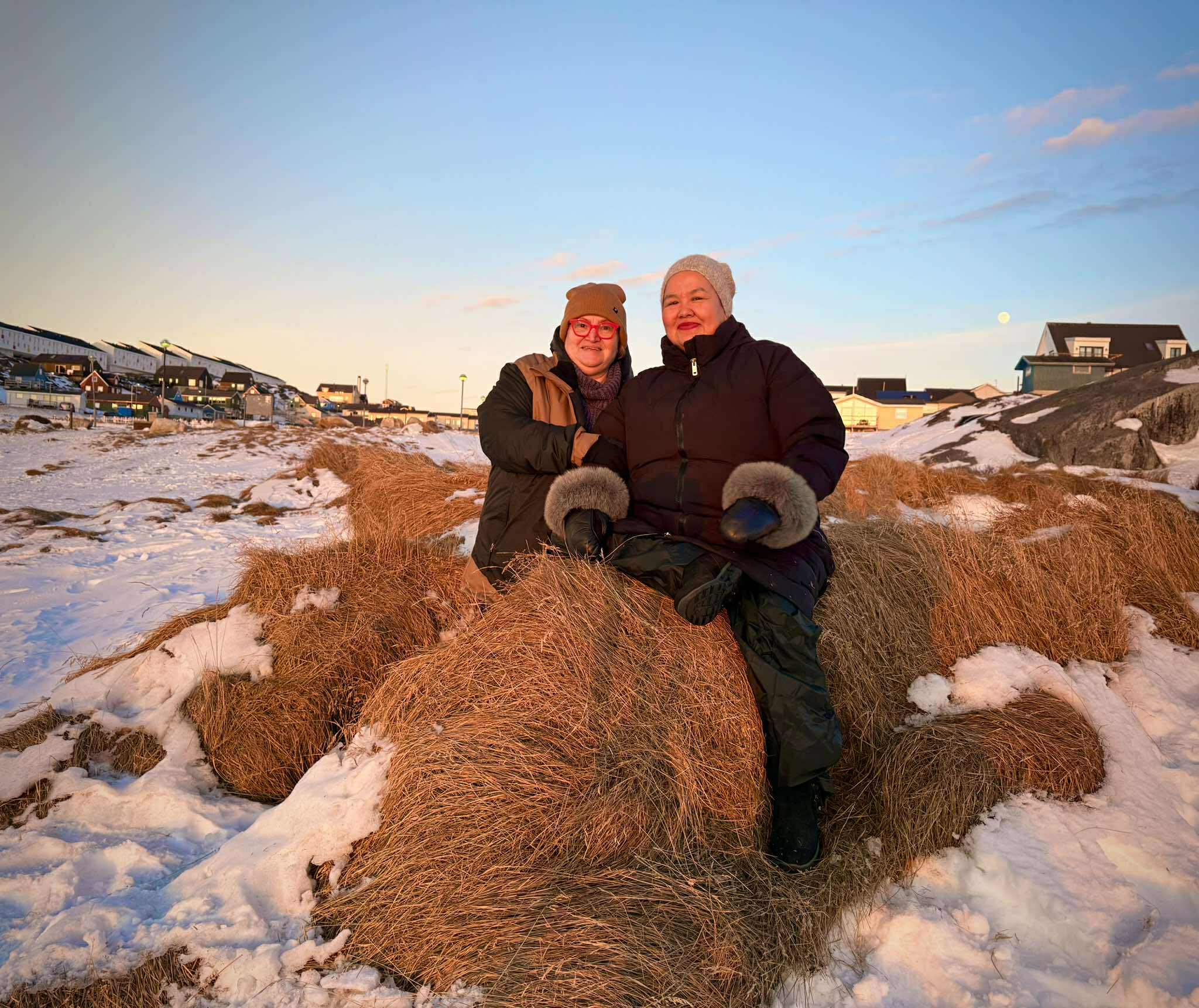
Both interviews were recorded on video and will be published with subtitles upon the team’s return.
______________________________________________
Are you seeking news from Greece presented from a progressive, non-mainstream perspective? Subscribe monthly or annually to support TPP International in delivering independent reporting in English. Don’t let Greek progressive voices fade.
Make sure to reference “TPP International” and your order number as the reason for payment.