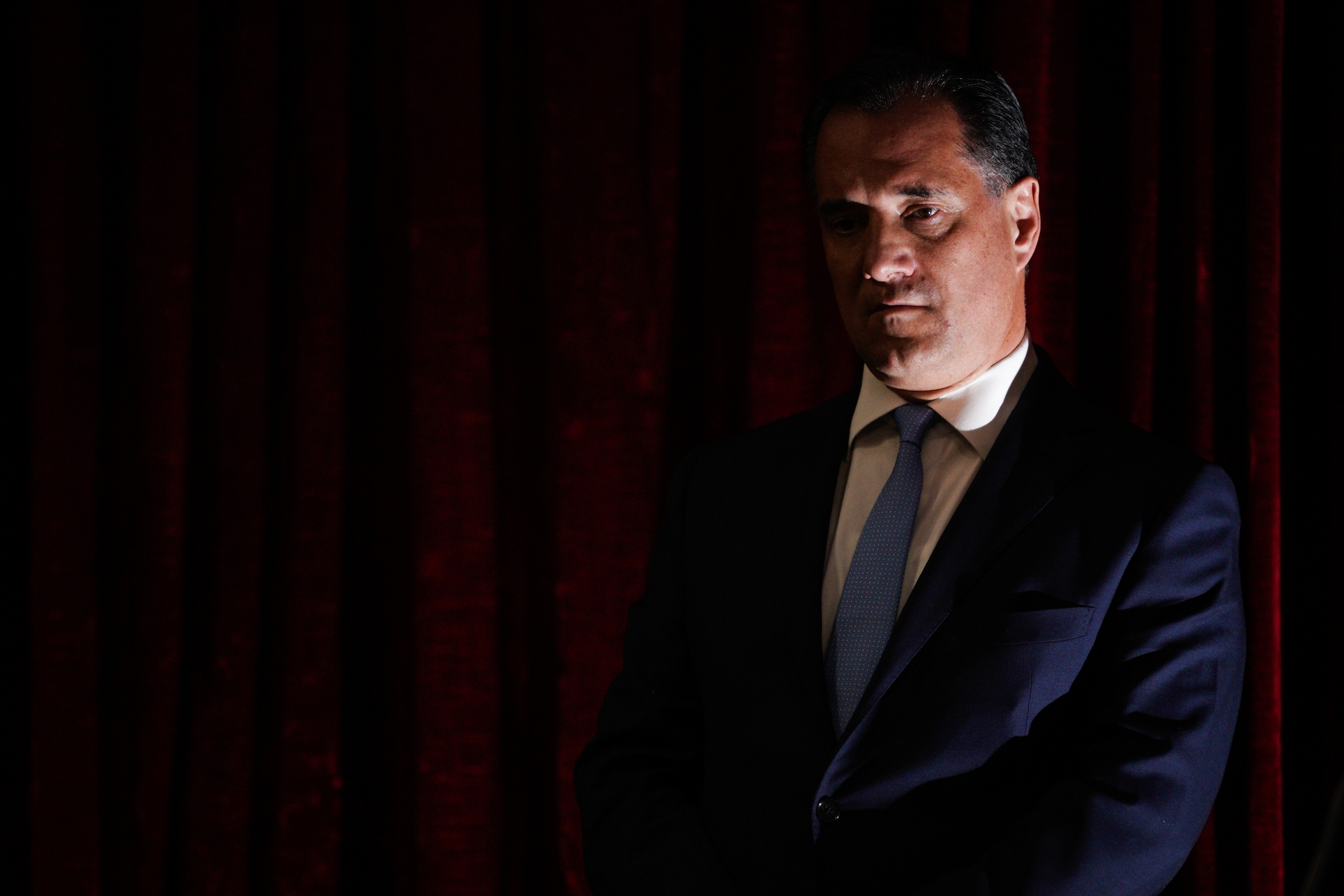
Georgiadis cited a 76% increase in the hospital’s budget and an increase of 65 doctors, 135 nurses and 133 other personnel between 2019 and 2026. Mary Agrogianni, president of the hospital’s workers’ union, told TPP that the minister’s figures include healthcare staff who were already working at the hospital and whose contracts were renewed or who were made permanent. When TPP put this to the minister, he replied that ‘Ms Agrogianni is talking nonsense because she is a communist’, and insisted that the data was ‘irrefutable’, sourced from the Ministry of Health’s official business intelligence (BI) platform. His staff, however, have not sent us any supporting documents, despite requests made since that Thursday. The president of the board of directors of the General Hospital of Nikaia, Eleni Kantaraki, declined to speak to us directly, but conveyed the message: ‘What the minister has said is true.’
The hospital visit
On the occasion of the confrontation on Thursday, 19 February, between healthcare workers and riot police outside the General Hospital of Nikaia during the health minister’s visit, Adonis Georgiadis did not miss the opportunity to cast himself as a victim, to deploy civil war rhetoric against ‘communists’, and to extol what he described as the hospital’s remarkable progress.
Speaking on Action24, he painted a glowing picture of the hospital in his characteristic style, citing a 76% increase in the budget and gains of 65 doctors, 135 nurses and 133 other staff between 2019 and 2026. Later the same day, responding to a question from TPP, he revised the nursing figure upward to 155.
Healthcare workers, however, conveyed an entirely different picture. Panos Papanikolaou, a neurosurgeon and director within the National Health System at the General Hospital of Nikaia, speaking on our radio show Animal Farm, referred to the ‘pillaging’ of dozens of established specialist doctor posts from the hospital.
This account is corroborated by EINAP (the Association of Hospital Doctors of Athens-Piraeus), which issued a statement at the end of January denouncing plans to gradually reduce the total number of established pathology specialist posts at the hospital from 44 to 30, with 14 posts transferred to the Attikon – West Attica Hospital.
The union’s position: ‘We deny that staff numbers have increased’
TPP asked Mary Agrogianni, president of the Nikaia General Hospital union and member of the EINAP board of directors, whether she disputes the minister’s claims.
‘We deny that staff has increased. As on other occasions when Georgiadis presents figures, he counts new hires without accounting for the fact that we are talking about staff who were already working at the hospital and may, for example, have moved from a fixed-term contract to a permanent post, or have had their contract renewed,’ she told TPP. ‘We have not increased the staff.’
She added a pointed observation: ‘If we had seen an increase, employees would not need to work double shifts or carry 50 or 60 days of outstanding unpaid leave.’ One does not presume that doctors forgo their rest days out of excessive professional devotion.
On the reduction of established posts, Agrogianni explained that the transfer of positions originated with the relocation of the organisational integration of the Agia Varvara Hospital (formerly an infectious diseases facility) from Nikaia to the Attikon University Hospital. She recalled that it was Georgiadis himself who closed Agia Varvara 13 years ago; it has remained closed as an organisation and does not function as a hospital, but as an annex. ‘On that basis, 14 intern posts at our hospital were cut,’ she said.
In this way, 14 established pathology specialist posts were transferred from Nikaia to Attikon, creating vacancies at Nikaia while allowing the hospital’s established posts to appear formally filled.
Those posts have been essential at the Nikaia hospital for the past 13 years, she stressed, particularly in the pathology wards, where doctors treat 60 to 70 patients in units with only 35 to 40 beds. ‘There is no room whatsoever for any reduction,’ she added.
Funding yes – but to what end?
On the question of the increased funding that the health minister so frequently cites in his public appearances, Agrogianni noted that what matters is where that money actually goes. ‘At the moment, a large amount of money is indeed being allocated, but it is not going towards meeting the needs of the hospital’s patient population. A large portion is going to private companies,’ she said.
As one example, she cited the CT scanner unit, which had gone unstaffed with permanent doctors for years, leaving just three doctors to cover the service. Unable to sustain full operations, the hospital contracted a private company to provide remote CT scans, at what she described as an astronomical cost per on-call shift. ‘For each shift, the private company receives approximately what a doctor’s monthly salary would cost. So yes, money is being spent there – but it does nothing to solve the hospital’s underlying problem. They are simply directing public money to private hands,’ she said.
Another example of what she called wasteful spending was the Recovery Fund money allocated for afternoon surgeries, which, she said, leaves no lasting benefit for the hospital. The government had promoted the afternoon surgery scheme heavily, but according to the union president, very little was actually carried out before it quietly stopped. ‘They were done simply so that someone could announce that they had been done, and then they stopped. For communication purposes, as the government appears to understand policy,’ she said.
A further example she raised was the use of contractors to supply hospital personnel for cleaning, catering and security at a cost far exceeding what it would cost to hire the equivalent staff directly through the public sector.
‘Every year is worse than the last’
In stark contrast to the image of a thriving hospital that Adonis Georgiadis projects, Agrogianni described precisely the opposite. ‘Especially staff who have been at the hospital for ten, fifteen, twenty years say that they genuinely never expected to be working in such conditions – that there would be two nurses for a ward of 40 patients, that they would work seven or eight days without a single day off, that they would be owed 50 or 60 days of leave and go home utterly exhausted. We are talking about a situation that has reached an untenable point,’ she said.
She also described the intent behind the healthcare workers’ mobilisation on that Thursday: to bring their grievances directly to the minister. ‘But he was accompanied by riot police and did not allow us to approach him,’ she said, holding him and the riot units responsible for the confrontation that followed.
Regarding the Emergency Department, for the inauguration of which the minister appeared at the hospital, Agrogianni noted a catalogue of problems: the unit has flooded two or three times and has yet to be fully staffed. It has flooded. ‘They are inaugurating a refurbished department without having hired additional staff, without having created the conditions for the department to function properly. The spaces are one issue. The other is who will work in them,’ she said, highlighting the minister’s pattern of staging celebratory events around incomplete projects.
The authorities’ response to the healthcare workers’ efforts was illustrated by the image of a doctor handcuffed in the emergency room. Dimitris Ziazias, like other healthcare workers during the protest, attempted to enter the inauguration – not an unreasonable ambition, one might note, given that the event was being held in their own hospital. He was not admitted, he was not charged, but he was handcuffed in the emergency room. That image tells us much about the New Democracy government’s treatment of healthcare personnel.
The episode did not end there. Over the weekend that followed, the minister falsely claimed that the doctor had stabbed him – a claim that his colleague Natasha Yamali is still awaiting video evidence to substantiate. The other protesters were met with batons and tear gas from the riot units deployed to guard the minister and his events.
When TPP asked Agrogianni what the hospital in Nikaia actually needs, she was unequivocal: ‘Based on the data we have collected as a union, we need at least 65 nurses to allow the hospital to operate safely, at least 15 ambulance drivers, and for the technical services department, which is severely understaffed, to be filled with permanent employees. It currently has 25 staff, while its established posts number around 100. The established doctor posts must also increase, because patient numbers at our hospital continue to grow year on year.’ Georgiadis did not hear any of this.
‘The minister would not lie’
TPP pressed ahead nonetheless, given that it should not be impossible to cross-check with valid, public sources the figures that the minister regularly broadcasts on television. The accounts of healthcare professionals and those of the minister are irreconcilable, and simply presenting that gap without investigation is not sufficient.
TPP contacted Adonis Georgiadis, who stated that ‘this data is beyond dispute – it is the official data of the Ministry of Health, and Mrs Agrogianni is talking nonsense because she is a communist.’ After once again deploying his civil war rhetoric against communists, he said that the figures are drawn from the Ministry of Health’s BI platform, which records the number of healthcare professionals receiving salaries in 2019 compared to today, and referred us to his assistant.
His assistant told us that ‘the minister cited the official data of the ministry’, to which, she said, she is unable to grant us access. We asked the obvious question: how are journalists supposed to verify with official data that what the minister says is accurate? ‘The minister would not lie,’ she replied – a reassurance we find less than convincing.
The minister’s staff subsequently told us they would extract the relevant data from the BI platform and send it to us, without granting direct access to the page. Four days later, no official document has arrived.
In the meantime, TPP also attempted to contact the president of the board of directors of the General Hospital of Nikaia ‘Agios Panteleimon’, to ask a straightforward question: are the minister’s figures accurate, and how many staff were working at the hospital in 2019 compared to 2026? A visit to the hospital’s official website and a click on the ‘personnel’ section yielded data from 2008.
Eleni Kantaraki did not respond to our request directly. She sent us the message: ‘What the minister has said is true.’
We began this report in search of official data that would confirm or refute the minister’s claims. We ended it having established that there is no straightforward mechanism for journalists to scrutinise the figures he presents. Perhaps that is precisely why he continues to appear on television and announce statistics unchallenged. We, however will wait for the data. And if they ever materialise, we will be here to examine them.
Are you seeking news from Greece presented from a progressive, non-mainstream perspective? Subscribe monthly or annually to support TPP International in delivering independent reporting in English. Don’t let Greek progressive voices fade.
Make sure to reference “TPP International” and your order number as the reason for payment.