Report by Iliana Zervou and Nektaria Psaraki
On the programme 3rd TOPIC, we spoke with Costas Kaloudis, Greenpeace’s campaign manager for climate and energy, about the potential impact of exploration and, if deposits are found, extraction. We also spoke directly with Venetia Gigi in Crete, a member of the Citizens’ Initiative of Crete Against Mining, described intense local reaction to plans that residents say could turn areas associated with fishing and tourism into hubs of heavy industry, without meaningful consultation.
The agreement signed
On 16 February, at an event attended by Kyriakos Mitsotakis and the US ambassador, Kimberly Guilfoyle, lease agreements were signed for four offshore areas in the Peloponnese and Crete. The exploration programme will cover 94,000 square kilometres, with the stated aim of locating hydrocarbons.
Mitsotakis said: ‘This is not just another agreement. It is a significant reinforcement and a critical element of our overall energy strategy. We fully understand the role that hydrocarbons play and will continue to play for many years to come. That is why we have invested significantly in natural gas pipelines, compression stations, LNG terminals and natural gas-fired power plants. These investments are progressing in parallel with our strategic choices in renewable energy sources. Greece is dynamically exploiting its solar and wind potential, which is particularly important. From a net importer of electricity, we have evolved into a significant exporter.’
According to the government, state revenues would come from a 20% corporate tax and a 5% regional tax. If hydrocarbons are found and deemed commercially exploitable, revenues would also include royalties starting at 4%, depending on the volume extracted.
The agreement was also presented by the government as a response to what it describes as ‘Turkish provocation’, with officials such as the minister of environment and energy, Stavros Papastavrou, speaking of a ‘seal of sovereignty’ and challenging the Turkish–Libyan memorandum. Critics argue that this framing obscures the wider direction of policy, which they describe as deepening dependence on major US energy corporations, with limited benefits for public finances.
What is known about potential deposits
Kaloudis said the history of drilling in Greek waters dates back to the 20th century, including wartime drilling by Italian forces in areas where oil was believed to exist, mainly in the Ionian Sea. He said discussions resumed in later decades, but findings for much of western Greece did not result in commercially viable projects, for technical and economic reasons.
‘Ultimately, the only deposit that became exploitable was the one in Prinos, Thassos, where first oil was found and then mineral gas, as we call it, in the marine area of the Thracian Sea. It was a deposit that was exploited for a few decades, until recently. It yielded what it had to yield. It is no longer operational,’ he said.
He said interest in south Crete is linked to geological data and comparisons with exploration elsewhere in the Mediterranean. ‘It is the edge of the so-called Greek trench, which starts from the west of Corfu, deepens quite a bit in the northwest of Kefalonia, until it becomes very deep and where two tectonic plates meet. It is estimated that there are resources that have been created after millions of years and have taken the form of mineral gas and oil,’ he said.
Environmental risks from exploration and extraction
Kaloudis described the Greek trench as an ecological hotspot. ‘There are so many creatures, few of which we know and many which are probably unknown to us,’ he said, describing it as a key Mediterranean habitat for cetaceans such as whales, dolphins and porpoises, which rely on depth for movement and feeding.
He said that even the research stage could intensify pressure on marine life. In the early phase of surveys, he said, instruments are used to record responses to powerful sound blasts intended to map geological formations.
‘These noises, the explosions, have a very high frequency and intensity. As we know, sound propagates very well in water. Therefore, even if it is very far away, if it is such an animal, it relies on the sonar system it has to move and perceive the environment around it. It is a huge biological danger, because this noise can deafen them, damage their ability to orient themselves, and even kill them directly if it is close and very loud,’ he said.
He added that if hydrocarbons are found and extraction proceeds, the disturbance would become continuous, with drilling rigs, platforms, vessels and associated infrastructure. He warned that pollution would be difficult to avoid. ‘When we talk about such processes, no matter how careful the manufacturers and engineers are, there will be leaks of either oil or gas. It should be noted that oil and gas are often together underground and it is not easy for someone to separate them during pumping. There are leaks,’ he said.
‘Even the revenue is insignificant, if hydrocarbons are found’
Kaloudis argued that the financial returns being discussed publicly depend on deposits being found and considered profitable by companies. ‘We hear a lot in publications about the total amount, profits and benefits over time, but in reality, if no exploratory drilling is done, no one can know if there is even a deposit and if it is exploitable,’ he said.
He emphasised that the expected revenue is structured as percentages rather than guaranteed amounts. ‘20% according to the contracts is corporate tax and 5% is regional tax,’ he said.
To illustrate his point, he offered an example: ‘If a barrel of oil has a value of 100 euros, the taxable income for the state with a profit margin of 10% will be 10 euros, of which the state will receive 20%, that is, 2 euros out of 100 of the company’s profit. The region will receive 5%, that is, half a euro. So 2.5 euros out of 100 will come to us.’
He said Greece also receives rent payments during the research phase, but described the sums as limited when spread over many years. He added that parts of the programme have previously stalled after companies withdrew, concluding that areas were not sufficiently attractive.
Kaloudis argued that arguments previously used to justify extraction, including claims linked to the Greek exclusive economic zone, did not play out as presented. He said the policy intensified competition with Turkey and increased pressure for higher defence spending.
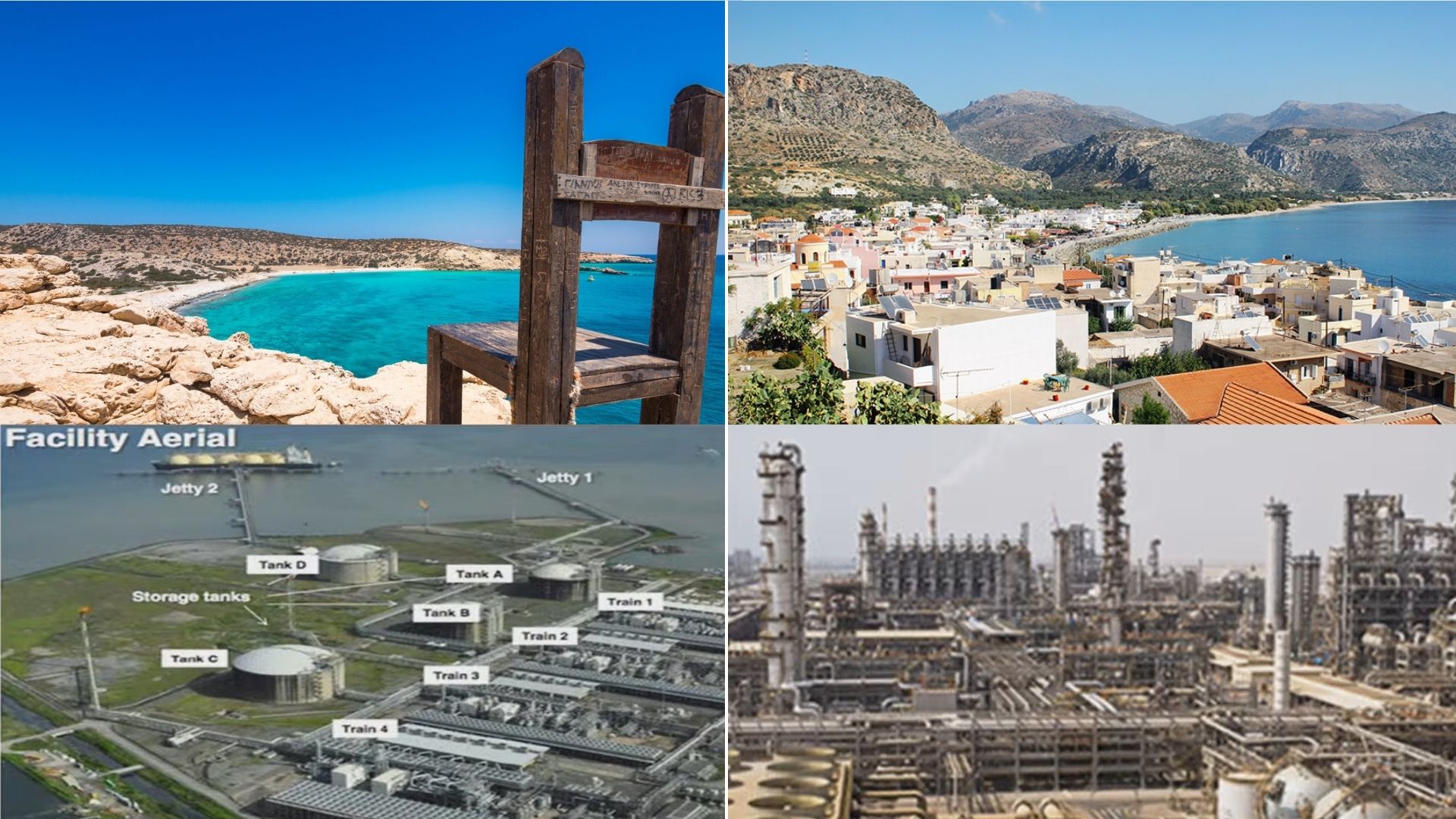
He also said any revenues that did materialise would have to be weighed against losses elsewhere, including potential impacts on tourism and the transformation of areas of natural beauty into industrialised zones.
Greenpeace criticism of Chevron
Kaloudis said Greenpeace has described Chevron as the second most polluting oil company in the world. He added that a US court fined the company $745m for polluting a marshland near New Orleans and failing to restore the affected area.
‘Its history does not allow us to be calm that at these depths, where until now technical capabilities did not allow mining, and while we will be among the first countries in the world to enter this process, that the highest safety standards will be applied,’ he said.
He also accused Chevron and Exxon Mobil of investing in campaigns since the 1980s aimed at spreading the view that climate change is not dangerous, does not exist, or is not human-made. He argued that such narratives have helped undermine environmental regulation and climate policy.
Fossil fuel plans amid climate targets
Kaloudis noted that Greece’s national energy and climate plan foresees a shift away from fossil fuels, accelerating from 2030. ‘Extractions do not seem to have such a logic of serving our commitment to our European partners. The goal is also less gas from 2035, until climate neutrality in 2050. However, if we continue with such plans, we are not moving towards this goal,’ he said.
He argued that policy should instead focus on renewable energy deployed sustainably, in consultation with local communities and in ways compatible with local landscapes. He advocated decentralised energy production, including small-scale installations on roofs of homes, businesses and public buildings, and further development of energy communities.
‘It is not a good choice. Not even economically,’ he said, arguing that the likely tax revenue would be limited while the long-term costs of climate impacts and environmental damage would rise.
Cretan initiative: ‘They decided for us without us’
The Initiative Against Mining in Crete was formed in 2019, after contracts were signed for offshore areas west and south-west of the island. Venetia Gigi said reactions in Epirus to onshore blocks had begun earlier, in 2014, and that Cretan residents began organising after learning that wide areas of the Ionian and Libyan seas were being offered for exploration.
She said the main organising base is in Heraklion, with support across the island, including groups in Paleochora in the south of Chania and in Ierapetra, where residents raised the issue with the municipal council. She said a local decision was taken opposing drilling in the south of the island. Coordination also takes place via social media, with a Facebook group that she said has more than 10,000 members.
Gigi said the first issue residents encountered was the scale of the change such projects could bring. ‘This is an activity that completely changes the place, the productive model of the place and the landscape. Everything. Environmental impacts, socio-economic at all levels,’ she said.
She argued that decisions of this scale should be put to local communities. ‘This should be done here too: to put the issue to a referendum on whether the residents of the Canary Islands, Crete, the Ionian Sea, etc. agree to change their productive model from fishing and tourism, to a model of heavy mining industry,’ she said.
Instead, she said, the matter was pushed through without adequate participation. ‘Not only did it not happen here, but they passed it on to a regional council with 17 out of 51 present. They weren’t even present, they didn’t even ask to be informed about something so serious,’ she said.
Gigi said the pattern repeats across major projects in Greece. ‘There is no consultation, no information, no dialogue. A collective decision should be made. It should be the decision of the local communities as to what will happen in their place,’ she said.
She said the initiative’s experience is that people often do not know what is planned, including those directly affected. ‘People initially don’t know. Not even those directly involved. When they hear it, they are left speechless. They wonder why they weren’t informed and are concerned about issues of alteration of the place, the landscape, and productive activity. They wonder what will happen in the event of an accident and what guarantees are in place,’ she said.
She added that residents are sometimes told they are too small to resist. ‘They consider us to be “minorities” and ignore us,’ she said, adding that the initiative has pursued legal avenues and submitted questions to regional authorities without receiving answers.
‘They will definitely find resistance’
Gigi questioned the logic of investing in hydrocarbon extraction while publicly funding green development projects and climate policy. She also pointed to what she described as contradictory government messaging. ‘There was a conference on the oceans last year. Mitsotakis and the minister of the environment pledged that we will not give any more concessions, any more new plots of land, precisely because we have the problem of climate change. A year later, Chevron comes,’ she said.
She argued that the companies entering Greek waters are not neutral actors. ‘The companies we are rolling out the red carpet for are not random companies. They are Exxon Mobil, they are Chevron, they are Energean,’ she said.
She concluded: ‘Obviously we do not know if they will find gas or oil. But they will definitely find resistance from us.’
______________________________________________
Are you seeking news from Greece presented from a progressive, non-mainstream perspective? Subscribe monthly or annually to support TPP International in delivering independent reporting in English. Don’t let Greek progressive voices fade.
Make sure to reference “TPP International” and your order number as the reason for payment.