Speaking in parliament, Prime Minister Kyriakos Mitsotakis called on the opposition to show consensus ‘against the slogans that divide.’ He spoke mockingly of ‘professionals who worry, sometimes about the responsible position of the country and sometimes about international law’, and urged these troublesome sceptics to understand that ‘foreign and defence policy is not practised ideologically but according to national criteria.’ In other words, unconditional alignment with the interests of the US and Israel is not merely government policy. It is something altogether higher: ‘national policy’, which is to say the only permissible one. The opposition, in the prime minister’s framing, cannot disagree because to do so is to ‘divide’; it can only consent, or be dismissed as foolish and fanatical. New Democracy’s more vocal supporters would add ‘treasonous’ to that list.
That is not, of course, how politics works. There is no self-evident ‘national criterion’; there are different policies and competing visions of how best to serve a country’s interests. Spain, under Prime Minister Pedro Sánchez, offers a case in point. It has refused to allow its military bases to be used for US attacks on Iran. Months ago, it was the only NATO member to reject the alliance’s new target of raising defence spending to 5% of GDP by 2030, stating its intention to prioritise the welfare state instead. It has been the most outspoken European voice in condemning Israel’s conduct in Gaza, pursuing a series of diplomatic, economic and legal measures. Its position is captured in a phrase Sánchez used in a speech: ‘No a la guerra’ — no to war.
The furious reaction of Greek government supporters to the Spanish prime minister reveals that a stance in favour of peace is now treated as a form of subversion. It also reveals that any dissenting voice will be targeted with coarseness and aggression, in the binary logic of ‘either you are with us or against us.’ Sánchez, a centre-left Social Democrat, was widely branded in Greece a ‘mullah supporter’ and ‘pro-Turk.’ Dimitris Economou of SKAI television demanded ‘should we stand with Iran, and also with Sánchez?’, describing those who praised his stance as ‘caricatures.’ Thousands of people and dozens of journalists simultaneously pointed to Spain’s arms exports to Turkey, while conveniently omitting that Germany, Britain and the United States do the same. The criticism only intensified when Spain announced it would send a frigate to Cyprus, an EU member state, as part of European coordination. These were not fringe voices. They were all the voices.
The reason Spain agitated so much the Greek commentariat is that it demonstrated something inconvenient: that it can be done. That a NATO member state can take a fundamentally different position on the most critical issues, speak plainly about an illegal war, invoke international law, and simply say: not in our name. Under normal circumstances, the Spanish government’s position would be considered moderate. Today it is presented as unthinkable, lest anyone get ideas.
If the demand for peace and non-involvement is to be treated as revolution, utopia or betrayal, we are on a very dangerous course.
There are, of course, more pressing matters occupying the Greek public sphere than the strategic choices that drag the country into wars. Such as the breathless news that ‘Cimon has returned to Cyprus after 2,500 years.’ This was the substance of articles and television reports generated by a social media post from New Democracy MP and professor of international relations Angelos Syrigos, who sought to draw a connection between the ancient Greek past, the Persian Wars and the present, on the basis of the name given to a new frigate. It is one absurdity among many, part of a transparent effort to manufacture acceptance of war by stimulating ‘national sentiment.’
For years, two main arguments have structured debate over Greece’s foreign policy during a period of intensifying military conflict: the moral and the pragmatic. The moral argument reached its peak with the Russian invasion of Ukraine, framed daily as a matter of being on the ‘right side of history.’ But that moral appeal has since frayed badly, worn down by two years of the genocide in Gaza, the crimes and occupation of the West Bank, the US attack on Venezuela, and now the illegal assault on Iran. The propaganda poles deployed to maintain the appearance of moral high ground, ‘democracy versus regimes’, ‘Western civilisation versus barbarism’, cannot conceal the fact that Greece increasingly finds itself supporting aggressors in blatant violations of international law. The spectacle of Western liberal democracies meekly following the lead of Trump and Netanyahu does nothing to help those who continue to present geopolitics in the simple terms of good versus evil.
What remains is the pragmatic argument: that the country’s interests are served only through unconditional support for the US and Israel, in the logic of the dependable ally. Yet this choice, presented as a guarantee of security, carries serious risks that deserve to be named. The American bases on Greek soil and the systematic effort to present Greece as NATO’s frontline state represent a profound and unprecedented degree of entanglement. The relentless increase in military spending, which the prime minister has actively championed at the European level, will inevitably mean further cuts to the welfare state. However insistently New Democracy dismisses such talk as outdated or unrealistic, the money comes from the same budget and there are no exceptions. And the idea that at a critical moment the US will stand by its most loyal ally out of a sense of moral obligation or reciprocity is, particularly after its reversal on Ukraine, simply not credible.
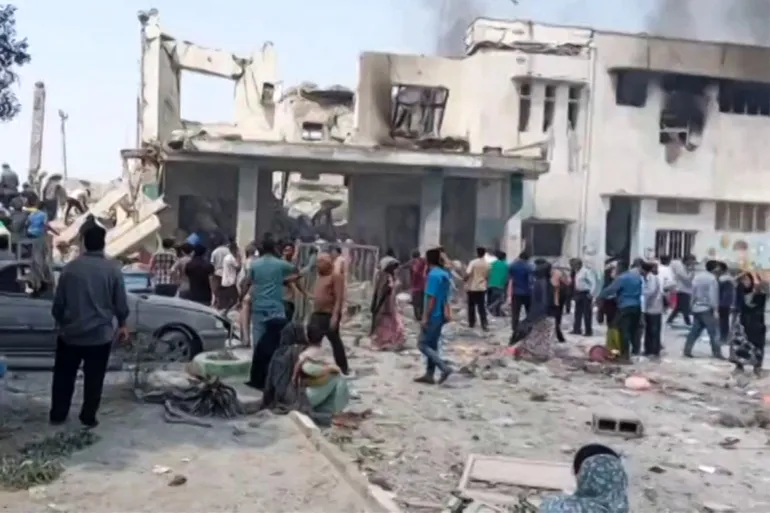
All of this deserves serious, responsible political debate, free from warmongering paranoia, nationalist dead ends and celebrations of military force. A debate that does not fantasise about triumphs but ensures we do not end up, as Defence Minister Nikos Dendias apparently wishes, welcoming home ‘flag-draped coffins.’ Dendias called, some months ago, for a ‘change of culture’ in European societies — a remark that passed without sufficient scrutiny. The reaction to the war in Greece has been notably weaker than in American society and media. Attacks on schools and health facilities are, at best, footnotes.
We cannot even agree in Greece on who is the aggressor and who is defending themselves in the war against Iran. Hours of television debate are devoted to the spotlight on Iran’s theocratic regime, while proportionally little time is given to the actual motives for the attack or to scrutinising those carrying it out. The belated interest in the rights of the Iranian people is not even reflected in statements from the Trump administration itself, while the elementary right of any people not to have bombs dropped on their heads goes unacknowledged.
Even if we were to set aside the absence of international legitimacy and assume the attack were being carried out for some higher good, the liberation of the Iranian people from the regime, even granting the US and Israel false humanitarian motives and a genuine interest in social rights and political freedoms, one question still demands an answer: when has this plan ever worked? In Iraq? In Afghanistan? In Libya? In Syria?
History is instructive, and we need not reach for books and documentaries to understand what happens when democracy is exported by bombing. When has a social revolution been achieved by the military intervention of a foreign state? These are not distant historical episodes; some are less than twenty years old. Is there any substantive evidence to suggest that this time will be different? Given that today’s ‘forces of good’ are an American president with authoritarian tendencies and an Israeli prime minister wanted by the International Criminal Court for war crimes, the answer is plainly no.
‘Woman, life, freedom’ was the slogan of the great Iranian mobilisations of 2022, which followed the death of Mahsa Amini at the hands of the ‘morality police’ and drew international solidarity. The notion that the first of those three words can be advanced by violating the other two is, at best, wishful thinking and, at worst, cynical hypocrisy. The more plausible scenario is that foreign aggression will bury social demands, either by strengthening the regime’s grip at home or through a prolonged civil war.
‘They are trying to ride the wave of the people’s just protests and divert the anti-dictatorship movement from its right path’, wrote the Iranian communist party Tudeh on 12 January, in reference to the scenario of military intervention, amid large-scale and bloody demonstrations. Its statements over the past two months offer a revealing indication of how anti-regime forces within Iran are responding to successive critical events.
‘In today’s extremely critical and decisive circumstances, mobilising world public opinion to end the military aggression of American imperialism and the criminal Israeli government against Iran, as well as to achieve an immediate ceasefire, is one of the most important tasks facing all progressive, national and peace-loving forces’, Tudeh stated on 6 March. ‘In these difficult circumstances, defending the country’s right to national sovereignty, the people of Iran seek above all the end of the war and the establishment of peace, so that they can determine the future of the country free from any foreign interference. They call for the opening of a path towards a national and democratic government, the immediate and unconditional release of all political prisoners, as well as the creation of conditions that will allow them to play an active and meaningful role in determining their own destiny.’
The dominant narrative’s professed concern for Iranian society is, of course, hypocritical, as it always is when double standards prevail. Were it otherwise, the alliance of Western states with monarchies such as Saudi Arabia would at least be questioned, and the erosion of democracy in the United States under Trump would attract strong condemnation. Were it genuine, refugees would be recognised by the majority for what they are: people risking their lives to flee war, imprisonment and torture, not ‘invaders’ and a ‘national threat.’
Instead, we are in the era of ‘whatever it takes.’ Humanism and intolerance, democracy and nationalism, realism and the battles of ancient Greeks are thrown together indiscriminately, with the sole aim of dissolving doubt and manufacturing consent for destruction. Without coherence, without logic. The screens are filled with war, but it is not a video game, nor a Hollywood film, nor a football match.
It is horror, destruction and lives lost: for the dead, life ended; for the living, life diminished.
______________________________________________
Are you seeking news from Greece presented from a progressive, non-mainstream perspective? Subscribe monthly or annually to support TPP International in delivering independent reporting in English. Don’t let Greek progressive voices fade.
Make sure to reference “TPP International” and your order number as the reason for payment.