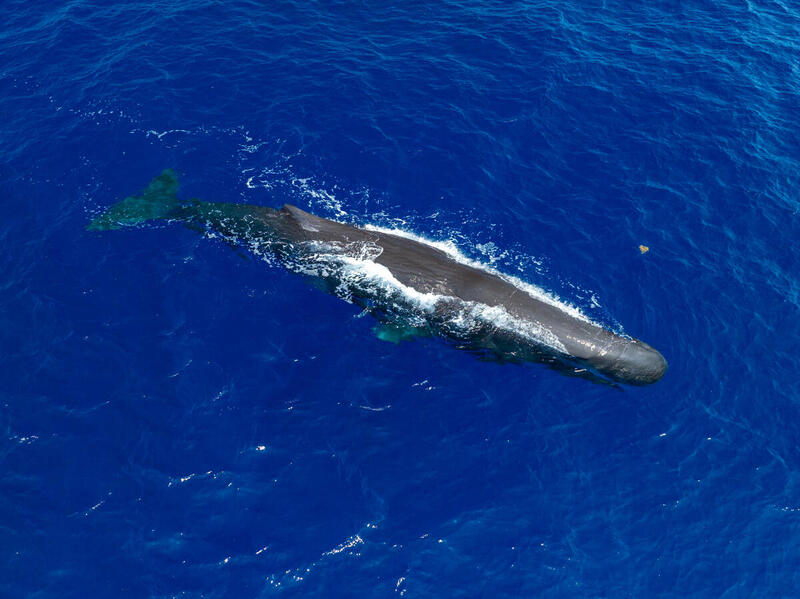
The article, published this month in the scientific journal Ethics in Science and Environmental Politics by distinguished marine biologists from around the world, shows that the impacts of seismic surveys and hydrocarbon extraction on marine megafauna, particularly whales and dolphins, are numerous and devastating. They include physical harm, such as hearing damage, chronic stress and hormonal changes; behavioural changes, such as disrupted feeding and resting patterns; and possible cetacean strandings and deaths.
Seismic surveys, which are mainly conducted to map the seabed before oil and gas drilling projects, require the use of so-called air guns that produce extremely loud low-frequency sounds with a range of up to 4,000 kilometres. Cetaceans’ navigation, communication, foraging and overall survival depend directly on sound.
The possible displacement of populations from their habitats is also a major concern, as species such as Cuvier’s beaked whales avoid noisy areas for days. This makes seismic surveys one of the most harmful and dangerous activities for marine life, as the sounds produced are among the loudest in the ocean and louder than any known biological sound.
The formal complaint to the European Commission
Two of the three cases examined in the publication are the subject of a pending legal case initiated by ClientEarth, WWF Greece and Greenpeace Greece. In 2023 the three organisations filed a formal complaint with the European Commission, warning that oil and gas exploration and exploitation projects were being approved in the ecologically important area of the Hellenic Trench, very close to protected areas, despite the clear risks they pose to marine species and in violation of EU nature protection law.
Francesco Maletto, a lawyer at ClientEarth, said: ‘The devastating effects of fossil fuels on the climate are widely known, especially in Greece. However, this new research reveals the scale at which this industry is causing devastation to ecosystems at every level. The Hellenic Trench is one of the richest areas in biodiversity in the entire Mediterranean. Yet the widespread noise caused by hydrocarbon exploration and extraction is devastating for marine mammals. Will the Commission stand by and watch this happen, in violation of EU law, or will it step in to protect some of Europe’s most endangered marine species?’
Anna Vafeiadou, head of legal affairs at WWF Greece, said: ‘Greece’s seas are still among the healthiest in Europe, precisely thanks to the absence of destructive activities such as oil and gas extraction. We are sleepwalking towards an environmental catastrophe if these extraction plans go ahead. This scientific article published today highlights the serious risks to our seas and marine life from oil and gas projects. The science is clear: the measures that can be taken to mitigate the impacts of hydrocarbon exploration on the unique ecosystem of the Hellenic Trench have limitations. We call on the European Commission to intervene and ensure the implementation of European legislation before irreparable damage is caused.’
Costas Kaloudis, climate and energy campaigner at Greenpeace Greece, said: ‘With 20% of Greece’s marine areas allocated for hydrocarbon exploration and an extremely weak institutional framework for the protection of the marine environment, the future of the marine mammals we are trying to protect looks bleak. The Greek government’s promises of thorough procedures to prevent environmental damage and ensure that marine mammals are not negatively affected by hydrocarbon exploration and drilling seem to be falling on deaf ears. It is time for the European Commission to step up the pressure on the Greek authorities: future generations should also be able to enjoy a thriving biodiversity in Greek seas.’
According to the text, EU environmental law requires the Greek authorities to fully assess the impact such activities will have on threatened marine biodiversity in protected areas before giving them the green light. The scientific publication confirms the arguments set out in the complaint: that assessments for projects approved in the Mediterranean were inappropriate and not based on the best available scientific knowledge, as required by EU law.
The publication raises critical questions about the validity of the findings that led to the approval of the projects, which appear to have been based on outdated, incomplete and inaccurate data. It also found that the assessments underestimated the serious risks posed by activities such as seismic surveys to endangered species such as fin whales, relying on scientifically unfounded assumptions, including the idea that animals would simply ‘move away’ from the source of the noise.
Following the publication, the three organisations reiterated their call for the European Commission to take action against widespread violations of EU nature conservation law in the region.
The scientific study
The article, titled ‘Impacts of hydrocarbon-related activities on marine megafauna: case studies from the Mediterranean Sea’, was published in the latest issue of the scientific journal Ethics in Science and Environmental Politics.
The article refers to research showing that low-frequency sound from seismic surveys can propagate across entire ocean basins and reach distances of up to 4,000 kilometres (Castellote et al 2012, Nieukirk et al 2012).
The article also found that a number of inadequate mitigation measures were taken during seismic surveys. These included the decision to carry out seismic surveys during winter in order to avoid impacts on cetacean ‘reproduction processes’. However, according to the report, despite these measures, a serious mass stranding of three whales occurred during the surveys, 10 kilometres from the Ionian Sea concession area, a fact that was not mentioned in the environmental assessment.
Biodiversity and local context
The entire Hellenic Trench and the adjacent Ionian Archipelago are areas of high biodiversity concentration and key habitats for many threatened whale species, including Cuvier’s beaked whales and the endangered Mediterranean sperm whale, as well as the loggerhead sea turtle Caretta caretta and the Mediterranean monk seal. For these reasons, they have also been designated Important Marine Mammal Areas (IMMAs) by the International Union for Conservation of Nature (IUCN).
Anthropogenic noise has been linked in the past to numerous strandings and deaths of Cuvier’s beaked whales. The study refers to seven known mass strandings during the 1990s, as well as the stranding of three Cuvier’s beaked whales in Corfu in February 2022, an unusual event that occurred while seismic surveys were being conducted in the area.
Noise from seismic surveys is not the only threat posed by the oil and gas industry to marine megafauna in the Mediterranean. From increased noise and shipping to extraction activities, chronic toxic pollution and the installation and dismantling of infrastructure, these activities contribute to chronic, cumulative and multi-level disturbance and pressure, while worsening the existing impacts of overfishing, climate change and pollution. The study argues that the impact of seismic surveys must be considered in this broader context.
The complaint
ClientEarth, WWF Greece and Greenpeace Greece initially sent a letter to the European Commission in December 2023, requesting the launch of infringement proceedings against Greece. The European Commission confirmed in late 2024 that it would proceed with an investigation.
In their latest letter, sent in April 2026, the organisations highlighted the conclusions of the new study regarding the inadequacy of impact assessments and compliance measures. In light of the continued expansion of offshore oil and gas activities in the region, they also reiterated the need for the Commission to take enforcement measures against these systemic breaches of EU law by the Greek authorities.
The concession contracts for four new hydrocarbon blocks located south of the Peloponnese and south of Crete have now been ratified by the Greek Parliament through Law 5287/2026. The report’s findings on deficiencies in the impact assessment have raised further concerns among the complainants that the new activities will be carried out in the same flawed manner as those covered in their complaint.
The multinational fossil fuel company Chevron and the Greek company HELLENiQ Energy have formally expressed interest in opening up more areas for oil and gas activities, and the Greek Ministry of Environment and Energy has accepted their request, launching the official licensing process. Chevron is the second-largest private hydrocarbon company in the world, headquartered in the US and active in more than 180 countries.
______________________________________________
Are you seeking news from Greece presented from a progressive, non-mainstream perspective? Subscribe monthly or annually to support TPP International in delivering independent reporting in English. Don’t let Greek progressive voices fade.
Make sure to reference “TPP International” and your order number as the reason for payment.