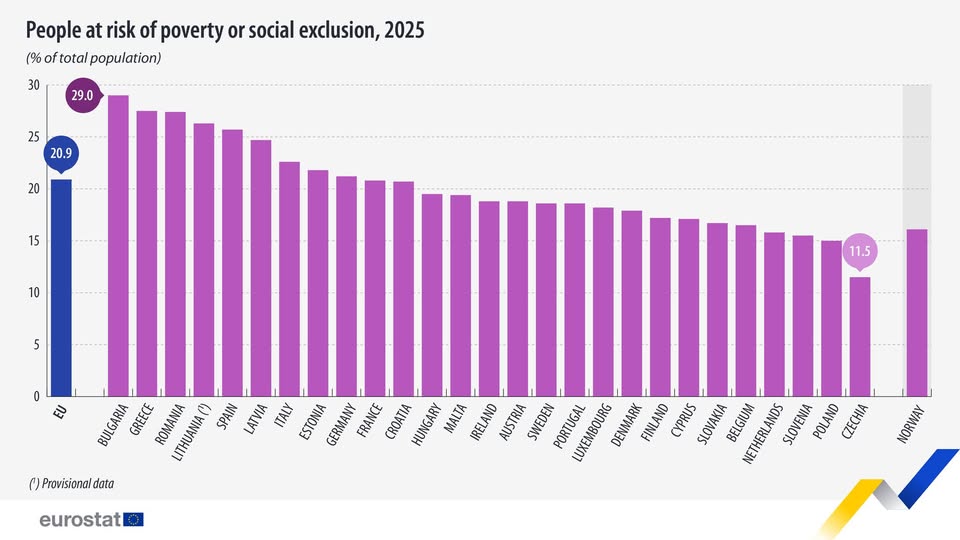
According to Eurostat data for 2025, 27.5% of Greece’s population is at risk of poverty or social exclusion, placing the country second in the EU. The figure marks an increase from 2024, when Greece ranked third in the EU, with 26.9% of the population at risk. Across the EU, 92.7 million people, or 20.9% of the population, were at risk of poverty or social exclusion, with Eurostat recording a decrease compared with 2024.
The risk of poverty or social exclusion refers to populations facing at least one of three main forms of vulnerability: low income, severe material and social deprivation, or very low work intensity. A person is considered at risk of poverty or social exclusion if they fall into one of the following categories:
people at risk of poverty, meaning those with disposable income below the at-risk-of-poverty threshold
people experiencing severe material and social deprivation, meaning those who cannot afford at least seven of the 13 deprivation items, six relating to the individual and seven to the household, that are considered by most people desirable or even necessary for a decent quality of life
people under the age of 65 living in a household with ‘very low work intensity’, meaning households where adults worked 20% or less of their total combined potential working time in the previous 12 months.
According to the data released by Eurostat, the highest share of people at risk of poverty or social exclusion in 2025 was recorded in Bulgaria, at 29.0%, followed by Greece, at 27.5%, and Romania, at 27.4%. By contrast, the lowest rates were recorded in Czechia, at 11.5%, Poland, at 15.0%, and Slovenia, at 15.5%.
In the 2024 data, Greece ranked third in the EU, at 26.9%, while in both 2023 and 2022 the rate stood at 26.0%.
______________________________________________
Are you seeking news from Greece presented from a progressive, non-mainstream perspective? Subscribe monthly or annually to support TPP International in delivering independent reporting in English. Don’t let Greek progressive voices fade.
Make sure to reference “TPP International” and your order number as the reason for payment.