Doctor of Law Dimitris Sarafianos told The Press Project that the new framework effectively privatises justice. Until now, the relevant orders carried the guarantees of judicial authority. Under the new procedure, he says, almost any lawyer can undertake them for the prescribed fee.
‘Landlords will have superpowers from now on against tenants,’ said Alexandros Romanos Angelis, a member of the United Initiative Against Auctions, arguing that the term ‘strategic defaulter’ is little more than a communication trick.
‘Only 0.1% of tenants have not paid their rent, and this is remarkable given the current cost of rents,’ said Nikos Vrantsis of the Thessaloniki Tenants’ Union, sharply criticising the new ‘solvency register’ now being prepared, through which landlords may be able to assess prospective tenants on the basis of a wider range of past debts.
In a country already deep in a housing crisis, legal notices have begun to arrive. The only thing missing was faster eviction from people’s homes.
The new framework
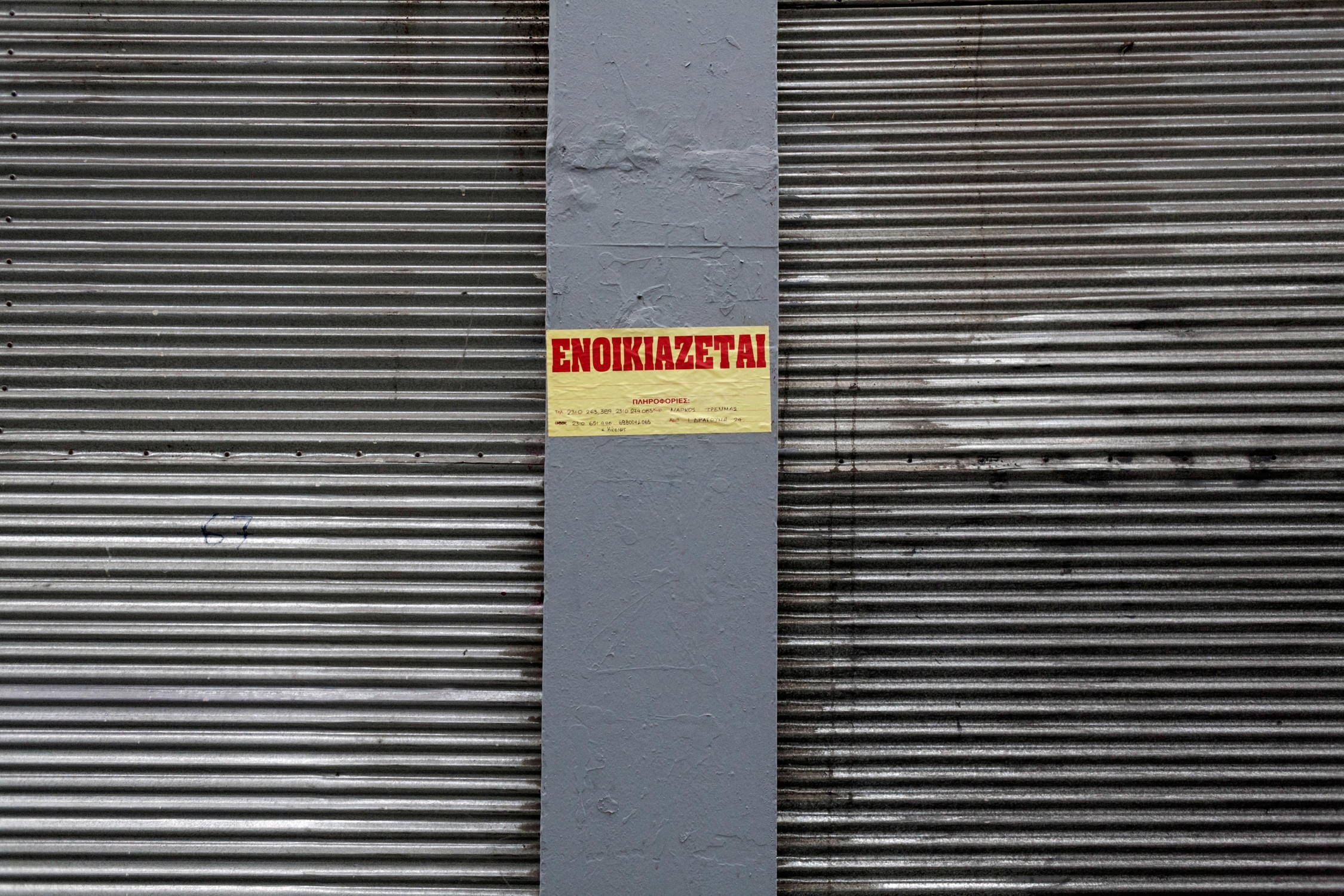
The new express eviction framework was implemented on 1 May, with much of the coverage presenting the measure positively and framing it almost entirely from the perspective of landlords and judges.
Kyriakos Mitsotakis has put it plainly before: ‘What is a problem for the tenant is a benefit for the landlord’, and vice versa. In other words, there are conflicting interests. The Press Project looked at the side of those most exposed: the tenants.
Eviction orders will now be issued not by judges, but by lawyers, within 20 days. The Panhellenic Federation of Property Owners (POMIDA) claims that, under the new procedure, the total timeframe reaches six months. Several media outlets have also reported that tenants will have, by law and without any action or expense, at least six months to relocate.
What is not always made clear is when that six-month period begins. It includes the three months covered by the legal notice sent before the end of a lease of up to one year, the one month required for the order returning the property to be issued and the two months granted to the tenant to organise their move.
At the same time, a ‘solvency platform’ is being developed, which will be fed by the myProperty system and the Independent Authority for Public Revenue (AADE). It could therefore potentially provide information on all debts owed by a prospective tenant, both to the state and to banks, not only debts arising from previous tenancies. This raises serious questions over personal data.
Lawyers take on the role of judges
Lawyer and Doctor of Law Dimitris Sarafianos told TPP that the essential change is that lawyers are taking on the role of judges.
Until now, eviction orders and payment orders were issued on the basis of documents provided for by law, which were examined by judges. Under the new framework, there will be a list of lawyers from which each case will be assigned. In practice, the landlord’s lawyer will go to the registry of the Court of First Instance and be told whose turn it is to take the case.
The difference is that the eviction order will not be issued by a judge, but by a lawyer. It will then go to court only to receive a stamp, issued in the name of the Greek people.
Sarafianos is clear: ‘This is not the role of lawyers.’ He argues that lawyers are being turned into an annex of the judicial mechanism in the name of speeding up the process.
He also stresses that the character of the legal profession is changing, from a defence profession into something closer to a state-appointed enforcement function. At the same time, the new procedure privatises the institution of justice: what previously carried the guarantees of judicial authority may now be handled by a lawyer for the prescribed fee.
The government’s narrative focuses on speeding up the process and deliberately overlooks what is at stake: the validity and safeguards attached to these orders. A decision leading to eviction will be made immediately, without real supervision by the justice system, while the discussion proceeds smoothly under the language of ‘relieving’ judges of supposedly trivial procedures.
These procedures concern whether people will have a home.
Landlords with ‘superpowers’
Why express evictions? ‘The judicial system stops intervening in order for a payment order or an eviction, or generally a forced execution procedure, to be completed,’ said Alexandros Romanos Angelis, a member of the United Initiative Against Auctions, who intervened on behalf of the collective in the relevant parliamentary debate.
Evictions will be fast-tracked, without the presence of a judge, with only a lawyer’s signature and without public oversight.
Nikos Vrantsis of the Thessaloniki Tenants’ Union described the change as ‘a privatisation of the process, that is, they are transferring it from the judicial system to a private lawyer’. A landlord will apply, through their own lawyer, to a private lawyer, who will issue the eviction order within a very short period, potentially within 20 days.
‘A decision that will obviously be burdensome for us tenants and will tell us: “you have to leave the house”,’ Vrantsis said.
‘The lawyers will essentially become the heavies for the landlords,’ Angelis said.
The procedure can be triggered either when a landlord claims rent has not been paid or when a lease expires. According to the plan, the landlord will be able to go to a private lawyer three months after sending the tenant a notice, and 20 days later the lawyer will be able to issue the eviction order.
‘Then we will have two months to leave the house, and in total they calculate this as a six-month process. They argue that this is a reasonable period of time for us to find another house,’ Vrantsis said.
‘It is essentially a gift to landlords, making tenant evictions easier and faster. As long as we live in rented housing, it will be an extortionate dilemma and a weapon in the landlords’ arsenal,’ he added.
‘Landlords will have superpowers from now on against tenants. That is the point,’ Angelis said.
In the country with the EU’s heaviest housing burden
In order to grant landlords these new powers, tenants first have to be targeted under the imaginative and infuriating label of the ‘strategic defaulter’.
Infuriating, because Greece is a country where neoliberal policy and the commercialisation of housing have pushed more and more people into renting while driving house prices to extreme levels.
In the 1980s and 1990s, the homeownership rate in Greece was over 80%. It gradually declined, reaching 75% in the early 2000s. Although it rose slightly to 77% at the end of that decade, by 2023 it had fallen to 69.6%. In other words, more than three in ten people in Greece now live in rented homes.
The situation in Athens is even worse, with homeownership lower than the national average, at around 64% to 65%.
And many of these people spend half their salary on rent. According to Eurostat, the share of the population spending more than 40% of disposable income on housing costs reached 28.9% in Greece in 2024, compared with an EU average of 8.2%. Greece ranks first in the EU for housing cost burden. In large urban centres the figure was estimated at 29.1%, while in rural areas it stood at 27.7%. Among tenants, the proportion paying more than 40% of their income on housing is estimated at 37.4%.
‘The myth of the strategic defaulter’
The government is now adopting acceleration policies under the narrative of protecting the ‘unlucky landlord’ from the ‘strategic defaulter’.
Angelis described this as a ‘communication trick’. If we imagine the ideal ‘strategic defaulter’ as the government presents them, he said, it would be someone who enters a home, rents it, pays a deposit and rent in advance, then stops paying.
‘Of course, they will first have to show us how many “strategic defaulters” there are, that is, people who, as a matter of choice, want to stay in a house and intend not to pay for it,’ he added.
Vrantsis called it a ‘myth’.
‘It is their own myth and they put all tenants under this umbrella,’ he said. ‘The real motive is that they want to be able to evict people from their homes easily, so they have the flexibility to raise rents and follow trends in the real estate market.’
He described the logic sharply. Landlords see others in their area raising rents to, for example, €1,000, and think: ‘With this contract I have now, my tenant only pays me €600, with a salary of €800. Let me ask him for €1,000, so he can find another €200 on top of his salary.’
‘Our salary should be transferred directly to the landlords if we are to continue like this, and they can give us back a crumb to eat,’ he said.
‘The narrative of both the government and POMIDA has completely prevailed,’ Vrantsis said. ‘The most vulgar claim is that this is a very important measure, invoking a myth they have made up in their minds that all tenants are “damaging” homes, destroying them or not paying, which is not proven by AADE’s statistical data. Only 0.1% of tenants have not paid the rent, and this is admirable given the cost of rents they are asking for.’
‘In this situation, the fact that we continue to pay is admirable,’ he added.
Angelis put it differently: ‘The real strategic defaulters are those who owe millions to the state. New Democracy owes €590m. PASOK owes €580m. I don’t know whether you or I could owe such a monstrous amount and be considered “solvent” enough to settle it. We would be the definition of a “strategic defaulter”.’
A system for recording solvency
The government is investing heavily in this framing. Under the new framework, the state is moving ahead with the creation of a Tenant Solvency Register, a digital database that will draw information from myProperty and AADE.
Vrantsis described it as ‘a system for recording solvency, which does not concern only tenants, but also homeowners and people who may be burdened with a loan or may have delayed the payment of bills to local authorities, electricity companies and so on’.
There are legitimate concerns over what data will be recorded in the register. If landlords are given information from AADE, they could be able to see a citizen’s debts to the state and banks, not just rent-related debts.
Angelis called it a ‘Teiresias for tenants’, referring to Greece’s credit reporting system. ‘It will be like having bullet points. As an evaluation, it will be a bit like a Black Mirror episode, where they will tell you: “Oh, he is solvent, we can rent to him”.’
In other words, if someone went through a period in which they were unable to pay rent, they may be branded an ‘insolvent tenant’ for life. This is also a basic demand of POMIDA.
Vrantsis stressed that POMIDA represents not simply owners, but landlords.
‘We have never seen it issue an announcement about people who have debts, who pay servicers, who have been burdened so much. It is not for homeowners, it is for landlords,’ he said.
People who rent out property and receive passive income make up 15% of the population. In recent years, their income appears to have been climbing towards the highest income quartile. By contrast, in the Municipality of Thessaloniki, 40% of the population lives in rented housing.
‘We have seen our salary and our power decrease,’ Vrantsis said.
The government, then, is deliberately addressing an organised and powerful sector, its stable interlocutor, and legislating to please it.
The ‘solvency index’ is a sign of the degree to which housing has been commercialised.
‘Your ability to pay an immodest or modest rent has become a burden on your life, and this is precisely why we say that housing has been commercialised,’ Angelis said.
‘The number of renters is increasing, the number of owners who live in their own homes is decreasing,’ he added. ‘Essentially, over time, this favours those who seize homes through auctions, namely large companies and investment firms.’
Fifteen days for the tenant to be heard
Vrantsis said the Thessaloniki Tenants’ Union is already receiving complaints about eviction notices sent to tenants, including people belonging to vulnerable social groups.
‘They are sending eviction notices now because they have been emboldened. Many of our members have received notices to leave in the near future. They have children, they have health problems,’ he said.
He also referred to the case of a tenant who received an eviction notice a year before the lease expired.
‘Therefore, forget the three month period. There is no three month period. As soon as the contract expires, in 20 days the decision is made,’ he said.
When is the tenant’s voice heard in this whole process?
‘Once the eviction order is issued, we have 15 days to put our own argument on the table. This gives us the opportunity to do so, although the landscape is still unclear,’ Vrantsis said.
In theory, if there is reasonable cause, the order to return the property can be suspended. But the framework does not specify clearly what counts as reasonable cause.
People asked to leave their homes from one moment to the next have chosen those homes because they meet particular needs, the structure of their household and personal circumstances.
‘How will the lawyer judge “reasonable cause” for them to keep their home, given this murky landscape?’ Vrantsis asked.
‘The majority of people will never own a home’
‘That is why it is important for people who rent to start organising in unions, so that our voice cannot be silenced as it is now and so that we really become stronger. We are becoming stronger, but at a pace disproportionate to the scale and seriousness of the problem,’ Vrantsis said.
He explained that there has never been organised action around housing in Greece at the level required by the current crisis. Renting has long been treated as a marginal and transitional part of a person’s life on the path to homeownership. That assumption has now been overturned.
‘There is no way the majority of people will ever own a home,’ he said.
That, he argues, is why tenants will keep renting, and why fighting the new eviction framework matters.
______________________________________________
Are you seeking news from Greece presented from a progressive, non-mainstream perspective? Subscribe monthly or annually to support TPP International in delivering independent reporting in English. Don’t let Greek progressive voices fade.
Make sure to reference “TPP International” and your order number as the reason for payment.