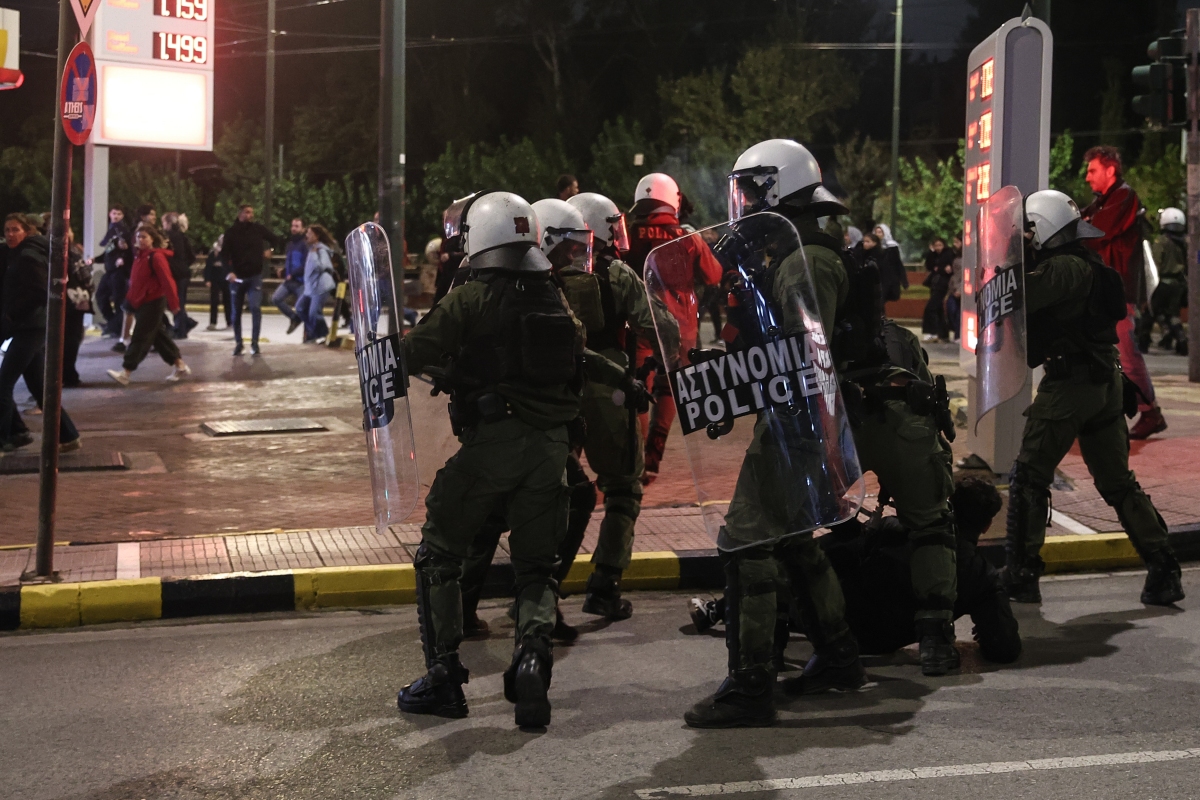
The report, published today under the title ‘Protests are not battlefields: Patterns of unlawful use of force by police and impunity in Greece’, finds that ‘these deeply disturbing abuses are underpinned by a protest law that fails to comply with international and regional standards, as well as by a persistent culture of impunity for abuses by law enforcement officials policing assemblies’.
Amnesty International has documented and raised concerns about the policing of protests in Greece for many years, including in reports published in 2021 and 2012.
‘The right to freedom of peaceful assembly in Greece is being flagrantly violated both in law and in practice, with peaceful protesters arbitrarily deprived of their liberty, criminalised and subjected to unlawful use of force at the hands of the police,’ said Kondylia Gogou, Amnesty International’s regional researcher for Europe.
She added: ‘The audiovisual material and testimonies we have documented reveal a pattern of dangerous use of stun grenades and misuse of batons and other less lethal weapons, which have caused a range of injuries, while journalists have also been targeted. These tactics, combined with widespread impunity for police violations, have a chilling effect on the exercise of the right to peaceful assembly.’
The research was presented on 4 June at the Journalists’ Union of Athens Daily Newspapers (ESIEA). In an article published today in EU Observer and ThePressProject, Amnesty International’s regional researcher for Europe explains why stun grenades have no place in the policing of protests.
‘Unlawful use of force and a culture of impunity’
According to Amnesty International, the report is based on two years of research and interviews with more than 100 protesters, journalists, lawyers and others, as well as extensive verification of audiovisual material and analysis of several different demonstrations. It reveals a persistent pattern of unnecessary or excessive use of force by police during protests.
Of the 67 people interviewed in relation to the unlawful use of force in the policing of protests, 30 described how police threw stun grenades directly at peaceful protesters, photojournalists and journalists, over their heads or at their feet, and/or into dense crowds.
Photojournalist Marios Lolos suffered hearing loss and a head injury when he was hit by a stun grenade thrown by a police officer on 26 January 2025, while covering a demonstration over the Tempi railway tragedy.
He told Amnesty International: ‘I was holding my camera and it was obvious that I was a photojournalist. I believe the riot police officer deliberately threw the stun grenade at me… It hit me on the left side (of my head) and exploded next to me. If it had exploded on my head and not shortly afterwards, we wouldn’t be talking to each other right now […]’.
Video verified by Amnesty International confirms Lolos’s testimony and suggests that the police officer deliberately targeted him.
In May 2022, student Giorgos Mavros suffered a ruptured eardrum, hearing loss, and wounds and burns to his right hand, arm and shoulder when police used stun grenades during a peaceful student protest in Thessaloniki. Mavros said: ‘It was like being hit by a large iron bar’.
Verified video shows police unlawfully using stun grenades next to a cafe where people were sitting after the dispersal of a demonstration in Athens in October 2025, with bystanders affected by the chaos.
The report also documents the unlawful use of batons, including incidents in which police officers beat peaceful protesters, chased protesters in so-called ‘baton charges’ and beat people who had already been brought under police control.
In addition, Amnesty International documented a series of incidents involving the misuse of chemical irritants and water cannon vehicles, unlawful use of force during arrest and/or detention, and unlawful use of force by motorcycle police units.
Anastasia Politi, an actor and theatre director, described to Amnesty International how two police officers on a motorcycle, one of them holding a baton, drove into a crowd taking part in a demonstration in solidarity with Palestinians on 7 October 2025.
‘I managed to get on to the pavement at the last minute so the motorbike wouldn’t run me over… and yet I felt the motorbike scrape past me and at the same time a very strong blow to my back,’ she said. She described how she ‘hit the ground like a watermelon’, resulting in a broken arm, a broken rib, mild brain injuries and injuries to her left knee and shin.
As Amnesty International has documented, victims of unlawful use of force by police often struggle to obtain justice. Incomplete disciplinary investigations, criminal investigations that fail to identify perpetrators, some court decisions that risk legitimising unlawful use of force, and the failure of public order units to wear visible identification all obstruct accountability.
At the same time, Greece’s police oversight mechanism, the National Mechanism for the Investigation of Incidents of Arbitrariness (EMIDIPA), lacks sufficient staff and resources to conduct more investigations of its own.
‘Broad police powers, draconian tactics and restrictive laws’
At the same time, Amnesty International said, ‘the use of overly broad police powers, which allow the police to stop protesters and take them to police stations for identity checks, has led to people being prevented from participating in demonstrations, often without reasonable suspicion that an offence has been committed’.
Protesters, journalists and lawyers who spoke to Amnesty International were subjected to arbitrary deprivation of liberty and described unnecessary and/or degrading body searches, unlawful use of force during their arrest and/or detention, and denial of medical assistance. They also reported that police failed to ensure their right to notify someone outside the detention facility, or to provide them with food.
Annie Paparoussou, a lawyer who provided legal assistance to peaceful protesters, and Marina Meintani, a journalist covering a demonstration, were both deprived of their liberty by police under the pretext of being taken in for identity checks. Both spoke of the unlawful nature of their detention, while Meintani also described the humiliation she suffered when police subjected her to a partial strip search.
The report also highlights the criminalisation of peaceful protesters, including people charged simply for participating in demonstrations or for acts of civil disobedience. Amnesty International documented the arrest of two of its own activists after the dispersal of a demonstration in Athens in 2022, during which they said they were subjected to unnecessary and abusive use of force by police.
Greek legislation governing demonstrations is not in line with international and regional human rights law, or with Greece’s obligations under international treaties to which it is a party. Nevertheless, Greek authorities have made efforts to further restrict the right to freedom of peaceful assembly, including through a 2025 legislative provision introducing a general ban on demonstrations in parts of Syntagma Square.
‘Participating in or covering peaceful protests should not force people to pass through a dangerous “corridor” or put their lives and physical integrity at risk. The Greek authorities must urgently reform the law on protests, end abusive police practices, protect those exercising their rights and break the cycle of impunity that has allowed these violations to continue,’ Gogou said.
‘The Greek authorities must also put an end to the disturbing pattern of unlawful use of force by police against protesters and journalists and ban the use of stun grenades in the policing of assemblies. Military-style devices have no place in the policing of demonstrations, neither in Greece nor anywhere else in the world.’
According to the NGO Greek Helsinki Monitor, prosecutors investigated 181 cases involving human rights violations and other serious offences by law enforcement officials between 2019 and November 2025, yet there were only seven convictions. Of the 60 cases investigated over allegations of torture by law enforcement officials during the same period, only four were brought to trial and there was just one conviction.
Amnesty International and civil society organisations participating in the Torture-Free Trade Network are calling on governments around the world to promote a Torture-Free Trade Treaty within the framework of the United Nations, with the aim of regulating the trade in policing equipment.
______________________________________________
Are you seeking news from Greece presented from a progressive, non-mainstream perspective? Subscribe monthly or annually to support TPP International in delivering independent reporting in English. Don’t let Greek progressive voices fade.
Make sure to reference “TPP International” and your order number as the reason for payment.