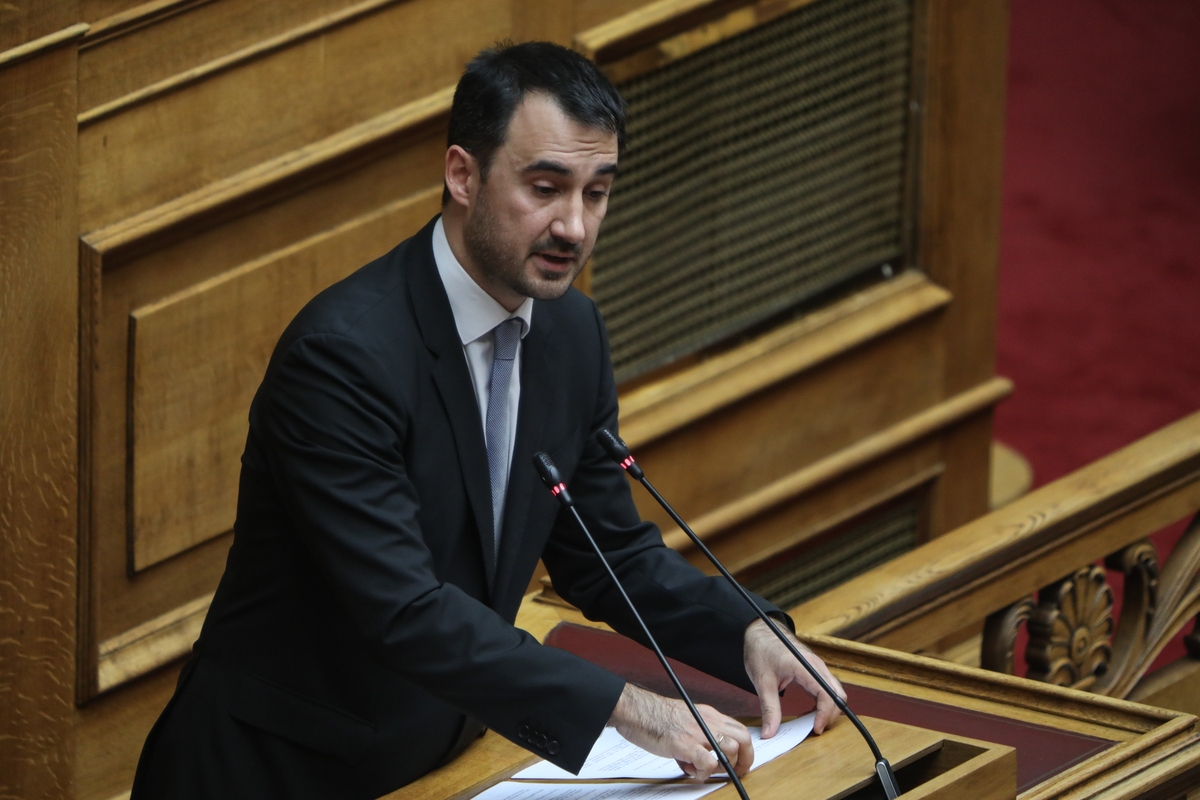
The independent MP for Messinia said that behind the investment’s designation as ‘strategic’, an extensive real estate development may be concealed, since 248 residences are planned against just 140 hotel rooms. This, he noted, raises the question of whether the project is genuinely tourism development or an exploitation of the favourable procedures of the fast-track regime.
He also voiced concern that the government is promoting special building conditions, accelerated licensing and possible facilitation of access to the shoreline before the necessary spatial-planning procedures are complete and without meaningful consultation with the local community.
Charitsis further argued that the plans made public so far appear to depart from the basic urban-planning principles adopted after the 1986 earthquakes, which emphasised public spaces, free access to the coastal front and limits on building. He also raised the question of whether this investment process affects or pre-empts the Special Urban Plan of Kalamata currently under way.
Finally, he pointed to the participation of Israeli capital in the investment, arguing that the Israeli government’s policy in Gaza and allegations of violations of international law should have led to a review of relations and cooperation with the Israeli state.
The full text of Charitsis’s question follows.
Subject: ‘Questions regarding the inclusion of IDM Kalamata’s investment in the strategic investments regime and the implementation of the ESCHASE on the western coastal front of Kalamata.’
IDM Kalamata Single-Member S.A. has submitted a request to include an investment plan worth €136.5 million in the strategic investments regime of Law 4864/2021, for the development of a tourist resort village in the Bournias area of Kalamata. According to the information made public so far, the plan does not only concern a 140-room hotel unit but also includes the construction of 248 residences with accompanying uses, on an area of approximately 205 stremmata on the western coastal front of Kalamata.
In addition, the investment plan is not limited to exploiting a private area through a fast-track licensing process; it is accompanied by a zoning request through a Special Spatial Development Plan for Strategic Investments (ESCHASE), as well as by recourse to the provisions for the concession of use of the seashore and beach.
The provision of 248 residences against a 140-room hotel indicates that this is not simply a tourism investment but the development of a new, integrated residential complex aimed at the international second-home market. This is a model that, though now discredited internationally and considered obsolete, has in recent years been expanding into the country’s coastal areas, where the production and commercial exploitation of real estate is becoming more important than tourism activity itself. In this context, land ceases to be treated as a resource for the city’s development and is turned into an investment product aimed at the international real estate market and wealthy foreign buyers, given that both IDM Kalamata and part of the investment scheme at Kalamata airport are linked to Israeli funds.
The question therefore arises whether the planning earmarked for one of the most important coastal zones of Kalamata serves the needs of the city and its residents, or is instead adapted to the requirements of a second-home market that treats the area primarily as an asset to be exploited. This question is especially important in the case of Kalamata, since the city’s post-earthquake reconstruction was carried out on the basis of an urban-planning model emphasising access to the coastal front, free public spaces and limits on building intensity, directions that the plans published so far appear to circumvent.
In this light, reasonable and pressing questions arise, first of all about the real nature of the investment. When 140 hotel rooms and 248 residences are envisaged, alongside a very limited number of jobs relative to the size of the investment, the impression is created that its main economic pillar is not tourism but the construction and sale of holiday homes, especially when the investing company operates internationally in the real estate sector and specifically in residential complexes (condominiums). And clearly, if these residences are put up for sale, the benefit will accrue exclusively to the investor, while for the local community there will be environmental burden, commitment of land and pressure on infrastructure.
A question of public benefit versus cost therefore arises when the investment ultimately leads to the creation of a new residential complex with a special urban-planning regime (building conditions, land uses) in an undeveloped coastal zone immediately adjacent to the urban fabric of Kalamata. It should be noted that the Greek State has filed approximately 150 lawsuits against owners in the Bournias area, claiming that part of their properties belongs to the State as former shoreline. In short, it becomes crucial to clarify the urban-planning and spatial rationale that justifies the construction of 39,700 sq m and accompanying uses through an ESCHASE, and what the competent services’ assessment is of the long-term effects of this choice on the form, function and character of the Kalamata coastline.
From the outset, the ESCHASE was a choice to prioritise investment planning over democratic spatial planning. Its basic premise was that attracting investment was sufficient reason to produce special urban-planning regimes. Fifteen years on, the consequences of this logic are now visible in many parts of the country: shrinking productive land, the intensification of tourist use and tourist-saturated areas, the expansion of the second-home market and growing pressure on coastal and public spaces.
Messinia is a region with a distinctive productive identity. It has a strong primary sector, internationally exportable agricultural products and significant natural resources. The question therefore arises whether there is any strategic planning for the balance between tourism development, tourist accommodation and the preservation of the region’s productive base, or whether the expansion of such investments is being examined piecemeal, without assessing the cumulative effects on the future character of Messinia. Kalamata, moreover, lies within the Mediterranean basin, a hotspot of the climate crisis, with the effects of high temperatures and extreme weather events already beginning to affect agricultural production, primarily in the very important sector of olive oil production.
In these critical circumstances, coastal development requires particular attention to environmental burden and cannot be based solely on present-day data. Factors such as sea-level rise, coastal erosion and extreme weather events increase the future need for protective works that will further burden the natural coastal environment.
Finally, it should be mentioned that in this case there is also special state treatment for investments linked to Israeli capital, while the genocide committed by the Netanyahu government in Gaza and the complete violation of international law should already, as has happened in other European countries, have led to the imposition of sanctions and the cessation of cooperation between the Greek state and the state of Israel.
Following the above, the Honourable Ministers are asked:
- Will this investment be placed under the strategic investments regime with an ESCHASE, pre-empting matters while the Special Urban Plan (SUP) for Kalamata–Messini–West Mani is still in its initial preparation, a plan being drawn up precisely to provide a comprehensive study of the Kalamata–Messini coastal front and its development in line with sustainable development objectives, taking environmental, economic and social factors into account? It should be noted that public dialogue and consultation have not yet begun, so the social consensus required for developing this area is not yet in place. Has the established case law of the Council of State been taken into account, according to which such an investment is not constitutionally permissible when it conflicts with overarching spatial planning?
- Will the investment be approved in advance, while the Special Spatial Planning Framework for Tourism, which will set guidelines for the area’s tourism development, is still under consultation?
- By what specific public-interest criteria is it judged that this investment, located in an area already covered by urban planning and close to the urban fabric of Kalamata, justifies activating the ESCHASE and creating a special spatial regime?
- Has a request been made, under articles 5 and 6 of Law 4864/2021, for the concession of exclusive or special use of parts of the shoreline, beach, marine area or seabed? What is the exact area, the type of concession, and what auxiliary or accompanying works are envisaged? How will it be ensured that these arrangements do not, directly or indirectly, restrict public access to and use of the coastal front?
- How is the protection of the public interest justified, given the different treatment afforded here compared with the restrictions imposed on thousands of small properties for off-plan construction?
- Of the 39,700 sq m of building area, how much concerns the hotel and how much the 248 residences? Will the 248 residences be able to be transferred independently to private individuals and become separate properties?
- Do you consider the creation of 75 new Annual Work Units cited in the dossier to correspond satisfactorily to an investment of €136.5 million? And what, ultimately, is the estimated added value to the region from this investment, even in narrow economic terms?
- Has a study been conducted, and how has the carrying capacity of Messinia been assessed, regarding the development of complex tourist accommodation and tourist housing? What is the cumulative impact on land use, water resources, infrastructure and the region’s productive base?
- How is this investment’s compatibility assessed with the basic principles of post-earthquake urban planning, as reflected in the Kalamata General Urban Plan?
- Given the extensive tourism development already carried out in many parts of the country, the expansion of the second-home market, the growing pressure on coastal zones and public spaces, and the shift of investment resources from productive activities to the real estate market:
(a) Do you consider that the development of tourist residences, complex tourist accommodation and related forms of tourist real estate still constitutes an independent ‘strategic investment’ justifying special urban-planning regimes, fast-track licensing and other investment privileges?
(b) Does the Government intend to review the existing framework for including tourist residences and complex tourist accommodation under Law 4864/2021, so that the incentives provided and the special spatial arrangements are tied to stricter criteria of public benefit, employment, environmental sustainability and protection of public space?The questioning MP, Alexandros (Alexis) Charitsis.
______________________________________________
Are you seeking news from Greece presented from a progressive, non-mainstream perspective? Subscribe monthly or annually to support TPP International in delivering independent reporting in English. Don’t let Greek progressive voices fade.
Make sure to reference “TPP International” and your order number as the reason for payment.