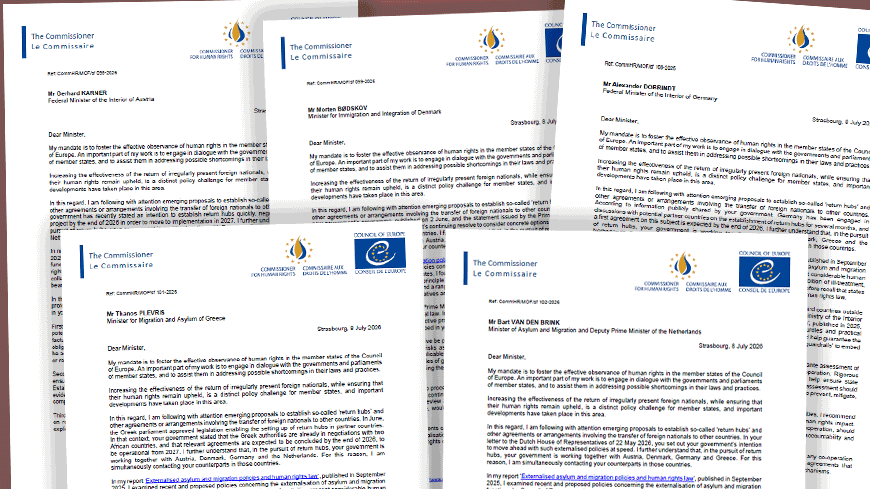
In a letter to Greece and four other countries considering joint initiatives to establish such centres, O’Flaherty proposed four safeguards to protect migrants’ rights.
Greek Migration and Asylum Minister Thanos Plevris responded that any policy adopted by Greece would be implemented in full compliance with European and international law.
In letters published on Monday, O’Flaherty called on the ministers responsible for migration policy in Austria, Denmark, Germany, Greece and the Netherlands to ensure that any plans to create ‘return hubs’ were compatible with international human rights law.
The five governments have expressed their intention to pursue joint initiatives to establish return hubs outside the EU.
Drawing on the findings of a report published in September 2025, in which he warned that transferring people to return hubs would pose significant human rights risks, the commissioner proposed four key safeguards grounded in international law and human rights standards.
First, any initiative to establish return hubs should be preceded by a comprehensive assessment of direct and indirect human rights risks. This should be based on rigorous factual and legal analysis and accompanied by a plan to prevent, mitigate or remedy those risks.
Second, should member states proceed, the hubs should be subject to adequate, independent and continuous human rights monitoring, with robust mechanisms for reviewing and suspending co-operation.
Third, co-operation on return hubs should be based on legally binding agreements containing explicit and enforceable human rights safeguards.
Fourth, parliamentary, public and judicial scrutiny should be guaranteed through the publication of risk assessments, mitigation plans, monitoring findings and relevant agreements.
The commissioner’s letter
‘Dear Minister,
‘My mandate is to promote the effective observance of human rights in the member states of the Council of Europe. An important part of my work involves dialogue with the governments and parliaments of member states, as well as assisting them in addressing possible shortcomings in their legislation and practices.
‘Improving the effectiveness of the return of foreign nationals residing irregularly in a country, while safeguarding their human rights, presents a particular challenge for member states, and there have been significant developments in this area.
‘In this context, I am closely following emerging proposals for the establishment of so-called “return hubs”, as well as other agreements or arrangements providing for the transfer of foreign nationals to third countries. In June, the Greek parliament adopted legislation allowing return hubs to be established in partner countries.
‘Your government has indicated that the Greek authorities are already in negotiations with two African countries and that the relevant agreements are expected to be concluded by the end of 2026, with a view to beginning operations in 2027. I also understand that, as part of efforts to establish return hubs, your government is co-operating with Austria, Denmark, Germany and the Netherlands. I am therefore also addressing your counterparts in those countries.
‘In my report, “Outsourcing asylum and migration policies and human rights law”, published in September 2025, I examined recent and proposed policies concerning the outsourcing of asylum and migration functions by Council of Europe member states.
‘I found that such practices pose significant risks to human rights, including in relation to the principle of non-refoulement, the prohibition of ill-treatment and collective expulsions, arbitrary detention and a wide range of other fundamental rights.
‘I therefore recall that states are responsible for ensuring that such initiatives comply with international human rights law.
‘Through this letter, I would like to draw your attention to several measures that could contribute to the effective protection of human rights. To that end, allow me to propose four key “guardrails” that should be incorporated into the relevant policy and legal frameworks.
‘First, I recommend that any such initiative be preceded by a comprehensive ex ante assessment of the potential direct and indirect human rights risks associated with the proposed co-operation.
‘A rigorous factual and legal analysis, based on applicable human rights standards, would help ensure that states fulfil their obligations and observe the general principles of good administration.
‘This assessment should be accompanied by a risk management and mitigation plan setting out the measures to be taken to prevent, mitigate or remedy any identified violations.
‘Second, should your government decide to pursue such forms of co-operation, I recommend ensuring adequate, independent and continuous monitoring of their actual impact on human rights.
‘The establishment of robust monitoring mechanisms, together with the possibility of suspending co-operation where there are indications of human rights violations, would make an important contribution to accountability and compliance with international obligations.
‘Third, recognising that informal arrangements can increase risks, I recommend that any co-operation relating to return hubs or other forms of externalisation be based on legally binding agreements containing explicit and enforceable human rights safeguards, as well as robust accountability mechanisms.
‘Fourth, to facilitate adequate parliamentary, public and judicial scrutiny, I encourage the public disclosure of the relevant risk assessments, response plans, findings of monitoring mechanisms and co-operation agreements.
‘I remain at your disposal for any further exchange of views you may consider useful.’
Plevris’s response
In a letter transmitted through Greece’s Permanent Representation to the Council of Europe under Ambassador Nikolaos Sigalas, Plevris thanked the commissioner for his comments and said that ‘Greece remains committed to implementing all migration policies in full compliance with its obligations under international and European law’.
The minister wrote:
‘Dear Commissioner,
‘Thank you for your letter of 8 July 2026 and for expressing your views and recommendations regarding the possible establishment of return hubs.
‘I appreciate your continued engagement with issues relating to migration management and the protection of human rights. Greece remains firmly committed to ensuring that all migration policies are implemented in full compliance with its obligations under international and European law.
‘As discussions on the future establishment of return centres progress at European level, Greece considers that any relevant arrangement will be developed and implemented in accordance with the existing legal framework of the European Union, including the forthcoming Return Regulation, as well as the international obligations binding on all participating states. These legal standards will guide both the establishment of the relevant arrangements and their practical operation.
‘At the same time, we consider return centres to be a legitimate policy instrument within an integrated and effective migration management system, intended to facilitate the return of people who have no legal right to remain, with full respect for fundamental rights and the principle of non-refoulement.
‘Thank you again for your valuable comments. My services remain at your disposal should you wish to continue this constructive dialogue on this or any related matter.
‘Yours sincerely,
‘Thanos K Plevris’
______________________________________________
Are you seeking news from Greece presented from a progressive, non-mainstream perspective? Subscribe monthly or annually to support TPP International in delivering independent reporting in English. Don’t let Greek progressive voices fade.
Make sure to reference “TPP International” and your order number as the reason for payment.