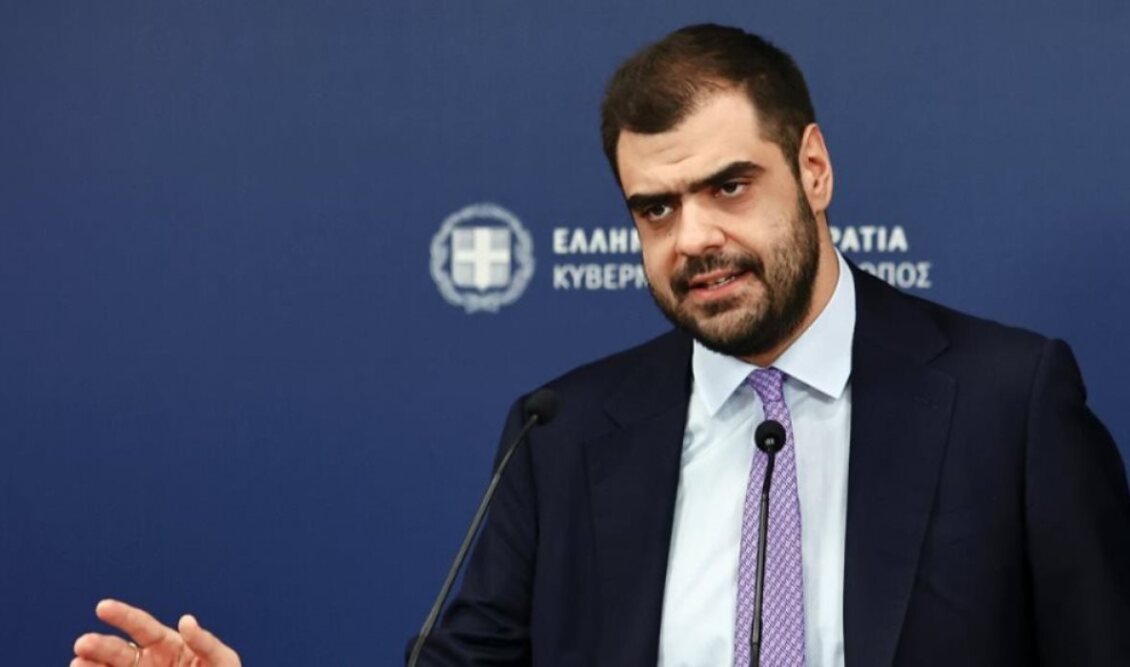
During the regular briefing for political journalists and foreign correspondents, Marinakis was asked to comment on Eurostat’s findings, which show that 50.5% of people in Greece say they cannot afford an unexpected financial expense.
The government spokesperson characterised the survey as subjective because it relies on respondents’ declarations, contrasting its findings with other Eurostat indicators concerning wages, personal consumption and economic growth.
‘This particular survey, without wishing to underestimate it, is subjective. It is not an objective survey based on objective data. It is an opinion survey conducted by Eurostat, which also carries out objective surveys. This particular survey, therefore, is based on the declarations of citizens in each country.’
Marinakis argued that the opposition’s portrayal of the Greek economy failed to reflect the full range of available data, without acknowledging in the same remarks that a significant proportion of the population continues to face financial hardship.
‘It is wrong for the opposition to paint a blanket picture of Greece as ranking last or second to last’, he said, adding that ‘the reality is that, over seven very difficult years marked by crises and wars, we have already made very significant progress towards reaching the European average’.
Marinakis’s remarks in full
‘This particular survey, without wishing to underestimate it, is subjective. It is not, in other words, an objective survey based on objective data. It is an opinion survey conducted by Eurostat, which also carries out objective surveys. This particular survey, therefore, is based on the declarations of citizens in each country. We do not underestimate these findings, but let us look at what the objective surveys and studies by Eurostat, not by any other authority, tell us. They show that it is wrong for the opposition to paint a blanket picture of Greece as ranking last or second to last.
‘However, it would also be an exaggeration to celebrate or portray our country as an ideal place. What is the reality? The reality is that, over seven very difficult years marked by crises and wars, we have already made very significant progress towards reaching the European average.
‘In terms of the minimum wage adjusted for purchasing power, Greece ranks 14th. Neither last nor second to last, and obviously not first. I will provide these tables for your convenience. In terms of the average net wage of employees, Greece ranks 17th. Ten countries rank below Greece. In fact, the figure rose from 11,900 to 21,500, and Greece climbed two places, from 19th to 17th, during very difficult years of crisis.
‘For me, the most important survey concerns personal consumption. Here is a map showing each country’s position relative to the European average. We have moved closer to that average and now stand at 80%. Five countries rank below us on the personal consumption index, which includes all expenditure. There is also the minimum wage calculated over a 12-month period. This table shows that ten countries rank below Greece. This is the reality, based, I repeat, on objective indicators that measure amounts, income, revenue, expenses and expenditure, rather than what people believe.
‘What people believe also matters, but I consider objective data more important. I am not saying this to suggest that we have solved all our problems or that none remain. I want to avoid being misunderstood, because we often see, particularly on certain websites, that we say one thing and it is presented as something entirely different, with misleading headlines. I am saying this because this is the reality, and it is the result of policies that have helped Greece progress through very difficult years. In recent years, Greece has been growing at twice the European average.
‘I remind you that in 2019 Greece ranked 27th in terms of growth, at the bottom of Europe. Greece now has 600,000 more jobs, while investment has increased by 95%, compared with 5% across Europe over the same seven-year period. So more investment has come in, exports have increased, jobs have been created and tax revenues have risen, even as taxes have been reduced. This is how we are approaching the European average.
‘Obviously, we must continue working to improve the situation further, because many of our fellow citizens are still going through difficult times.’
Greek Left Alliance: ‘Millions see their wages disappear before the end of the month’
The government’s position drew criticism from Eugenia Fotoniata, head of political planning at the Greek Left Alliance (EL.A.S), who argued that discussions about economic indicators cannot be separated from people’s actual living conditions.
‘Mr Marinakis can question European indicators. But he cannot question the daily reality of millions of citizens who see their wages disappear before the end of the month.
‘Seven years of the government’s “success story”, and Greece ranks among the worst in Europe in areas where it should be performing best.
‘The official figures are revealing.
‘Poverty: 27.5% of the population is at risk of poverty or social exclusion, compared with 20.9% across the EU. Greece has the second-worst record.
‘Housing: Greece ranks first in the EU for excessive housing costs. Some 26.4% of the population lives in households where housing expenses exceed 40% of disposable income, compared with just 7.7% across the EU.
‘Energy poverty: Greece also ranks first in the EU for the inability to keep homes adequately heated. Some 18.1% of the population cannot keep their homes sufficiently warm, compared with 8.8% across the EU.
‘Real wages: According to European Commission forecasts, real wages in Greece will remain below their 2019 levels even in 2026, while across the EU they will already have surpassed those levels.
‘This is the development delivered by the Mitsotakis government. Leading Europe in housing and energy poverty, while lagging behind in workers’ purchasing power.
‘The problem is not that Eurostat is measuring things incorrectly. It is that government policy is distributing the fruits of economic growth unfairly.
‘The Greek Left Alliance is not content merely to identify inequalities. We are fighting for an economy in which work is fairly rewarded and economic growth genuinely improves the lives of the social majority.
‘Our proposals are specific:
-
A minimum wage of €1,000 by 2027.
-
An average full-time wage of €1,800 by the end of the four-year term.
-
Strong collective bargaining agreements, substantial pay rises and the restoration of workers’ bargaining power.
-
Abolition of the 13-hour working day and meaningful protection of working hours.
-
Affordable housing and cheaper energy to deliver a genuine increase in purchasing power.
‘Labour creates wealth. New Democracy cannot celebrate its growth while workers continue to lose out on its distribution.’
______________________________________________
Are you seeking news from Greece presented from a progressive, non-mainstream perspective? Subscribe monthly or annually to support TPP International in delivering independent reporting in English. Don’t let Greek progressive voices fade.
Make sure to reference “TPP International” and your order number as the reason for payment.