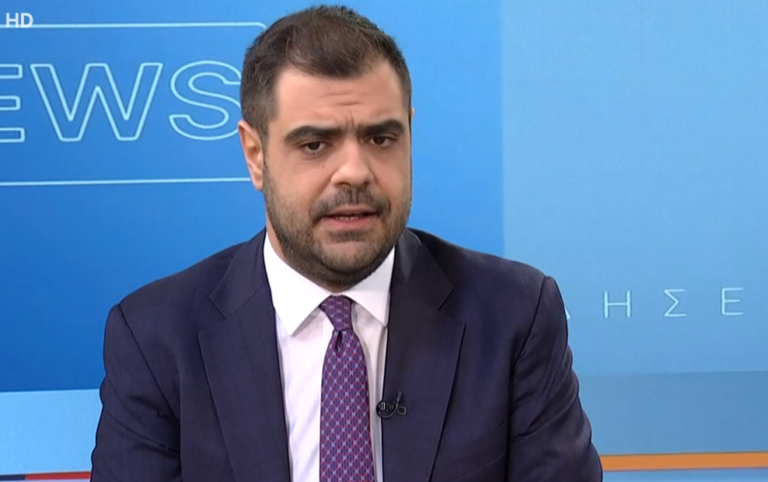
Speaking to OPEN, Marinakis argued that PASOK’s decision to back Akrita stood in clear contradiction to the position it had taken a few months earlier towards Yannis Stournaras, whose candidacy it had not supported.
The government spokesman linked the issue to the political crisis that began in 2010, when austerity measures were imposed and new political dividing lines emerged.
He argued that a distinction must be drawn between those who took part in protests in Athens’ upper and lower Syntagma squares, ‘called for gallows’, spoke of betrayal and used extreme language, placing Akrita in this category, particularly over her online activity, and those who, despite mistakes made in the past, wanted Greece to remain in Europe.
Marinakis said Greece’s continued membership of Europe was not a ‘fetish’, but an essential condition for the country to have access to medicines, vaccines, the Recovery Fund, preventive health tests and civil protection resources, and to become, as he put it, ‘a normal country’.
He added that Greece remained in Europe because, following what he described as Alexis Tsipras’s ‘U-turn’, MPs from New Democracy and PASOK voted in favour of the country remaining in the European framework, with Stournaras among the most prominent figures in that effort.
Attack on Androulakis over PASOK’s stance
Turning his criticism directly on Androulakis, Marinakis argued that PASOK had become a party aligned with those who had wanted Greece to leave Europe and who had branded PASOK officials ‘traitors’ and ‘German sympathisers’.
He also rejected statements by PASOK spokesman Kostas Tsoukalas, describing them as ‘two big lies’.
The first, he said, concerned the claim that the government had ‘celebrated’ votes from the Spartans. Marinakis argued that the government had stated explicitly, ‘word for word’, that such votes were not welcome.
He also noted that the current government had legislated to allow the Supreme Court to rule on cases involving a criminal organisation or a concealed political leader.
The second and, according to Marinakis, more serious falsehood concerned PASOK’s claim that, as a matter of institutional practice, it supports all parties’ nominees for deputy speaker, with the exception of far-right or Nazi candidates.
As a counter-example, Marinakis cited the candidacy of Michalis Hourdakis, who had been nominated by Zoe Konstantopoulou.
He noted that, of PASOK’s 32 MPs at the time, 24 had not voted for Hourdakis, even though, as Marinakis pointed out, he was not far right and later joined PASOK.
Marinakis called on PASOK to provide an explanation, accusing it of ‘making fun of the people’.
Criticism of PASOK’s private debt proposals
Turning to PASOK’s proposals on private debt, Marinakis cited an official Finance Ministry response which, he said, refuted the main opposition party’s proposals point by point.
After saying that no one disagreed in principle with supporting vulnerable borrowers, he said that, according to figures available up to the end of May, the government had already overseen 62,600 debt settlements worth a total of €20bn.
He argued that PASOK was either proposing measures that were already in force or disregarding European rules.
On protection of the primary residence, Marinakis said this had been in place since 21 September under government legislation, as borrowers entering the out-of-court debt settlement mechanism are protected.
On PASOK’s call for repayment plans of up to 120 instalments, he said 72-instalment schemes had already been introduced, while the out-of-court mechanism allows for up to 240 instalments.
Regarding PASOK’s proposal to allow borrowers to buy back their loan before it is sold to investment funds, Marinakis argued that this disregarded established European insolvency rules, referring again to the Finance Ministry’s response.
He also said the party’s proposal on Swiss franc loans ignored borrowers who had continued to meet their repayment obligations, arguing that those borrowers should receive the greatest possible support.
On making participation in the out-of-court mechanism mandatory, Marinakis said this had already been legislated under Law 5072/2023, requiring servicers to make proposals through the mechanism that can lead to protection of a borrower’s primary residence.
He further argued that the Mitsotakis government, through legislation introduced by Kostis Hatzidakis and Finance Minister Kyriakos Pierrakakis, had widened eligibility criteria, increased tax-free and protected thresholds and legislated for the lifting of account freezes once 25% of a debt had been paid.
Marinakis concluded that what he described as irresponsible promises to grant loans or write off debts without calculating the cost recalled policies which, according to him, led to the bailout memoranda, the loss of GDP, cuts to pensions and wages and the tax burden associated with the Katrougalos-Tsipras law.
Criminal Code, violence against women and attack on Tsipras
In the final part of his remarks, Marinakis turned to Alexis Tsipras, accusing the former prime minister of irresponsibility both on the economy and on sensitive social issues.
Responding to criticism from Tsipras’s political camp over femicide and sexual offences, Marinakis pointed to measures introduced by the government during its seven years in office.
He cited the creation of 63 specialised domestic violence offices, which he said had not previously existed, the operation of 20 shelters across Greece for women and children, the introduction of the Panic Button and the operation of the SOS helpline.
He also referred to officials of the Hellenic Police, making specific mention of Ms Koufanikolako, and criticised Tsipras over the Criminal Code introduced in 2019.
Marinakis argued that the Code made it possible for people convicted of murder, including femicide, to receive lighter sentences.
He also said that SYRIZA had reduced the minimum sentence for human trafficking, loosened the sentencing framework for sexual offences including incest and lowered the maximum prison sentence for serious felonies from 20 to 15 years.
The government spokesman said the current government had restored all these provisions ‘in the strictest possible way’ in 2026.
He added that the government would not allow Tsipras to ‘rewrite history’, although he said that comparing the current government with Tsipras set ‘the bar very low’.
Finally, Marinakis referred to opinion polls which currently show Tsipras ahead of PASOK in second place. He stressed, however, that the final political balance and the question of who comes second in an election would be decided solely by voters at the ballot box.
______________________________________________
Are you seeking news from Greece presented from a progressive, non-mainstream perspective? Subscribe monthly or annually to support TPP International in delivering independent reporting in English. Don’t let Greek progressive voices fade.
Make sure to reference “TPP International” and your order number as the reason for payment.