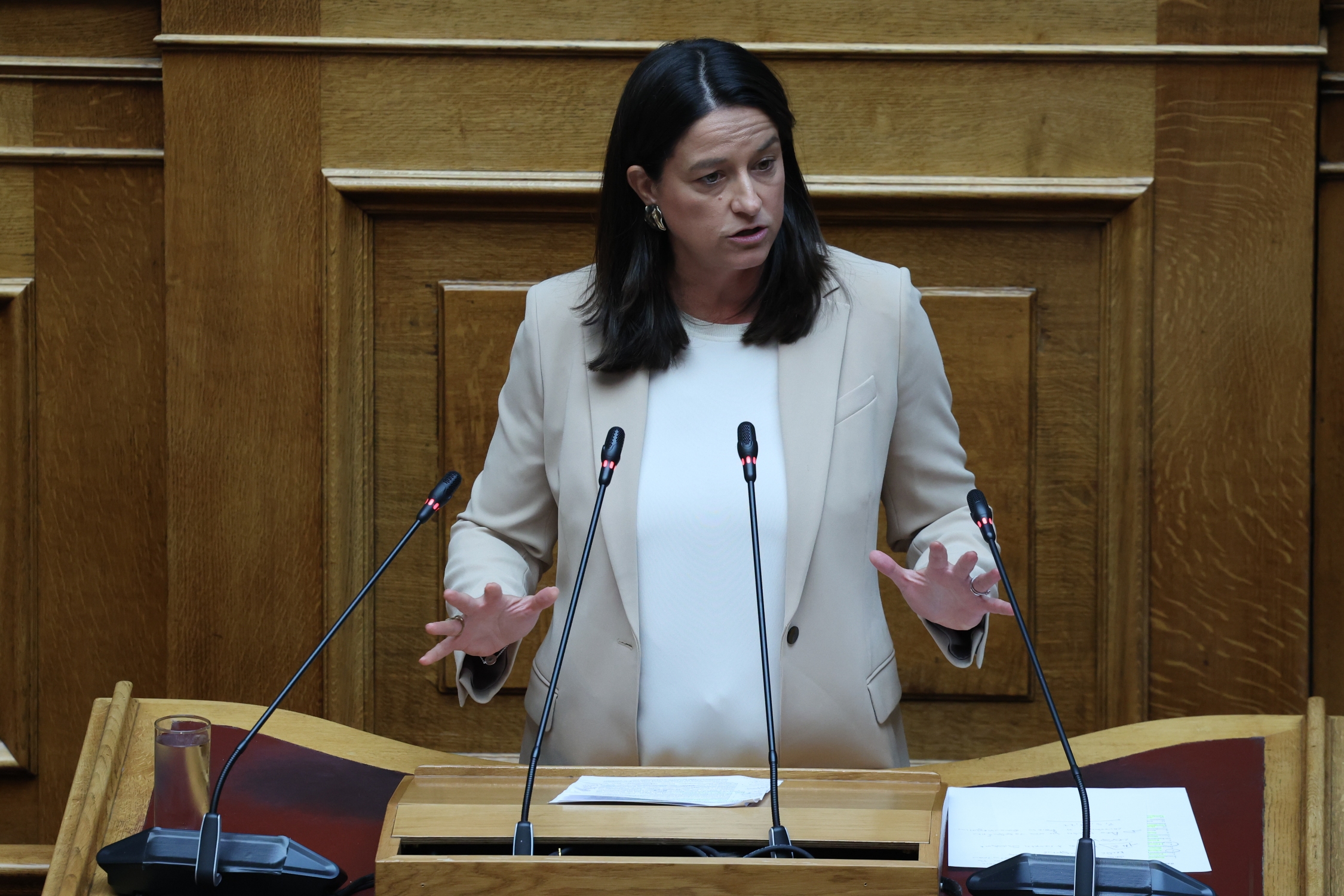
Regarding the inclusion of nurses, nursing assistants, drivers and ambulance rescue assistants in the heavy and unhealthy occupations category, Kerameos said: ‘It is an important regulation, which comes to support a sector which is objectively very difficult. It is a difficult profession and we want to strengthen it. You also heard the Prime Minister the other day, who said that we will bring a set of overall regulations for nurses, and this is a regulation which comes to strengthen a very important and critical profession, which we must strengthen and stand by.’
Regarding the Council of State decision concerning widows’ pensions, Kerameos categorically ruled out the possibility of any cuts, saying: ‘We are awaiting the Council of State decision. It has not yet been served on us. There is a summary. We will examine the issue as a whole and legislate, if necessary, but there will be no cuts to widows’ pensions. I want to be blunt, so that we can close the issue completely.’
She also said that the Ministry of Labour and Social Security is preparing a bill on equal pay between women and men for equal work, which is expected to be presented to the cabinet next week.
‘The issue of equal pay is an issue for all of Europe, not just for Greece, as, although there has been significant improvement, the reality is that there are still wage discrepancies. There are cases where a woman is paid 12%–13% less than a man for exactly the same job and with the same qualifications,’ she said.
‘This is unthinkable,’ the minister commented, arguing that for this reason ‘we are bringing a bill that places further obligations on salary transparency, before hiring, but also afterwards’.
According to Kerameos, ‘the bill will provide that all job advertisements must be gender neutral, that the employer must announce before the interview either the salary range or the exact salary, for reasons of salary transparency. In addition, it will be prohibited to ask the candidate what their earnings have been to date.’
She explained that after hiring, the bill will provide that ‘if there is a suspicion of inequality in remuneration, the employee will have the right to request further information regarding their own earnings and regarding the earnings of a similar category of employees.’
The minister added that for there to be a difference in pay, there must be an objective reason, such as greater experience, special skills or special qualifications.
‘So, if there is no justification for the deviation and if this deviation is more than 5%, the Ombudsman will come first and the Labour Inspectorate will then come to make a recommendation and impose a sanction,’ Kerameos explained.
She also noted that the law concerns both men and women, while adding that in Greece, wage inequalities are recorded among older workers with more experience.
______________________________________________
Are you seeking news from Greece presented from a progressive, non-mainstream perspective? Subscribe monthly or annually to support TPP International in delivering independent reporting in English. Don’t let Greek progressive voices fade.
Make sure to reference “TPP International” and your order number as the reason for payment.