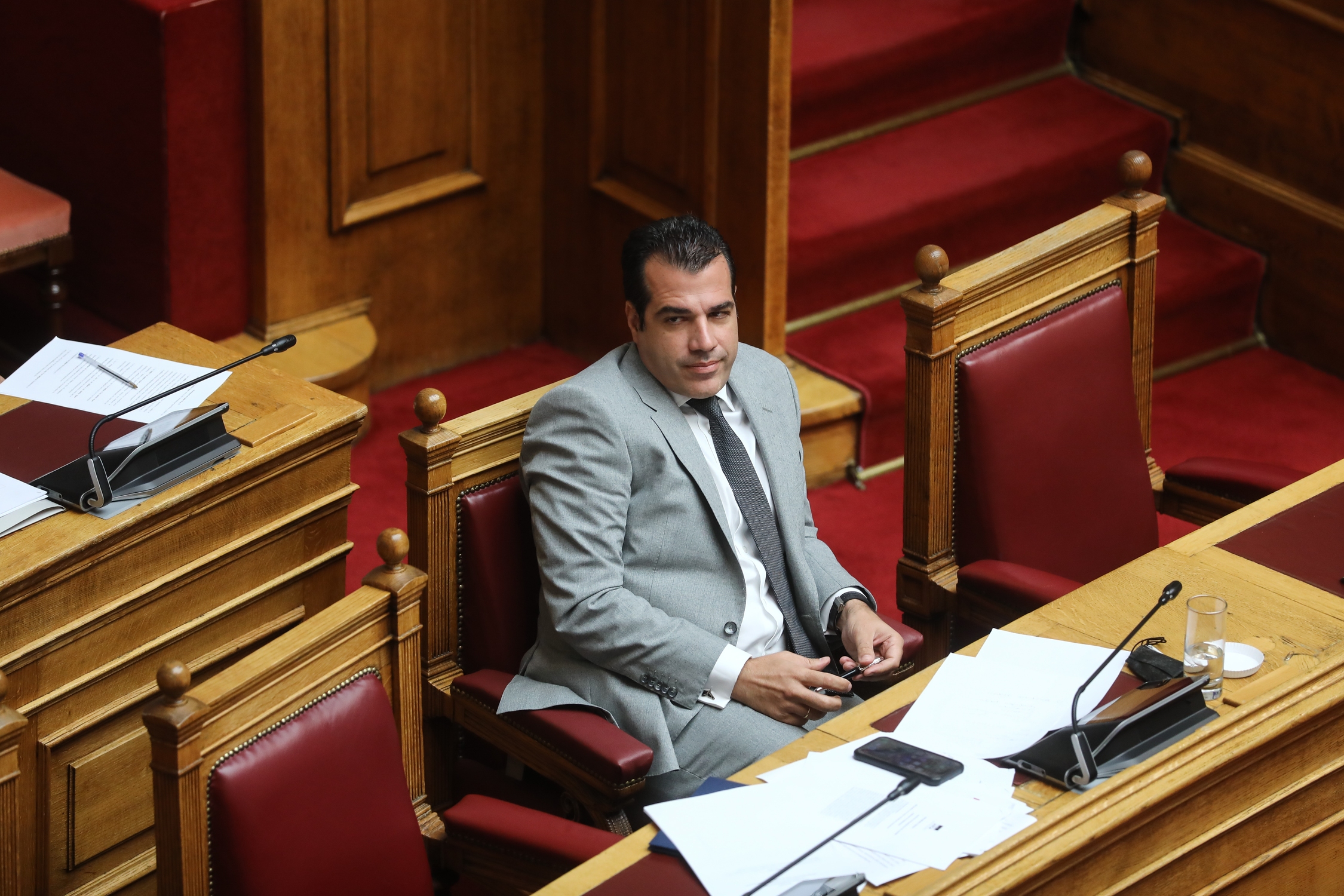
Plevris said he had known Theodoropoulos since 2012 through their participation in the Hellenic Medico-Legal Council, but maintained that their acquaintance at the time was limited to the association and that his personal contact with the doctor, as a patient, began in 2016.
His response followed a PASOK statement claiming that Plevris and the two doctors linked to the case concerning the death of Giorgos Mazonakis were among the founding members of the Hellenic Medico-Legal Council in 2012. The party cited documents which it said showed that Plevris had known the doctors earlier than he had initially indicated.
According to PASOK, Plevris had previously said that he contacted the two doctors for nutritional advice following a personal health problem and subsequently remained in touch with them.
‘Since then, as he has publicly stated, he had remained in contact and, on the day of the tragic incident, called the doctor to find out what had happened,’ PASOK said.
The party, however, claimed that Plevris’s acquaintance with the two doctors went back considerably further, to 2012, when, according to its statement, they were founding members of the Hellenic Medico-Legal Council.
PASOK said that Plevris and the two accused doctors appeared as three of the five members of the association’s provisional administration, which jointly applied to the Athens Single-Member Court of First Instance for approval of its statute, dated 3 June 2012.
PASOK called on Plevris to explain when he first became acquainted with the two doctors and whether he was aware of their activities.
‘The minister must explain why he lied about when he first became acquainted with them and whether he knew that the two doctors were carrying out illegal medical procedures. The case is extremely serious and the questions that arise demand answers,’ the party said.
Speaking to Meganews 104.6 radio, Plevris rejected the suggestion that their involvement in the same association constituted professional collaboration.
‘There was no collaboration with Theodoropoulos. Besides, the association never operated,’ he said. Asked about the issue again, he responded: ‘What collaboration are you talking about? There was no collaboration.’
Plevris said the association consisted of doctors and lawyers and dealt with medico-legal issues. He described it as a group with numerous members which ultimately never became operational.
‘It was a medico-legal association. I tried to explain that I had a personal relationship [with Theodoropoulos] and called him to find out what had happened. Since I revealed that I had been to his clinic, why would I hide the fact that we were both in an association? My main relationship with him was that he had been my doctor,’ he said.
Addressing PASOK, he added: ‘Why doesn’t PASOK release all the names of the association’s members?’
Plevris also argued that the appearance of his name in the association’s documents did not mean that its members had personal or professional relationships with one another. The fact that the association dealt with medical and legal matters, he said, did not mean that its approximately 22 members were friends or associates.
He linked his participation to his professional interest in medical law, saying that at the time he was not a career politician and had also been academically involved in the field. He said he holds a doctorate in medical law and has written books on bioethics and medical liability.
Plevris also described the capacity in which he knew Theodoropoulos.
‘This particular doctor is a pathologist. I knew him as a pathologist with further training in haematology,’ he said, adding that he had not visited him in his capacity as health minister.
Asked how many times he had met Theodoropoulos while serving as health minister, Plevris said he had never visited his office in that capacity.
He also spoke at length about his personal relationship with the doctor, which he linked to a health problem he had experienced.
‘Whatever medical advice Theodoropoulos gave me was correct. I sent him my test results when I was dealing with the health problem. He did not suggest that kind of treatment [such as the treatment given to Mazonakis],’ he said.
Plevris said Theodoropoulos had recommended complementary preparations which did not replace the treatment prescribed by his other doctors.
‘The doctors gave me treatment. Because some of my organs were under strain, Theodoropoulos suggested certain supplements, for example milk thistle and magnesium… Are these quack remedies? He never told me to stop my treatment. He did not take any money from me. I made one visit,’ he said.
Referring to treatments reported in connection with the Mazonakis case, Plevris said he had neither received nor been made aware of any such recommendation from Theodoropoulos.
‘He did not suggest treatments such as plasmapheresis to me, and I would not have undergone them,’ he said. ‘I was not aware that such treatments were being carried out, nor did he ever suggest anything like that to me.’
Plevris also addressed his attempt to contact Theodoropoulos by telephone after news emerged of Giorgos Mazonakis’s death.
He said he called because he knew the doctor and because there had previously been a doctor-patient relationship between them.
‘I came forward to say something very simple, even though there was nothing against me. I wanted to explain that I had also spoken to him that day and why I had spoken to him. Because I know him,’ he said.
Asked why he had chosen to call Theodoropoulos specifically, Plevris said he was interested in what had happened and in the doctor’s situation. He maintained that the call was made before charges had been brought against him.
‘Obviously, if you call someone, it means you know them, that you have some connection and that you are interested,’ he said, while stressing that he was not describing a friendship.
He said Theodoropoulos was not someone with whom he maintained a close personal relationship, but someone he knew and had remained in contact with because he had previously been his doctor.
Plevris said their communication was not regular.
‘I was in contact with him, but not regularly. I would contact him during the holidays. He never asked me for any favour when I was health minister. In general, he never asked me for anything,’ he said.
On the question of when he first met Theodoropoulos, Plevris argued that there was no contradiction between his reference to 2012 and his earlier reference to 2016.
______________________________________________
Are you seeking news from Greece presented from a progressive, non-mainstream perspective? Subscribe monthly or annually to support TPP International in delivering independent reporting in English. Don’t let Greek progressive voices fade.
Make sure to reference “TPP International” and your order number as the reason for payment.