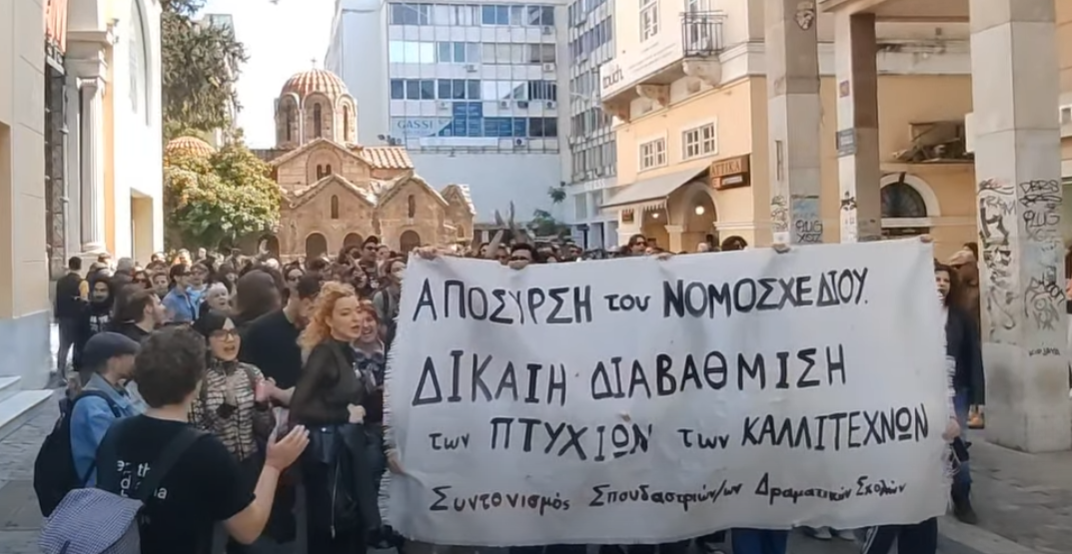
The public consultation on the bill for the Higher School of Performing Arts concluded on 10 March. On the same day, students from drama schools staged a protest in central Athens, while hundreds of theatre artists had already sent an open letter to the Ministry of Education.
In a statement, the Greek Actors’ Union said that the demands of working artists and students are ‘night and day away from the government’s bill’. It stressed that, although the creation of a Higher School of Performing Arts has long been a standing demand of the sector, and although the struggle against Presidential Decree 85/2022 was vindicated by the Council of State, the specific bill contains so many problematic provisions that it effectively cancels out the demands it claims to address. For that reason, the union and other bodies are calling for its withdrawal and resubmission after meaningful consultation.
The Ministry of Education said during the consultation process that the proposed bill seeks to establish a Higher School of Performing Arts, create a new branch of artistic education, and define the operating framework for higher schools of artistic and music education.
Kyriakos Mitsotakis pledged in 2023 to establish the Higher School of Performing Arts, under pressure from large-scale mobilisations in the sector against Presidential Decree 85/2022. The reference to a new branch of artistic education also comes after the Council of State ruled, a few months ago, that the presidential decree was unconstitutional.
According to repeated interventions by artists, students and the Greek Actors’ Union, however, the bill contains a series of provisions that hollow out the demands it is supposedly meant to satisfy.
Demonstration and open letter
Students from drama schools who demonstrated in central Athens demanded the withdrawal of the bill, the resumption of substantive negotiations, fair grading of artists’ qualifications and the implementation of Article 16. They are preparing new assemblies and mobilisations in order to escalate their struggle.
In their open letter, more than 470 theatre artists recalled that their two core demands were the grading of studies at Higher Schools of Dramatic Art and the establishment of a Higher School of Performing Arts.
They noted that the plenary ruling of the Council of State vindicated the reactions of the artistic world to Presidential Decree 85/2022, finding that the omission from the qualifications register of a special category for graduates of Higher Schools of Artistic Education violated constitutional provisions.
While welcoming the ministry’s initiative in principle, they stressed that the bill in its current form needs major revision and called for its withdrawal and for a new round of substantive consultation involving the Ministry of Education, the Ministry of Culture, the National Theatre, the State Theatre of Northern Greece and all representative bodies of the theatre community.
The main objections raised by the sector
According to the signatories, the bill effectively abolishes two historic public drama schools, those of the National Theatre, founded in 1930, and the State Theatre of Northern Greece, founded in 1973. The demand of the theatre community, they said, was for the creation of new university departments focused on theatre practice, not for the absorption of existing state drama schools into newly established departments. What they had called for was the upgrading of the state drama schools and their connection with the new university departments.
They also argue that retaining the names ‘National Theatre’ and ‘State Theatre of Northern Greece’ for the new departments is misleading, since the draft law provides for no meaningful connection with the two institutions beyond the use of their buildings.
Another major criticism is that the proposed school makes no provision for other theatre-related artistic specialisms such as playwriting, translation, dramaturgy, set design, costume design and lighting.
The artists also object to the provisions governing the selection of teaching staff, arguing that they exclude almost all active theatre practitioners from election to faculty posts. They say academic qualifications are being prioritised over artistic work, without regard for the particular nature of theatre teaching, and insist that active artists from all specialisms must be able to serve as faculty members, since they help shape the identity of a university department.
They further argue that the bill devalues artistic education qualifications that the Greek state has been awarding for decades. Degrees from Higher Schools of Dramatic Art are not recognised as qualifications for faculty selection, except for a limited transitional four-year period and even then under a quota of up to 30 per cent. Teaching experience in Higher Schools of Dramatic Art, where many active artists have taught for years, is also not recognised as prior service.
The provision for Special Artistic Personnel, selected on the basis of artistic work, is described as positive in principle. However, the quota is considered far too small in relation to elected faculty members, at up to 20 per cent, or exceptionally 40 per cent for the first four years.
The signatories also say the bill excludes hundreds of graduates of Higher Schools of Dramatic Art from continuing their studies in the new university departments, since it allows for the admission of only a very small number of candidates, just 15 per cent of each department’s intake. They also criticise the recognition of only two years of prior study, which would place successful candidates in the third year rather than the fourth.
Particular concern is also expressed over the proposed new category of public sector posts under ‘Artistic Education’. While the creation of such a category is seen as positive, classifying Higher Schools of Artistic Education at level five of the National Qualifications Framework is described as deeply problematic because it equates two-year post-secondary studies with three-year studies at art schools.
Greek Actors’ Union: ‘We had no illusions’
The Greek Actors’ Union said it had ‘no illusions’ that the bill would be far removed from the needs of artists and society for higher-level artistic studies.
It argued that the government, like its predecessors, had prepared a so-called university model that runs in the opposite direction to the demands formulated by artists during the mass mobilisations against Presidential Decree 85/2022.
The union said the draft law reproduces fragmented degrees and professional rights, lifelong learning, credit points and tuition fees, at a moment when the debate on revising Article 16 has reopened. It noted that student associations and major student mobilisations have long opposed precisely these features, which the government now seeks to extend into artistic education.
Among its specific objections, the union says the government is presenting the merger of five schools, including the drama schools of the National Theatre and the State Theatre of Northern Greece, as a Higher School of Performing Arts without making any provision for their upgrading or real unification. It points out that there is no mention of buildings, curricula or student numbers, and says these issues are being left deliberately vague, revealing the real degradation that the so-called higher school would bring.
It also warns that private drama schools are being downgraded through their classification at level five, alongside vocational training institutes, while even the minimal curriculum requirements currently in place are being removed.
The union says the bill also leaves the future of the current teaching staff unclear, despite their long experience and contribution to artistic education. It argues that the government is only making use of them for a four-year period, without any indication of what will follow, while beyond the initial years no stable teaching or specialist staff is guaranteed and artistic personnel are explicitly confined to contract work.
For graduates of higher art schools, the union says the bill allows entry into the fifth semester of the new institution for only 15 per cent of candidates, meaning just one or two artists per specialism. It argues that those excluded will instead be funnelled into lifelong learning programmes and programmes run in cooperation with the Hellenic Open University, with tuition fees, turning artists into customers in a market of skills and training.
According to the union, the result will be graduates ‘at different speeds’: a small elite with higher education degrees, while the majority are pushed into paid training schemes. Combined with private drama schools, it says, this will broaden the range of qualifications while driving down rights, salaries and working conditions, turning the bill into a gift to employers.
It also describes the bill as a gift to private education, since preparation for admission to the new institution will be left entirely to private artistic education providers. At the same time, it says art teaching in schools is being further degraded, while art and music schools are being left to fend for themselves.
The union adds that students will have to pay more out of pocket, since the bill contains no provision for welfare, textbooks, transport passes, halls of residence or clubs. It also notes that there is no reference to the right of students to elect collective bodies or to be represented through them in university governing structures.
The union’s demands
The Greek Actors’ Union is calling for the establishment of a Higher School of Performing Arts that is exclusively public and free, with full rights attached to the degree, and with upgraded and unified curricula for each artistic field that guarantee comprehensive theoretical and practical education.
It is also demanding the withdrawal of the current bill, an increase in admissions to meet the needs of both artists and the public, and the right of any graduate of a recognised higher art school to enter the university, which should determine any additional courses required for the completion of studies and the awarding of a higher education degree.
Among its further demands are the inclusion of pedagogical competence in the degree, public and free artistic education at all levels from early childhood to university, a network of public and free art schools under state and school responsibility with permanent staff, modern accessible facilities for all artistic specialisms, permanent recruitment of teaching and support staff, upgraded aesthetic education in primary and secondary schooling, opposition to the abolition of Article 16, and hostels, clubs, passes and textbooks for all students.
______________________________________________
Are you seeking news from Greece presented from a progressive, non-mainstream perspective? Subscribe monthly or annually to support TPP International in delivering independent reporting in English. Don’t let Greek progressive voices fade.
Make sure to reference “TPP International” and your order number as the reason for payment.