Government outlines enforcement plan for under-15 social media ban
The government on Wednesday set out the details of its new framework banning children under 15 from accessing social media, in a press conference led by Health Minister Adonis Georgiadis, Digital Governance and Artificial Intelligence Minister Dimitris Papastergiou, and Minister of State Akis Skertsos at the Ministry of Digital Governance. No representative from the Ministry of Education took part in the presentation.
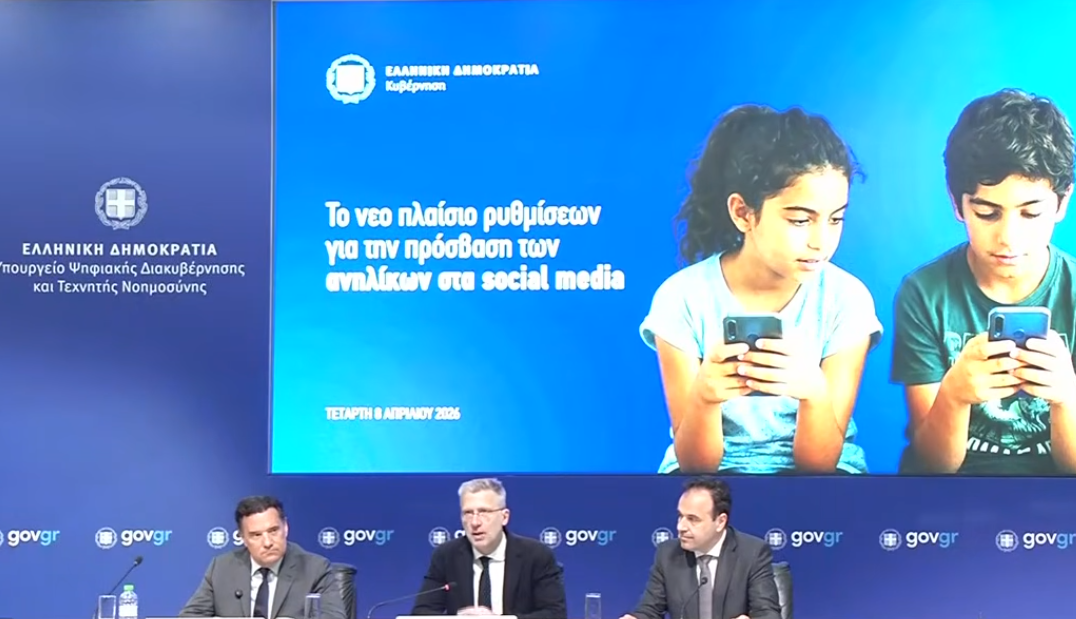
Skertsos said the government still needed to examine sanctions to ensure the framework would be effective once activated, while stressing that the regulation would have to be harmonised at European level.
He said Prime Minister Kyriakos Mitsotakis had sent a letter to European Commission President Ursula von der Leyen calling for a ‘digital alliance of the willing’ to secure a more effective framework for protecting minors from social media use. Greece’s proposal includes the introduction of a European ‘digital age of majority’ set at 15.
Explaining the reasoning behind the new framework, Skertsos said that ‘the way algorithms and the model of modern technology work can be addictive for people who have not completed their psychosocial development’.
‘When the automotive industry started, seat belts were not mandatory. They gradually became mandatory. The same thing is happening in technology. We are not technophobic. We are establishing sensible, safe and reasoned rules,’ he said.
He also said the measure formed part of a broader agenda for the protection of minors, alongside policies on bullying in and outside schools, the panic button for domestic violence, the new framework for controls and sanctions on the sale of alcohol and tobacco to minors, and the digital ticket introduced in response to sports violence and hooliganism.
Skertsos cited Australia as an example, saying it had moved to ban social media entirely for children under 15. ‘Unlimited scrolling is harmful. We need to discuss these things openly, including around the family Easter table. We are also sending a message to the companies. Their profit model treats our children’s mental health as expendable and promotes fake news. We are taking a clear stand against that,’ he said.
Among the measures he listed were the operation of the parco.gov.gr website, the KidsWallet app and the ban on mobile phone use in schools.
Georgiadis said that ‘my sons are in favour of the ban. I can tell you from experience that I am also addicted to scrolling’, adding that ‘we are not restricting freedom, we are taking preventive measures to adapt to the new world’. He also said the government would launch an initiative for a total ban on cannabis sales in kiosks.
Presenting data on minors’ exposure to social media, Georgiadis said that ‘minors under 15 are sexting’, adding to the alarmist tone of the presentation.
Papastergiou said the measure would apply to children born from 2012 onwards, that is, pupils up to the third year of lower secondary school.
Asked about the absence of a representative from the Ministry of Education, he said that Education Minister Sofia Zacharaki was aware of the plan and that there would be inter-ministerial cooperation on both implementation and public information.
He said the ban would come into force on 1 January 2027 and that platforms would be required to introduce age-verification mechanisms. The measure will apply to platforms such as Instagram, TikTok, Facebook and Snapchat, but not to services used solely for private messaging, such as Viber and WhatsApp, raising obvious questions about the limits of the measure.
Papastergiou also said Greece was the first and only country to implement controls on the sale of alcohol and tobacco to minors and described KidsWallet as a Greek-developed age-verification app. According to him, the mechanism does not transmit personal data but merely confirms whether a user is over or under 15.
He added that Ireland, where many of the major platforms are based in Europe, would be notified of possible violations and that the provisions of the European framework would then be triggered.
‘The measure does not restrict access to information or sociability. We want children to live with technology, but to use it reasonably and at an age when they have first developed the ability to defend and regulate themselves,’ he said.
He also urged parents to ensure that children do not simply use their parents’ phones to get around the ban.
None of the speakers adequately explained how the framework would deal with VPN use, platforms outside the reach of the European Union, or open forums accessible to anyone.
‘These issues must be addressed at pan-European level,’ Papastergiou said. ‘For our part, we pioneered with KidsWallet and are striving for the best.’
______________________________________________
Are you seeking news from Greece presented from a progressive, non-mainstream perspective? Subscribe monthly or annually to support TPP International in delivering independent reporting in English. Don’t let Greek progressive voices fade.
Make sure to reference “TPP International” and your order number as the reason for payment.
Σε χρειαζόμαστε
Το ThePressProject είναι το μοναδικό μέσο ανεξάρτητης, ερευνητικής και αποκαλυπτικής δημοσιογραφίας που στηρίζεται αποκλειστικά στις μικρο-δωρεές των επισκεπτών του. Πιστεύουμε ότι η πληροφορία πρέπει να είναι διαθέσιμη σε όλους και για αυτό δεν κλειδώνουμε κανένα κομμάτι της ύλης αλλά για να παραχθεί το πρωτογενές υλικό που θα βρείτε εδώ χρειαζόμαστε την υποστήριξή σου. Αν δεν πληρώσουμε εμείς για την ενημέρωσή μας, θα την πληρώσει κάποιος άλλος (και αν δεν είσαι ο Μαρινάκης μάλλον δεν έχεις τα ίδια συμφέροντα). Μάθε πώς
Σχόλια
- Κάνε κλικ για να σχολιάσεις
Πολιτική Σχολιασμού