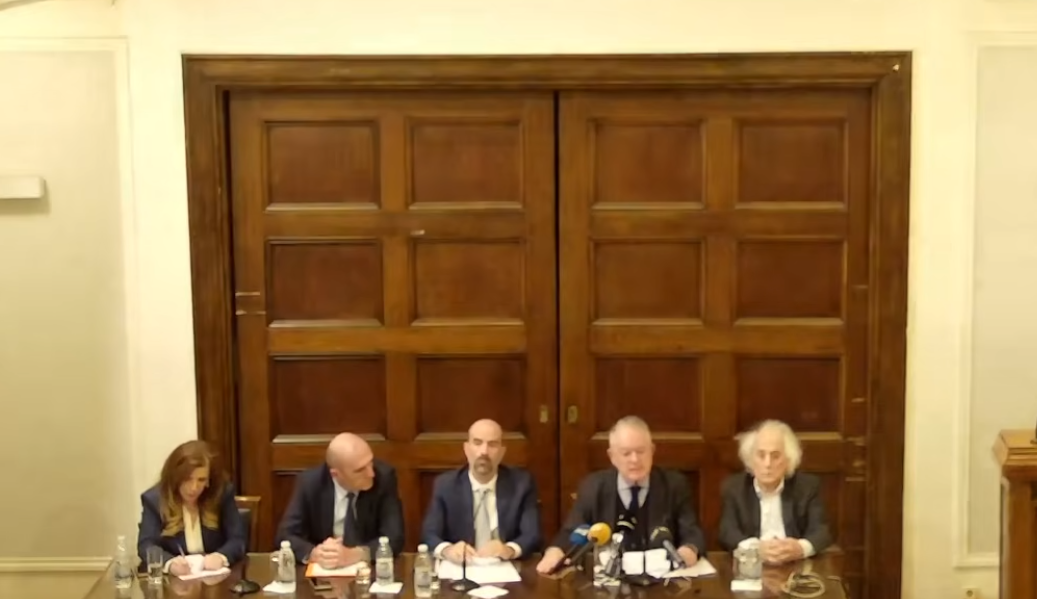
The association said it was reacting to the insistence of the Prosecutor’s Office at the Supreme Court on keeping the case closed, despite indications that serious offences may have been committed.
During the press conference, emeritus professor of constitutional law Nikos Alivizatos outlined the legal strategy for Strasbourg, noting that the decision to archive the case can be reviewed under European legal criteria.
He said the case forms part of a wider set of pending proceedings before the European Court of Human Rights, including the appeal by PASOK president Nikos Androulakis against the refusal of the National Intelligence Service to inform him of the reasons for his surveillance.
Alivizatos said the Greek state is fighting a ‘tough battle’ at European level, citing recent European Court of Human Rights rulings, including the conviction of Bulgaria in a similar case, which he said strengthen the possibility of scrutiny over Greek practices.
Lawyers say the decision violates the constitution and international case law
Andreas Koutsolambros, president of the Plenary of Greek Bar Associations, stressed what he described as the absolute unity of the legal profession in the face of a decision that conflicts with the constitution and international case law.
Particular emphasis was placed on Supreme Court Prosecutor Konstantinos Tzavellas, with speakers underlining that the senior prosecutor had supervised the National Intelligence Service during the period in question.
The presidium described his refusal to retrieve the case file, despite the ruling of the single-member Athens Misdemeanours Court requesting an investigation into the offence of espionage, as an act directly contradicting the rule of law.
Concern over statute of limitations
Members of the Athens Bar Association also expressed concern over the risk that offences may become statute-barred. Theodoros Mantas and Thanasis Kambagiannis noted that a large number of cases have already been time-barred, while many more are at risk of expiring in the coming months.
The legal profession interprets the decision to archive the case as an attempt to close the file before justice can reach the real perpetrators.
Athens Bar Association vice-president Christina Tsagli described the case as a ‘major violation of the rule of law’ and an instance of ‘institutional deviation’, stressing that the overwhelming majority of the board shares this assessment.
In a similar vein, former justice minister Antonis Roupakiotis linked the case to the need for constitutional revision, particularly regarding the method of selecting the judiciary’s leadership, in order to strengthen its independence from the executive branch.
Bar association vows to continue
Athens Bar Association secretary general Kostas Karetsos said the aim of the intervention is to fully inform society about a case with serious institutional consequences.
The association said it is determined to continue its actions at both national and European level, supporting the victims of surveillance and demanding the full clarification of a scandal that, it said, tests the limits of democracy and the rule of law in Greece.
______________________________________________
Are you seeking news from Greece presented from a progressive, non-mainstream perspective? Subscribe monthly or annually to support TPP International in delivering independent reporting in English. Don’t let Greek progressive voices fade.
Make sure to reference “TPP International” and your order number as the reason for payment.