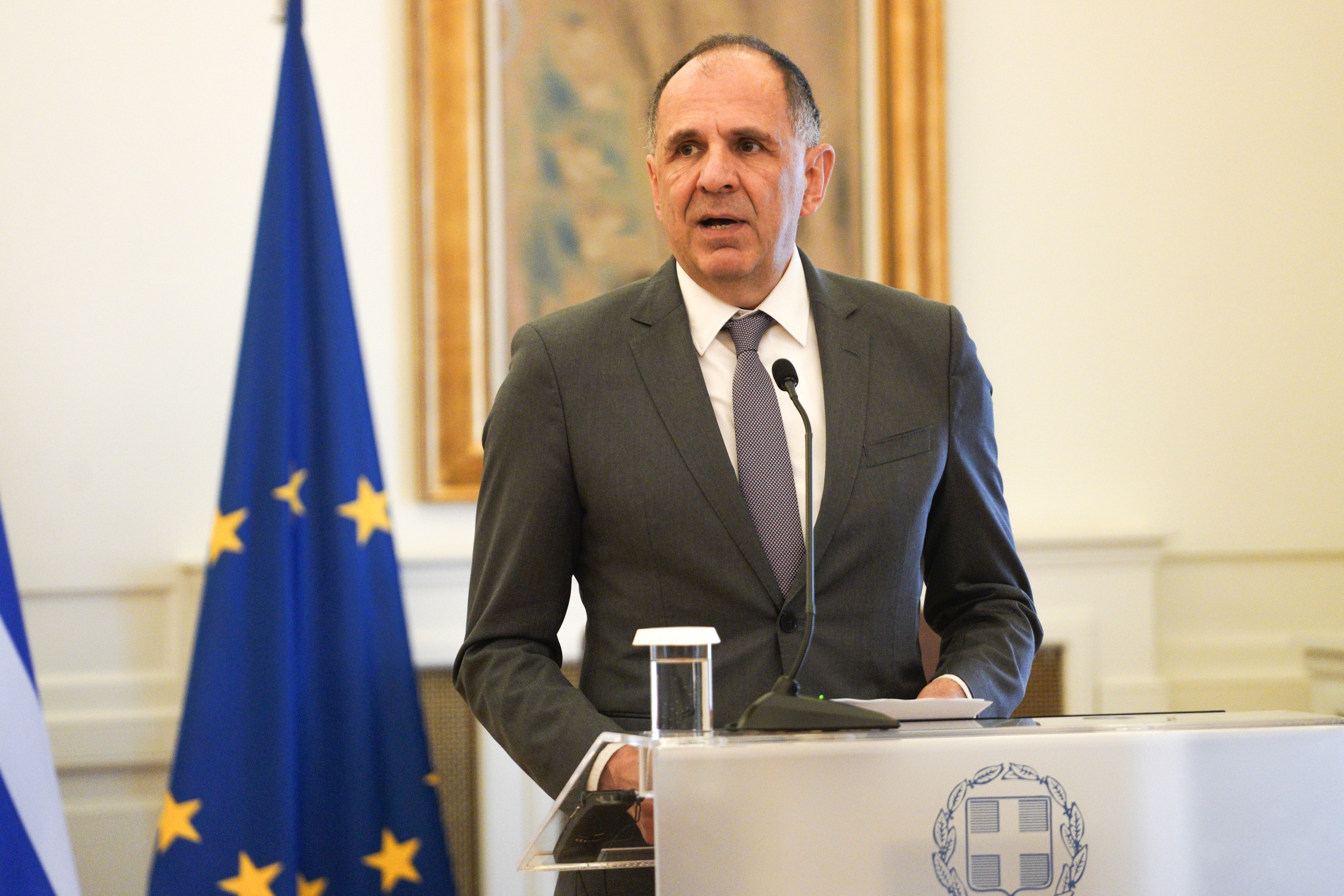
‘As it turned out afterwards, two people who were on board the Israeli vessel continued their journey towards Israel,’ he said, referring to Thiago Avila and Saif Abu Kishek, who were taken to Israel and remain held in Israeli prisons.
Zoe Konstantopoulou, president of Course of Freedom, challenged his wording. ‘The Israelis did not “disembark” the hostages. They released them. The people who suffered torture and abuse did not “have health issues”,’ she said. ‘And of course the conditions in which the two activists are being held are neither conditions of the rule of law nor conditions of temporary detention by authorities, as you characterised them.’
‘We are always available for humanitarian aid. If any humanitarian organisation believes that we can contribute to the delivery of humanitarian material, we will do so, as is our international duty,’ Gerapetritis told parliament, referring to the upcoming mobilisation of the Global Sumud Flotilla.
The foreign minister was responding to a topical question from Konstantopoulou on ‘Greece’s international responsibility for the kidnapping and hostage-taking of the Global Sumud Flotilla activists and for the flagrant violations of international law by the state of Israel in the Greek search and rescue zone, south of the Peloponnese and west of Crete’.
Gerapetritis said Greece had ‘responsibly demonstrated its humanitarian stance’ and secured the release of citizens who, at that time, were being held on Israeli vessels.
Konstantopoulou said that ‘on the evening and during the night of 29 to 30 April 2026, warships and members of the Israeli army and navy carried out acts of piracy, terrorism, kidnapping and hostage-taking, as well as facilitating the genocide being committed, at sea, south of the Peloponnese and west of Crete’.
She said they had attacked the Global Sumud Flotilla, which was sailing to Gaza with the declared aim of delivering humanitarian aid, and had intervened against 22 ships, taking 178 citizen activists hostage and terrorising the rest.
‘Following interventions and demarches to you and your own activation, you informed me that the activists would all be released on the afternoon of Thursday 30 April 2026, and that you were in communication with the Israelis to this end. However, as it ultimately turned out, only 176 activists were released, in a miserable condition, abused through torture and violence, while two of them, Thiago Avila and Saif Abu Kishek, were not released, but were transferred to Israel against their will, having suffered extreme violence and torture,’ Konstantopoulou said.
She asked the foreign minister to state the Greek government’s official position on the events, what action it would take against Israel over flagrant violations of international law, international humanitarian law and international criminal law, and what action would be taken to protect and release the two activists, whose lives and freedom, she said, are in serious danger because of their humanitarian action against genocide and apartheid.
Gerapetritis replied that ‘there was, in fact, an operation by Israeli warships in international waters, within a Greek search and rescue area’, adding that the Greek government and the Greek state had no prior knowledge of the Israeli operation when it took place.
He argued that ‘within the context of Greece’s active humanitarian policy, what we did is what was asked of us by all the countries whose citizens were on board the Israeli warships at that time. We asked the Israelis to disembark the citizens, so that there would be no further humanitarian crisis. We obviously had no knowledge either of the number of people on board, as it would have been completely impossible for this to happen, or of the actual circumstances under which this event occurred.’
He said a Greek Coast Guard operation took place off Crete to disembark 176 citizens from 34 countries from the Israeli vessel. Of those 176 people, 31 had or stated that they had health issues, he claimed, adding that they were immediately transferred to Sitia hospital. The rest, with consular assistance from the countries concerned, either remained there or were transferred to Heraklion airport, from where they boarded flights to their home countries.
‘As it turned out afterwards, two people who were on board the Israeli vessel continued their journey towards Israel,’ Gerapetritis said. ‘Greece did what it was supposed to do.’
He argued that, under international law of the sea, there was no possibility of further action because the incident took place in international waters, where the scope for intervention under the UN Convention on the Law of the Sea is very specific. He also said the Israeli vessel enjoyed immunity under article 95 of the convention.
Gerapetritis said foreign countries whose citizens were on board had thanked the Greek government for securing their release. Regarding the two activists who remain held in Israeli prisons, he said the issue would be discussed before the competent bodies, noting that the EU Foreign Affairs Council would meet on Monday and that there would also be a meeting of the Security Council.
Konstantopoulou accused the minister of using unacceptable language. ‘Allow me to tell you that the vocabulary we use is very important and I would like to correct what you said,’ she said.
‘The Israelis did not “disembark” the hostages. They released them. The people who suffered torture and abuse did not “have health issues” but requested healthcare because of serious violations of their health and physical integrity. There are people with broken noses, with bruised faces, with water deprivation, with very serious symptoms of cruel and inhuman treatment and torture, which were reported. And it strikes me very much, as you have academic status, that you are silent about the international crimes that you know were committed against people whom Greece welcomed after the commission of international crimes against them.’
Konstantopoulou also stressed that the two activists who were not released had been heading towards Gaza and therefore ‘did not continue their journey towards Israel’, as the minister had said.
‘International crimes have been committed here, and international crimes have even reached the waters off Crete. Those who committed these crimes also entered Greek territorial waters, because the disembarkation, as you characterised it, the release, as I would characterise it, of the kidnapped and tortured hostages took place in Greek territorial waters, and there are relevant photographs,’ she said.
‘It is not true that you did not know the exact number of those on board and kidnapped. You knew it and you told me with reservation, you told me 178 with reservation, and the Coast Guard, with whom I spoke, and the minister of shipping knew it from the same night of 29 to 30 April,’ Konstantopoulou added.
She noted that Greece has ratified the statute of the International Criminal Court since 2002, and said that the inclusion of crimes related to occupation among war crimes had been one of Greece’s contributions.
‘Greece today is involved in the expansion of these international crimes beyond Gaza and beyond Palestine, because what was committed against the activists is the implementation of genocide. The fact that the delivery of humanitarian aid was prevented is a continuation of genocide, the fact that the blockade of Gaza continues is a continuation of genocide. And of course the conditions in which the two activists are being held are neither conditions of the rule of law nor conditions of temporary detention by authorities, as you characterised them. We are a member state of the UN Security Council, a member state of the EU, and we not only have rights, we also have obligations to act,’ she stressed.
Gerapetritis responded by saying he was surprised that, while all the countries whose citizens were on the Israeli ships had expressed gratitude to Greece, a political party leader was criticising the Greek government for the way the citizens were released.
‘So I want to tell you that there is a profound contradiction in what you mentioned. The fact is that 176 people, on the initiative of the Greek government, and with gratitude shown by foreign governments, are today free and safe thanks to the efforts of the Greek government,’ he said, adding that the government had a different approach to the humanitarian issue.
Gerapetritis also lectured Konstantopoulou on humanitarianism. ‘I understand your sensitivities, which you have highlighted many times. However, I want to tell you this: the real value of humanitarianism is to be able to ensure a greater degree of freedom and prosperity for the greatest number of people. And that is what we did. It was not 178, it was 176, and I do not understand what exactly your disagreement consists of. You did not mention anything in relation to what should have been done. So I tell you directly: Greece released 176 citizens of foreign countries, provided medical care, restored freedom to citizens, and those countries returned gratitude to Greece.’
Regarding Greece’s stance on Israel’s genocide of Palestinians, Gerapetritis claimed that Greece is among the countries that have provided the greatest assistance in terms of humanitarian aid to Palestine, and that it has supported the Palestinian Authority while many other European countries have not.
Despite Greece’s close cooperation with the apartheid state of Israel, Gerapetritis said Greece had supported all humanitarian operations from any country, had hosted a number of injured Palestinians, and that for all this the Palestinian Authority had expressed thanks and gratitude to the Greek government, ‘except for you, Madam President’.
On the flotilla specifically, he said that during a previous operation last year, ‘again, thanks to the active initiatives of the Greek government, 27 Greek citizens were released. Greece was the only country that did this to free them,’ while ‘161 citizens from 16 countries boarded the Greek flight that brought them here’, after which there were extensive thanks.
______________________________________________
Are you seeking news from Greece presented from a progressive, non-mainstream perspective? Subscribe monthly or annually to support TPP International in delivering independent reporting in English. Don’t let Greek progressive voices fade.
Make sure to reference “TPP International” and your order number as the reason for payment.