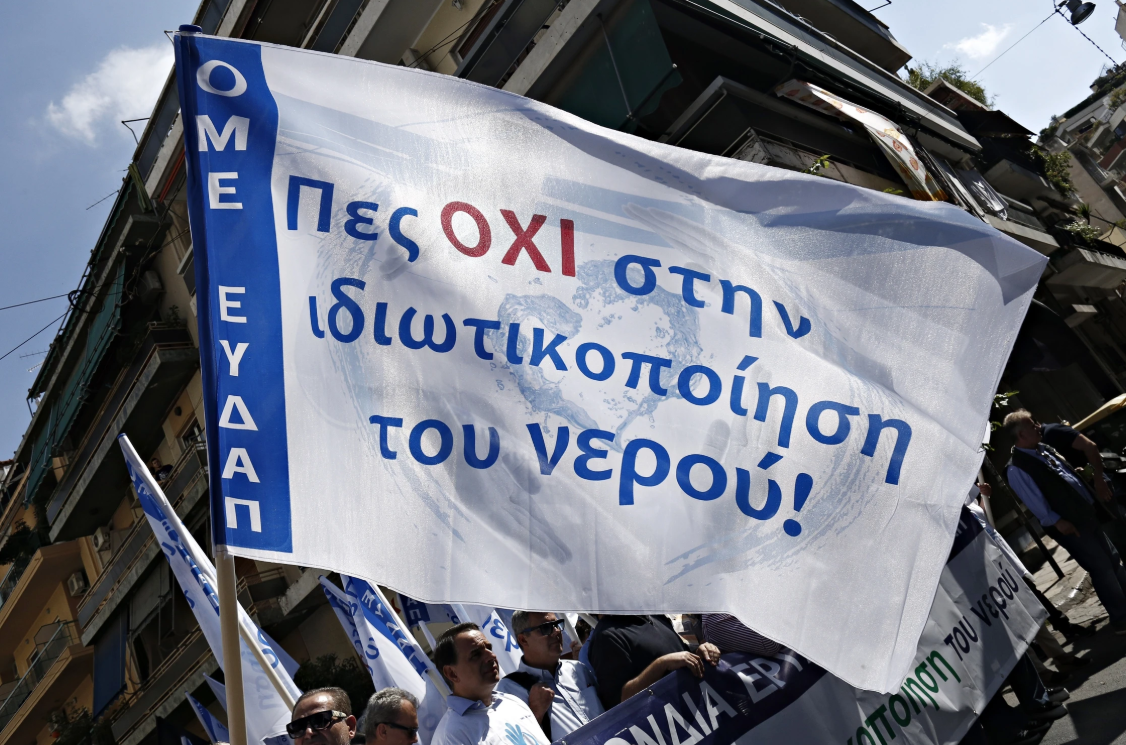
The Environment Ministry introduced the bill through a fast-track summer process, allowing just 12 days for public consultation. It expands the responsibilities of the Athens Water Supply and Sewerage Company (EYDAP) and the Thessaloniki Water Supply and Sewerage Company (EYATH).
PASOK: Government deliberately allowed debts to accumulate
PASOK rapporteur Manolis Christodoulakis expressed the party’s firm opposition to the bill, denouncing its submission while the public consultation on the national water strategy was still under way.
He described the consultation process as a pretence, noting that the Central Union of Municipalities of Greece (KEDE) and the Union of Municipal Water Supply and Sewerage Companies (EDEYA) had been excluded.
Christodoulakis also argued that the government had deliberately allowed debts to accumulate among municipal water and sewerage companies in order to use their financial condition as justification for changing the existing management model.
PASOK submitted an objection on constitutional grounds regarding articles 3, 4, 6 and 16, arguing that they violated article 102 of the Constitution, which safeguards the administrative and financial autonomy of local authorities. The objection was rejected by the parliamentary majority.
SYRIZA: Government intervening in the core functions of local authorities
SYRIZA MP Theofilos Xanthopoulos said the legislation formed part of a broader series of government interventions restricting the institutional responsibilities of public bodies, citing recent provisions concerning the Panhellenic Medical Association, courts of first instance and notaries.
He argued that the government was interfering with the core functions of local authorities, as water management through municipal companies constitutes one of their fundamental responsibilities.
‘Water management through the operation of municipal companies belongs to the very core of local government,’ he said.
Communist Party: Water is being turned into a commodity
Greek Communist Party (KKE) MP Nikos Karathanasopoulos said the government was accelerating the commercialisation of water resources in line with European Union policy.
‘Under capitalism, water is a commodity, not a public good,’ he said.
Karathanasopoulos described PASOK’s constitutional objection as ‘a pretence’, arguing that the party was attempting to oppose policies with which it essentially agreed. The KKE nevertheless supported the objection because of its own opposition to the accelerated commercialisation of water.
Environmental groups demand withdrawal of water provisions
Seventeen environmental organisations issued a joint statement calling for the immediate withdrawal of the bill’s water provisions.
Their statement follows:
‘We, the undersigned environmental organisations, demand the immediate withdrawal of the draft law concerning the “expansion of responsibilities” of the Athens Water Supply and Sewerage Company (EYDAP) and the Thessaloniki Water Supply and Sewerage Company (EYATH), the strengthening of the Regulatory Authority for Waste, Energy and Water (RAAEY) and the Thessaly Water Management Organisation SA (ODYTH), along with other related provisions.
‘The provisions concerning water companies offer no solutions to the real problems of water management: understaffing, inadequate funding, soaring energy costs for water supply, sewerage and irrigation bodies, leaks, ageing networks, over-pumping, uncontrolled consumption and the absence of a comprehensive plan for protecting, reusing, recycling and conserving water resources.
‘Instead of strengthening existing public and municipal bodies and placing the sustainable management of water resources under social control, the bill transfers responsibilities, infrastructure, financial obligations and critical decisions to larger corporate and supra-local structures, as well as to regulatory mechanisms that are both literally and figuratively removed from the lives and needs of local communities and the natural environment.
‘The principles of proximity and subsidiarity, as well as transparency and accountability, are therefore being violated. Water-related matters will no longer be managed locally and directly, but according to private economic criteria, transforming water from a vital common good into a commodity.
‘This will have serious consequences, including higher costs, the degradation of environmental management and threats to public health and other forms of life that depend on water.
‘Article 35 of the bill is also particularly alarming, as it effectively grants institutional legitimacy to a wholly paradoxical and undocumented project: the diversion of water from the Krikelopotamos and Karpenisiotis rivers to Attica.
‘Although this diversion is presented as a response to water scarcity, it bypasses the legally binding procedures required under European Union law for the proper, scientifically documented and transparent management of valuable aquatic ecosystems.
‘The legislative pre-approval of a project that has not been justified or documented through the recently approved river basin management plans is an extremely worrying development.
‘We recall that a similar attempt was previously made to use legislation to “regulate” the diversion of the Acheloos river, but the project was annulled by the courts.
‘We call for the abandonment of river diversion plans and the immediate development of a national water policy based on protecting and restoring valuable aquatic ecosystems, properly implementing the Water Framework Directive 2000/60/EC and prioritising nature-based solutions throughout the country.
‘At a time of climate crisis, the continued abuse and waste of water resources is a recipe for disaster.
‘The undersigned environmental organisations join their voices with those of consumers, workers, farmers, municipalities, local communities and every citizen defending water as a public good, a precondition for life and a common right.’
The statement was signed by:
ARION Research Centre for the Rescue and Care of Cetaceans; Action for Wildlife; the Hellenic Society for the Environment and Cultural Heritage; the Hellenic Society for the Protection of Nature; the Hellenic Ornithological Society; the Hellenic Network Friends of Nature; the Thrace Biodiversity Protection Society; the Society for the Protection of Prespa; Kallisto; Mamagaia; Ecological Recycling Society; the Citizens’ Association for Streams, ROH; iSea; MEDASSET; MedINA; Greenpeace Greece; and WWF Greece.
______________________________________________
Are you seeking news from Greece presented from a progressive, non-mainstream perspective? Subscribe monthly or annually to support TPP International in delivering independent reporting in English. Don’t let Greek progressive voices fade.
Make sure to reference “TPP International” and your order number as the reason for payment.