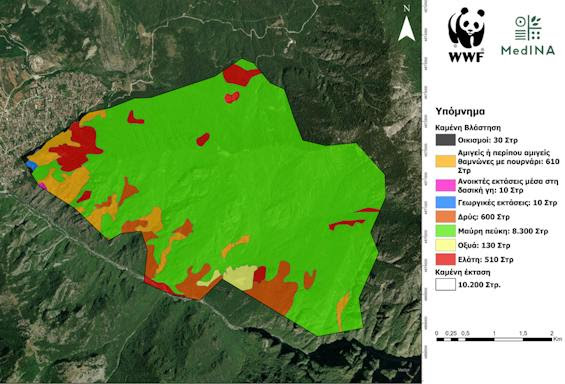
Scientists from WWF Greece and the Mediterranean Institute for Nature and Man carried out an initial assessment of the impact of the days-long fire in Trapezitsa, Konitsa, combining a field inspection with satellite imagery.
According to their initial findings, the fire affected approximately 1,000 hectares, although its intensity varied considerably across the area.
The field inspection, carried out with the assistance of members of the Konitsa Mountaineering Association, found that across most of the affected area the fire remained at ground level, primarily burning low vegetation.
In around 100 hectares, however, the fire was more intense and reached the tree canopy, causing more extensive damage to the forest ecosystem.
Despite the scale of the fire, scientists believe that a significant part of the forest ecosystem has the capacity to recover naturally.
For this reason, they do not currently recommend immediate reforestation. Instead, their assessment is that the ecosystem should be given time to regenerate naturally, while the area’s recovery is closely monitored.
Particular concern remains over specific parts of the forest, especially areas along the ridge where mature robolo pine forests are found.
Scientists also stressed the need for an early assessment of the risk of soil erosion ahead of the period of heavy rainfall.
Assessing the erosion risk is considered crucial for planning any subsequent interventions, as the effects of fire on the soil and its natural capacity to retain water can become more severe during heavy rainfall.
______________________________________________
Are you seeking news from Greece presented from a progressive, non-mainstream perspective? Subscribe monthly or annually to support TPP International in delivering independent reporting in English. Don’t let Greek progressive voices fade.
Make sure to reference “TPP International” and your order number as the reason for payment.