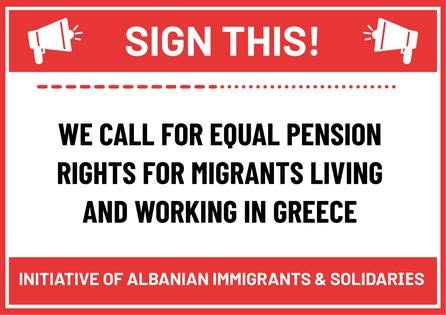
In addition to meeting insurance contribution requirements, recipients must have 40 years of legal and permanent residence in Greece to receive the full national pension. The amount is reduced for every year short of that threshold.
‘The first generation of migrants who came to Greece in the 1990s are now reaching retirement age. We worked in construction, in the fields, in food service, in cleaning, in homes and in elderly care. We supported society and the economy with our work, often at a heavy price for our health and lives. Today we are faced with yet another institutional injustice: after decades of work, a decent pension remains out of reach for many of us,’ the Initiative said.
It noted that for years, the absence of legalisation procedures left migrants undocumented and vulnerable to exploitation by employers.
‘Uninsured and undeclared work, difficulties in renewing residence permits and unemployment created gaps in our insurance history and legal residence. Migrant women in particular, who worked in domestic work and care, were often left without insurance coverage despite working continuously.’
‘Now we are being asked to pay once again for the consequences of these barriers,’ the Initiative said, before setting out the legal framework behind the pension rules.
‘Law 4387/2016, passed by the SYRIZA-ANEL government with Katrougalos as minister, links the amount of the national pension to the years of legal and permanent residence in Greece: for the full amount, 40 years of residence are required, in addition to the insurance requirements, while for each missing year a reduction of 1/40 is imposed. Similarly, length of residence also affects the Social Solidarity Allowance for Uninsured Elderly People.’
The Initiative said that the New Democracy government changed the residence requirement in 2019, reducing it from 40 to 30 years for people of Greek origin living abroad.
‘The New Democracy government in 2019, realising the injustice but acting on vote-seeking criteria, reduced the required period of permanent and legal residence from 40 to 30 years only for expatriates,’ it said.
‘As a result, even people with the same years of insurance and the same contributions can receive different amounts of national pension. A seemingly universal condition disproportionately burdens those of us who migrated here as adults and lived for years without the possibility of legalisation. Our work was necessary, but our rights remain conditional.’
The Initiative said the campaign builds on an earlier effort focusing on the pensions of Albanian migrants, which collected approximately 1,000 individual signatures.
‘Our demand already has a collective history. As the Initiative of Albanian Migrants and Solidarity, we previously published a text on the pensions of Albanian migrants, collecting approximately 1,000 signatures from individuals. The effort was also supported by unions such as SMT and the Lantza group for workers in food service and tourism, as well as organisations including Anametrisi, Mera25 and Metavasi, among others.’
It said the new campaign is intended to broaden that effort to migrants from different countries who arrived in Greece during the same period and faced similar conditions.
‘Today we are launching a broader campaign to collect signatures, recognising that this injustice affects migrants from different countries of origin who arrived during that period and faced the same harsh conditions. The previous effort becomes the starting point for a common demand.’
The Initiative is calling for the immediate decoupling of the amount of the national pension and the Social Solidarity Allowance for Uninsured Elderly People from the length of residence in Greece.
It is also demanding bilateral agreements with countries of origin where none currently exist, so that periods of insurance completed in each country can be fairly taken into account.
The Initiative called on ‘workers, unions, collectives and organisations to support the campaign’, adding that ‘equality in pensions concerns the entire world of work’.
It also called specifically on collectives to send messages of support by email or through its Facebook page and, if they wish, to have their names publicly listed among the campaign’s supporters.
‘Dignity is not determined by origin. Neither are pension rights,’ the campaign states.
The Initiative also thanked the Hellenic Migrant Forum for helping with the multilingual translation of the campaign text, allowing it to reach migrants from different backgrounds.
______________________________________________
Are you seeking news from Greece presented from a progressive, non-mainstream perspective? Subscribe monthly or annually to support TPP International in delivering independent reporting in English. Don’t let Greek progressive voices fade.
Make sure to reference “TPP International” and your order number as the reason for payment.