Amnesty International’s 2025 annual report on Greece
Criminal proceedings were brought against 21 coastguard officers over the 2023 Pylos shipwreck. An unlawful three-month suspension of access to asylum was imposed on people arriving in Greece via North Africa, a discriminatory measure that resulted in mass detention in unsuitable conditions. A new law on the return of third-country nationals further undermined their rights. A felony trial was opened against 24 humanitarian workers who had assisted people in danger at sea. Reports of unjustified and excessive use of force against peaceful protesters continued. A controversial general ban on demonstrations outside the parliament building was introduced. Legislation ostensibly aimed at combating gender-based violence was heavily criticised for failing to prioritise support for victims and prevention. Four executives of companies linked to the Predator spyware scandal were brought to trial. Reports of attacks against members of the LGBTQI community continued. More than a quarter of the country’s population was at risk of poverty or social exclusion.
General context
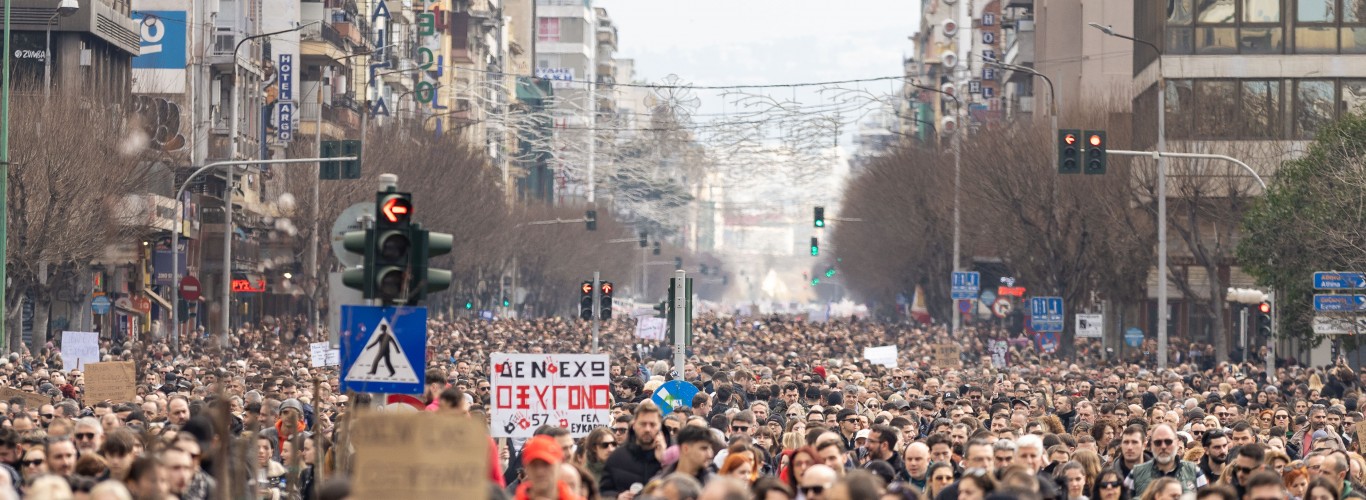
Mass protests demanding justice and accountability for the victims, survivors and families followed the devastating 2023 Tempi train crash, which killed 57 people. In February, the National Transportation Safety Board concluded that the tragedy resulted from a combination of human error, poor infrastructure and systemic failures in rail safety management.
Between June and August, amid a severe heatwave likely intensified by climate change, major wildfires destroyed tens of thousands of hectares of land, claimed the life of one man and caused damage to homes and basic infrastructure in areas including Crete, Chios, Attica and Achaia.
Rights of refugees and migrants
In a landmark ruling in January, the European Court of Human Rights found ‘strong indications’ of systematic illegal pushbacks at the land border with Turkey in 2019. Further pushback cases remained pending before the court. NGOs expressed concern that, despite more than 200 domestic investigations into allegations of pushbacks between 2019 and 2024, none had led to charges against officials.
In May, the prosecutor of the maritime court concluded the preliminary investigation into the role of the coastguard in the 2023 Pylos shipwreck, in which more than 600 people lost their lives, by bringing criminal charges against 17 officers and referring them for further questioning. In November, a prosecutor at the court of appeal brought criminal charges against four additional senior coastguard officers. The defendants included the crew and captain of the patrol boat which, according to survivors, caused the fishing vessel to capsize while attempting to tow it, as well as the current and former commanders of the coastguard.
In October, the European Court of Human Rights issued a ruling in a case concerning a fatal 2018 shipwreck, condemning Greece for violations of the right to life because of failings in both the rescue operation and the subsequent investigation.
In June, the Council of Europe’s Committee of Ministers suspended its monitoring of the implementation of the landmark ECtHR ruling in MSS v. Greece, which concerned deficiencies in asylum procedures and the living conditions of asylum seekers. Despite reports by the European Committee for the Prevention of Torture, the UN and NGOs documenting continuing failings, the committee found that the progress made by the Greek authorities in complying with the convention was satisfactory.
Just one month later, a legislative amendment introduced an unlawful and discriminatory three-month suspension of asylum applications by people arriving on the islands of Crete and Gavdos via North Africa, while allowing for their forced return to their country of origin or transit. The ECtHR granted interim measures in two cases involving individuals from Sudan and Eritrea affected by this measure, ordering Greece not to remove them while registration of their asylum applications remained suspended.
Those subjected to the new provisions were largely held in facilities across Greece, in some cases in inadequate conditions. The European Commission failed to use the tools at its disposal to ensure Greece complied with its human rights obligations.
Throughout the year, asylum seekers living in EU-funded Closed Controlled Facilities on the Aegean islands continued to be subjected to ‘restrictions on liberty’ amounting to unlawful detention. In February, the ECtHR granted interim measures to protect children in the ‘safe zone’ of the Samos facility and to ensure their relocation.
In September, parliament passed a new law on the return of third-country nationals that weakened their protections, in some respects in breach of existing law and EU standards, and signalled a punitive turn in migration policy. The law criminalised irregular stay, broadened penalties linked to irregular entry and exit, extended detention beyond the limits set by EU law and introduced electronic monitoring to prevent absconding. It followed, and was inspired by, a widely criticised European Commission proposal on returns published in March, which remained non-binding at the end of the year.
In March, the Council of State annulled the decision designating Turkey a safe third country, following a 2024 ruling by the Court of Justice of the EU on the compatibility of such designations with EU law when the country concerned has suspended readmissions. Turkey has suspended readmissions since 2020. NGOs expressed concern that a new ministerial decision issued in April effectively reinstated Turkey’s designation as a safe third country.
Human rights defenders
In June, an Athens court acquitted human rights defender Alexia Tsouni of charges including defamation, which appeared to have been brought in response to her anti-racist work and activism in support of refugees.
In December, a felony trial began against 24 humanitarian workers, including the Irish human rights defender Sean Binder, who had rescued and treated refugees and migrants on Lesbos. The charges included migrant smuggling and carried sentences of up to 20 years in prison. In the same month, a legislative proposal introduced membership of a registered NGO as an aggravating factor in migrant smuggling cases.
Right to life
In June, a police officer was found guilty over the fatal shooting of Kostas Fragoulis, a 16-year-old Roma boy killed during a police chase in Thessaloniki in 2022.
Right to peaceful assembly
According to reports, police used disproportionate and excessive force against protesters and photojournalists during demonstrations, including protests over the Tempi train crash and rallies in solidarity with Palestinians. There were also reports of peaceful protesters being taken to police stations for identification before and after demonstrations. In July, authorities misused anti-racism legislation to arrest some protesters taking part in a Palestine solidarity protest in Rhodes.
In October, parliament introduced a general ban on demonstrations in parts of Syntagma Square in Athens, in front of the parliament building, under the pretext of protecting the monument to the Unknown Soldier.
Concerns over long-standing impunity remained, although some law enforcement officers were brought to trial for rights violations against protesters.
In February, three police officers were found guilty of inflicting ‘dangerous bodily harm’ on Vasilios Maggos outside the Volos courthouse in 2020. Maggos had reported being mistreated during his arrest and detention and died a few weeks later. In November, six police officers were brought to trial on charges of torture, ‘dangerous bodily harm’, exposure to danger and arbitrary detention in connection with the case.
In August, two senior police officers were put on trial for unlawfully obstructing a lawful demonstration and attempting to inflict grievous bodily harm on at least 10 lawyers who took part in a protest in March 2021.
Right to privacy
In September, four executives from two companies linked to the Predator spyware scandal were tried on misdemeanour charges of violating communications privacy laws. The trial was still ongoing at the end of the year.
Violence against women and girls
In January, a law supposedly aimed at tackling gender-based violence by criminalising new forms of abuse, such as online harassment and revenge pornography, was criticised by women’s rights organisations for focusing on harsher penalties rather than prevention and support for victims.
Lawyers, activists and women’s rights organisations also continued to raise concerns about the impact of the 2021 joint custody legislation on women and children who have survived gender-based violence.
Rights of LGBTQI people
Reports of attacks against members of the LGBTQI community continued.
In April, parliament passed legislation that effectively excludes same-sex male couples and single men from access to surrogacy.
Economic, social and cultural rights
A report published in October by the Hellenic Network for Combating Poverty found that 26.9% of the country’s population was at risk of poverty or social exclusion, while child poverty remained high at 22.4%.
A controversial bill passed in October allowed some private-sector workers to work voluntarily for 13 hours a day for up to 37.5 days a year. The law was criticised by trade unions and opposition parties and triggered nationwide strikes and demonstrations.
Conscientious objection
In December, concerns were raised over a draft law amending armed forces legislation because it failed to recognise the right to conscientious objection to military service in line with international human rights standards. Alternative civilian service remained punitive and discriminatory, while the assessment of applications for conscientious objector status was still not fully under the control of civilian authorities.
Right to a healthy environment
In November, WWF said Greece’s hydrocarbon extraction agreements with major oil companies and its long-term commitment to importing liquefied natural gas from the US would lock the country into decades of dependence on fossil fuels, along with environmental risks and economic harm.
______________________________________________
Are you seeking news from Greece presented from a progressive, non-mainstream perspective? Subscribe monthly or annually to support TPP International in delivering independent reporting in English. Don’t let Greek progressive voices fade.
Make sure to reference “TPP International” and your order number as the reason for payment.