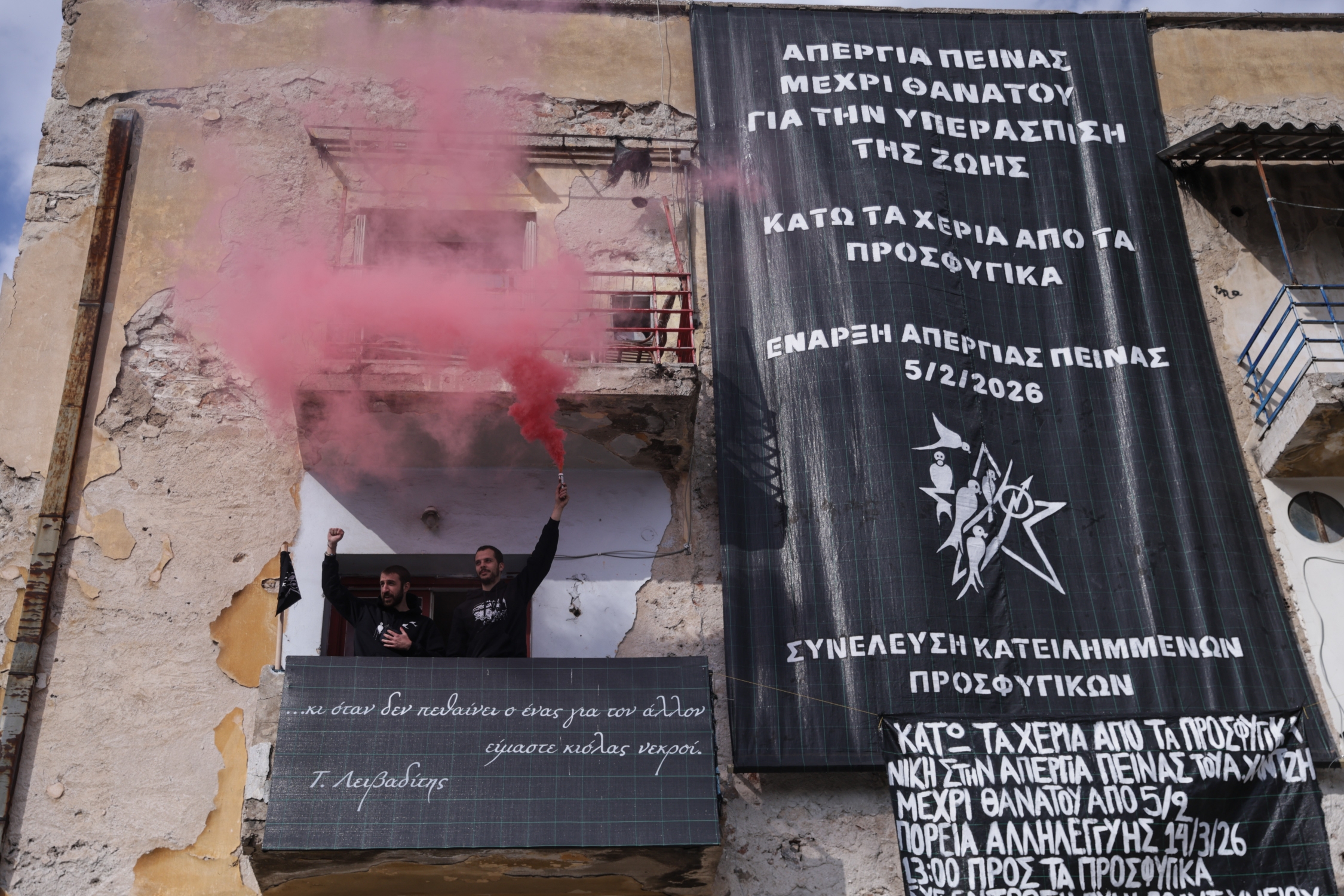
The focus was the extremely critical health condition of hunger strikers Aristos Chantzis and Suzon Doppagne, amid what participants described as the absolute silence of state authorities and the media.
According to information provided by doctors attending the press conference, Chantzis’s condition, after 110 days on hunger strike, is extremely critical and his life is in immediate danger. The health of Doppagne, who has been on hunger strike for 25 days, is also deteriorating.
During the press conference, the community presented its arguments for the immediate revocation of decision 836 of 6 June 2025 by the Regional Committee of the Attica Region, and for the cancellation of the proposed programmatic agreement for the ‘redevelopment’ of Prosfygika.
As stressed by participants, the agreement is non-existent, invalid and illegal, treating Prosfygika as ‘empty buildings’ while ignoring the fact that it is a living place of residence, history, collective memory and social action. They said it violates a series of human rights provisions, the constitution, Greek and European legislation, case law and numerous international conventions.
Particular reference was made to what speakers described as serious legal and institutional irregularities in the contract, changes to its basic terms, and the fact that the 2018 study concerns a substantially different project and cannot be applied to the current plan.
Olga Kleitsa spoke extensively about funding through the National Strategic Reference Framework (NSRF) 2021–27, the serious ambiguities and omissions in the plan, and the unclear ownership status of the Prosfygika housing complex.
Speakers stressed that Prosfygika has functioned as Greece’s only de facto social housing for 16 years. More than 400 residents, including families, children, refugees, homeless people, sick people and other vulnerable social groups, live in the community. Through 22 self-organised structures, social, cultural and educational activities open to the wider community are provided on a daily basis.
The community also presented the initiatives carried out over the past four months by residents and solidarity organisations in Greece and abroad. These include interventions and official requests to local government bodies, parliamentary questions, public statements and the intervention of Amnesty International, which denounced serious human rights violations and called for a halt to any process leading to evictions and the evacuation of the community.
An official complaint has also been filed with the UN Special Rapporteur on the right to housing, who has taken up the Prosfygika case, finding that there are serious indications of human rights violations. Dozens of collectives, associations, unions, organisations and municipal councils have issued resolutions in support, while thousands of people, including artists, academics and lawyers, have signed solidarity statements backing the community and the hunger strikers.
According to the community, the government and state and local authorities have responded to all the documented evidence, arguments and interventions with ‘guilty absolute silence’ and a ‘criminal refusal’ to engage in dialogue. Speakers accused them of limiting themselves to vague statements, threats of eviction and announcements produced with artificial intelligence software, while playing communication games and dangerous games with the lives of 400 people and the hunger strikers, ‘whose lives hang by a thread’.
The only official response mentioned was that of the Municipality of Athens, which on 20 April adopted a resolution that, although general and vague, called on the Attica Region to suspend any process concerning the redevelopment of Prosfygika and to take all necessary legal actions that it has not taken to date.
Stavros Stavridis stressed that the residents themselves are the ones who have kept the buildings alive, maintaining their interiors with their own resources, personal labour and collective care after almost a century of state abandonment.
A plan for the restoration of the buildings’ exterior was also presented. It has been prepared in collaboration with a specialised team of professionals and scientists and is planned to be implemented through the residents’ civil non-profit company and the team of experts working with the community.
In the interventions by community members, a central question was raised: ‘Who is ultimately illegal? The homeless, the 50 children of the community, the refugees, the seriously ill and the other vulnerable social groups who found in Prosfygika a place of life, solidarity and dignity? Or the state itself, which abandoned the buildings for decades, tried to demolish them and is today promoting the commercialisation of a historic neighbourhood of Athens?’
Particular reference was also made to the targeting, criminalisation and repression faced by community members through repeated police operations, arrests, surveillance and prosecutions. As Annie Paparrousou underlined, the planned evacuation is linked both to the political decision to dissolve a self-organised community that responds to social needs and to the gentrification of the area and the economic exploitation of one of the largest ‘prime assets’ in central Athens.
Lia Gogou, a representative of Amnesty International, defended the social work of the self-organised community and called for the plans leading to human rights violations and illegal violent evictions to be halted. She also called on the competent authorities to examine the demands of the hunger strikers and the community immediately and urgently, before it is too late.
The Occupied Prosfygika Community declared that it will continue its struggle to defend life and dignity and to satisfy the just demands expressed through the hunger strike. It announced that two more members, who already face serious health problems, will begin a hunger strike to the death in the coming days.
Faced with what it described as absolute and guilty silence, refusal of any dialogue and mockery of hundreds of residents and hunger strikers by state authorities, the community said it was ending superficial dialogue, while remaining open to any process that raises these issues and specific demands.
The community said the acceleration of such dialogue is the exclusive responsibility of state authorities, who must satisfy the just demands of the community and the hunger strikers. It added that they will be held accountable, both politically and criminally, for anything that happens from now on.
______________________________________________
Are you seeking news from Greece presented from a progressive, non-mainstream perspective? Subscribe monthly or annually to support TPP International in delivering independent reporting in English. Don’t let Greek progressive voices fade.
Make sure to reference “TPP International” and your order number as the reason for payment.