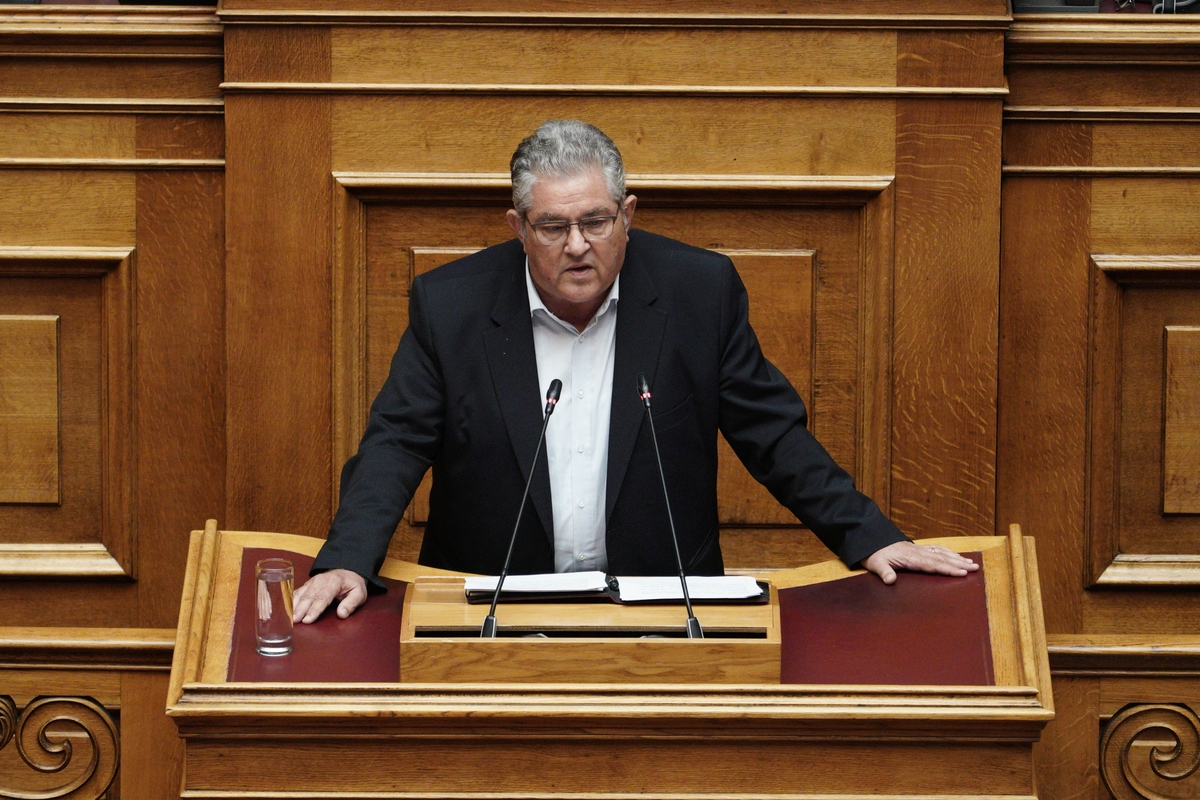
‘Developments confirm the irreversible course of escalation in the imperialist war, the fronts of which now extend across a vast geographical area around us and which has at its core the great conflict between the US and China for global primacy,’ he said.
According to Koutsoumbas, the ruling class in each country seeks to secure the greatest possible gains for itself through involvement in war, while burdening ordinary people with the consequences. He accused the Greek government of doing exactly the same on behalf of the Greek bourgeoisie, calling its stance ‘shameful for the Greek people’, especially when it adopts and reproduces what he described as the pretexts for the crime committed by the US and Israel, ‘as Mr Mitsotakis did yesterday from Cyprus’.
He said the government claimed it was sending a frigate and F-16 fighter jets to Cyprus to protect ‘Hellenism’, while, in his view, it was clear they had in fact been sent because the British bases on the island had been targeted. He also referred to repeated reports linking the presence of the frigate Kimon to the operational needs of Israel and the US in the Middle East.
Koutsoumbas further accused the government of having acted as a forerunner in the concentration of military forces from other NATO countries on the island, including what he described as the ‘supposedly peace-loving’ Spain, as well as occupying Turkey.
‘These moves have accelerated the course towards the de facto NATOisation and partition of the island, a course that already existed before this war,’ he said.
Referring to the dispatch of Patriot missile systems and F-16s to northern Greece to protect Bulgaria, he said this was being done in order to protect not only American bases in Bulgaria, but clearly also Alexandroupolis. He argued that this development underlined the danger of a wider conflagration, given the existence of other war fronts in the broader region.
He also criticised the government’s stance on the protection of seafarers, saying that while it was highly active in sending military forces in different directions, it had refused to take meaningful measures to protect seafarers trapped in the Persian Gulf.
‘At the same time, you turn a blind eye to the shipowners, who continue to send others there, into the wolf’s mouth, through blackmail, in order to profit from freight rates that have soared because of the war,’ he said.
Koutsoumbas called for all areas where armed conflicts are taking place to be designated war zones and for the passage and stay of merchant ships in those areas to be prohibited. He warned that the government would bear joint responsibility for whatever followed.
He added that agricultural production could not remain unaffected under such conditions. Among other things, he said, bilateral agreements with third countries, such as the Mercosur agreement, were being accelerated on this basis and would dramatically worsen the conditions of survival for small farmers in Greece and other EU countries.
He also predicted that with the new revision of the Common Agricultural Policy from 2027, farmers who depend exclusively on cultivating their own land for survival would find themselves in an even worse position. In that context, he said, revelations such as those contained in the European Public Prosecutor’s Office case file on OPEKEPE would be used, while the real victims would once again be the farmers whose money had been stolen over many years by ‘various cunning people’.
OPEKEPE and the ‘cover-up’
Turning to the government’s conclusion on OPEKEPE, Koutsoumbas described it as ‘yet another finding of a cover-up, both of the causes and of those responsible for this scandal’. He said it was the latest in a series of acts aimed at avoiding, at all costs, any investigation into the criminal responsibilities of ministers involved in the case.
He argued that the KKE conclusion, unlike that of the majority, took into account the evidence that emerged during the committee’s work and documented that ‘we are talking about a scandal that clearly bears the signature of the New Democracy government’.
‘You have put your signature on this foul industry of systematic illegalities and clientelist relationships, which secured benefits for your party officials and others, at the expense of the majority of struggling farmers,’ he said.
He added that the scandal also clearly bore the stamp of the EU and the Common Agricultural Policy, which, in his words, provided the fertile ground for such parasitic phenomena to flourish.
According to Koutsoumbas, under the pretext of relieving the hardships faced by the poorest small farmers, a corrupt privatised system of agricultural subsidy payments was built, which under the most recent New Democracy governments developed into ‘a deformed abscess’ that was exploited by political cronies and fraudsters.
He said it was beyond doubt that the government knew very well the paths of corruption involving grazing land, the national reserve, the notorious ‘technical solution’, and the vote-harvesting opened up by political choices made both by it and by previous governments.
He accused all governments involved of handing the organisation over to private companies, which appropriated valuable information systems and data without compensation, at the expense of farmers and society. He said a whole mechanism of parasites and intermediaries had been set up to feed on public money and the labour of producers, while the dismantling of control mechanisms, understaffing of services and deliberate downgrading of on-site checks created the vacuum needed for these networks to operate.
Koutsoumbas also referred to OPEKEPE employees who had attempted to raise objections and obstruct the fraud, saying they had faced persecution and abusive treatment.
‘The system sidelined them. They were branded the bad guys, or even ridiculous, even mad, in order to delegitimise what they were saying,’ he said.
He linked what had happened at OPEKEPE to the government’s plans for the evaluation of civil servants, arguing that such evaluation was in reality another tool for intensifying pressure on public employees and imposing the omertà the government wanted.
‘Those who react, whether to anti-people policies or to various lobbying efforts, will now be under a regime of institutionalised threat aimed at silence. But you will not get away with it,’ he said.
According to Koutsoumbas, developments so far fully confirm the central points of the KKE proposal for the establishment of a preliminary investigation committee into former New Democracy ministers. He said the criminal ring had acted with their full knowledge and tolerance, if not under their direction, and argued that clear proof lay in the leading role played by local party officials, directors of MPs’ political offices and well-known political associates of ministers.
He said the KKE conclusion documented serious indications that former rural development and food minister Makis Voridis had criminal involvement in the offence of breach of duty through action, while former minister Lefteris Avgenakis had criminal involvement in the same offence through action, omission and breach of a specific legal obligation.
Koutsoumbas said an immediate preliminary investigation committee must be established to examine the responsibilities of those ministers, of any others who may be implicated, and of the prime minister himself, under whose authority the government’s plan was being implemented.
He repeated the KKE position that the postal voting procedure set up by the government in the summer in order to block the establishment of a preliminary investigation committee was invalid, and therefore the request could be brought back for discussion.
At the same time, he said the KKE was fully aware of the limits of such committees, since everything in them is determined by the government majority, which retains the power to absolve its own ministers. For that reason, he said, the party insisted on the complete abolition of Article 86 of the Constitution and the law on ministerial responsibility.
He recalled that the KKE had already submitted such a proposal during the previous constitutional revision, when it was rejected by New Democracy, PASOK and SYRIZA, parties which now, he said, hypocritically denounce the consequences of that decision.
Koutsoumbas also rejected attempts to portray the EU and institutions such as the European Public Prosecutor’s Office as neutral defenders of legality. As he argued, the EU itself, through its legislation and policies, contributes to corrupt practices, while subsidies are not some kind of dowry or donation from the European Union, but funds drawn from state revenues to which peoples such as the Greek people contribute overwhelmingly.
According to the KKE leader, the deeper scandal lies in the very nature of monopolistic competition, which uses subsidies as a tool for business groups to seize agricultural production at humiliating prices, pushing the people towards hunger and poor and middle farmers towards extinction.
‘This is the normality of the capitalist market that all the other parties defend. But when legal politics itself is a robbery, illegal fraud is simply its natural continuation,’ he said.
‘Return the money to the farmers’
He warned that the government’s proposed solutions to replace the technical solution would bring no genuine clean-up, arguing that the fraud would merely change form so long as the same policy remained in place.
Referring to the government’s admission that it had saved €160 million this year, Koutsoumbas said this amounted to ‘the most official confession that the amount of theft was proportional on an annual basis’.
He said the KKE demands that this money be returned immediately to the farmers struggling to survive and cultivate their land again, and that the government recover it from the fraudsters.
Finally, he reiterated the KKE’s support for the demands of the farmers’ movement, which is why, he said, it had backed the farmers’ blockades.
‘A struggle that cornered the government, exposed its hypocrisy and lies, and neutralised every attempt to suppress it, slander it and divide it. Perhaps the greatest achievement of this struggle is the unity and collective action that the struggling farmers forged among themselves, and with the whole Greek people, who stood by them,’ he said.
______________________________________________
Are you seeking news from Greece presented from a progressive, non-mainstream perspective? Subscribe monthly or annually to support TPP International in delivering independent reporting in English. Don’t let Greek progressive voices fade.
Make sure to reference “TPP International” and your order number as the reason for payment.