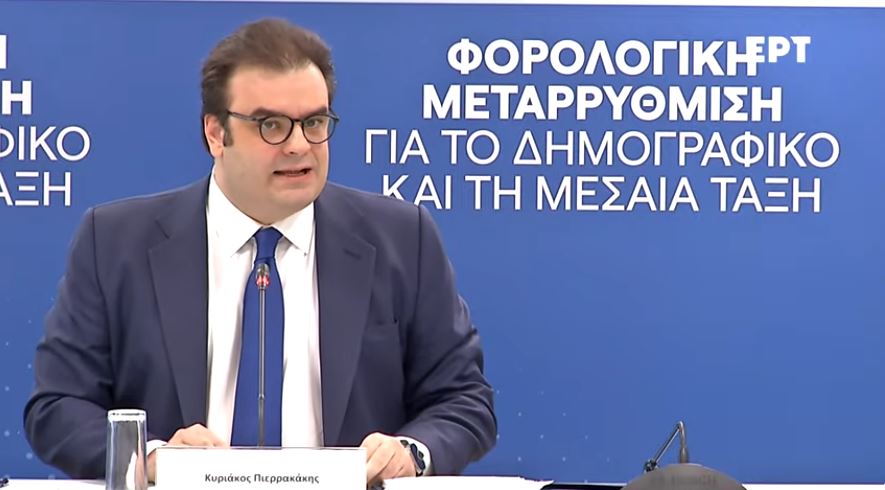
Pierrakakis placed particular emphasis on the new framework governing loan servicers, describing it as an intervention that had been announced in advance but required significant technical preparation. He said the previous system contained ‘loopholes’ and ‘cracks’ that needed to be addressed, describing the changes as ‘an intervention in the private debt sector, one of many’.
According to the minister, a key element of the new framework will be oversight and specific penalties for violations. He cited as an example the advance payments demanded by servicers as part of debt settlements: ‘In one arrangement, the servicers requested a very high advance payment. In some cases, you would owe €100,000 and they would ask you for half of it up front. So we set a ceiling of 15%.’
The new framework will also set a strict six-month deadline for completing the process, with what Pierrakakis described as a clear-cut response: ‘Yes should mean yes and be respected; no should mean no and be documented.’
He described as ‘unacceptable’ cases in which a debtor who is complying with a repayment arrangement nevertheless faces seizure or auction proceedings at the same time. ‘The state had to intervene. That’s what we did,’ he said.
The provisions also include financial penalties, with fines of up to €500,000. The new framework is expected to be submitted to parliament by the end of October and will take effect immediately after its passage. Pierrakakis stressed the distinction between a code of conduct and a law ‘which has very specific consequences’.
On the new 120-instalment repayment scheme, Pierrakakis said it would remain in force until mid-2027, with the government aiming to pass the legislation in October. He said the scheme would not cover debts incurred in 2025 because taxpayers already have access to the tax authority’s 24-instalment repayment scheme, which carries the same interest rate.
On interest rates, he argued that despite increases by the European Central Bank, the government had intervened to keep the rate stable. ‘The issue is to be able to give people tools, so that those who want to pay are able to pay,’ he said. ‘The job of the state is not to point fingers. It is to give a hand.’
Pierrakakis also referred to heating oil, with announcements expected on 14 October. Support will take two forms: a subsidy at the pump and an increase in the heating allowance.‘We want to create a double shield of protection,’ he said, adding that the amount of support had not yet been finalised because the government wanted to assess conditions when the distribution period begins. Eligibility criteria will remain unchanged, while the aim is for the price of heating oil to remain below last year’s opening price. He also left open the possibility of refineries contributing to the support measures.
On fuel more broadly, Pierrakakis said diesel is subsidised by a total of 20 cents per litre, with 15 cents coming from the state and five cents from refineries, while refineries subsidise unleaded petrol by 10 cents per litre. He claimed that Greece ranks third in Europe in terms of overall support.
Regarding Greece’s request to the European Union, the minister clarified that it does not concern a specific mechanism but the possibility of securing additional fiscal space. ‘Mitsotakis is not asking for a tax. He is asking for space,’ he said, explaining that Greece is seeking greater flexibility to direct additional resources towards supporting citizens.
The issue is expected to be discussed at the next meetings of the Eurogroup and ECOFIN before reaching the European Council at leaders’ level. Responding to criticism over increased VAT revenues, Pierrakakis said these amounted to €950 million, while government support for the energy crisis since the beginning of the year had exceeded €1 billion.
Pierrakakis presented the measures as part of a broader strategy covering private and public debt, the energy crisis and disposable income.
‘All of this ultimately affects citizens’ wallets,’ he said, pledging that the government would continue adjusting its interventions in response to developments. ‘We will be there step by step, constantly strengthening,’ he concluded.
______________________________________________
Are you seeking news from Greece presented from a progressive, non-mainstream perspective? Subscribe monthly or annually to support TPP International in delivering independent reporting in English. Don’t let Greek progressive voices fade.
Make sure to reference “TPP International” and your order number as the reason for payment.