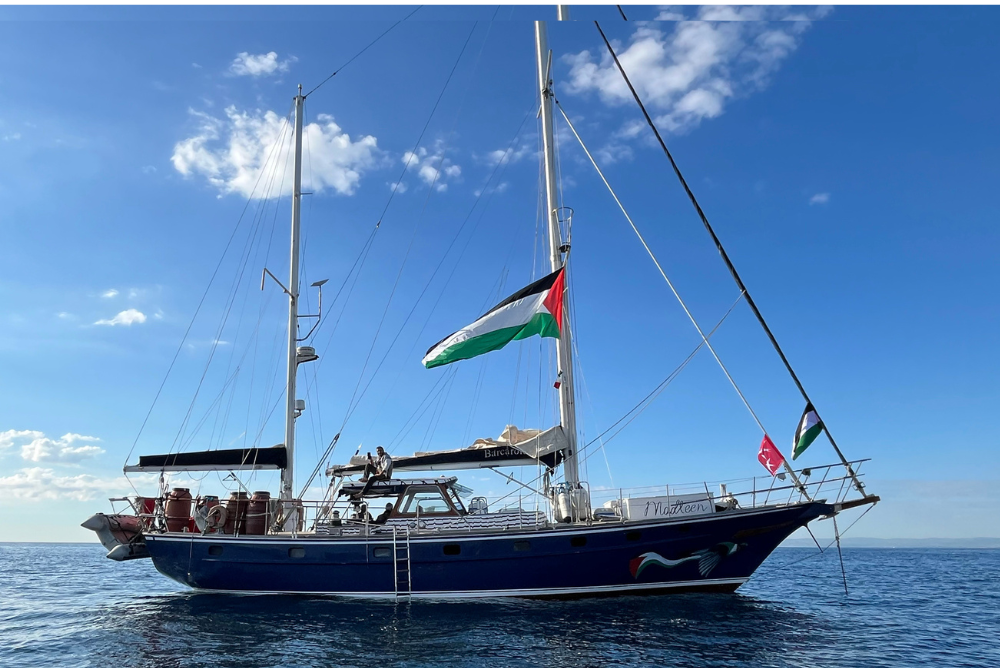
The incident took place less than 80 nautical miles west of Crete, from the evening of Wednesday 29 April 2026 into the early hours of Thursday 30 April 2026.
The legal team said it was seeking clarification on the legal basis and compatibility with international and domestic law of the actions of the Hellenic Republic, as these emerge from the recent Foreign Ministry announcement on the reception of the Global Sumud Flotilla passengers on Greek territory.
According to the letter, Greece announced on 30 April 2026 that, for humanitarian reasons and following consultation with the Israeli authorities, it had undertaken to receive the passengers and arrange their repatriation. However, the legal team argues that the circumstances raise serious questions relating to the law of the sea, state sovereignty and international responsibility.
The letter first raises the issue of the passage of warships and the protection of national sovereignty. Citing the United Nations Convention on the Law of the Sea (UNCLOS), it states that foreign warships do not enjoy an unconditional right of innocent passage through another state’s territorial waters, especially when their presence or activities may affect the peace, order or security of the coastal state.
The legal team asks whether the Greek authorities identified a breach of the rules on innocent passage or of Greece’s national sovereignty, what measures were taken to protect national security and prevent similar incidents, and whether explicit permission or consent had been given by the Greek authorities for the actions of the vessels in question in the area.
It also raises the legality of intervention against foreign-flagged vessels in international waters. Under the law of the sea, the letter notes, a state cannot exercise authority over a vessel in international waters without the consent of the flag state, except in limited cases such as piracy or human trafficking.
The team says that, based on the reactions of other EU member states and available information, it does not appear that prior authorisation had been given by the flag states to Israeli vessels for any intervention.
It also expresses strong concern over the transfer and detention of two members of the mission, citizens of EU member states and Brazil, who, according to the letter, were not disembarked on Greek territory but were detained and transferred by the Israeli authorities to Israel for further ‘interrogation’.
The letter says this raises serious questions under international law, particularly regarding the protection of their fundamental rights, including the right to a fair trial and the prohibition of torture and inhuman or degrading treatment.
The legal team asks on what rule of international or domestic law Greece co-operated with the Israeli authorities in relation to the interruption of a humanitarian aid initiative, and on what legal basis it co-operated over those taken by Israeli forces. It also asks whether the Greek authorities considered that an illegal act had been committed and whether Greece should have acted within its jurisdiction in response to that violation.
It further asks whether the Greek state considered the possibility of international responsibility arising from participation or complicity in an act that may be contrary to international law.
The letter also raises Greece’s search and rescue obligations. Citing the SAR Convention and article 98 of UNCLOS, it states that Greece has obligations to provide assistance to people in danger at sea within its area of responsibility.
Taking into account reports of distress signals, vessel destruction, loss of communications and impending bad weather, the legal team asks whether any request for assistance was submitted by the vessels or passengers within the Greek search and rescue area, what actions the Greek authorities took to ensure the life and safety of the passengers, and whether there was coordination with other states or international organisations in handling the incident.
Finally, the legal team asks whether the Greek authorities were aware that passengers, upon arrival on Greek territory, appeared to bear serious injuries as a result of abuse by the Israeli authorities. It asks what action was taken to ensure both their access to medical and pharmaceutical care and the effective exercise of their rights in relation to the acts committed against them.
The letter concludes that the issues raised require clarification regarding the legal basis of the Hellenic Republic’s actions, in order to ensure full compliance with international and domestic law.
______________________________________________
Are you seeking news from Greece presented from a progressive, non-mainstream perspective? Subscribe monthly or annually to support TPP International in delivering independent reporting in English. Don’t let Greek progressive voices fade.
Make sure to reference “TPP International” and your order number as the reason for payment.