Government retaliation dressed as heritage protection
The government’s clearest response to Panos Routsi’s request for the exhumation of his son's body, to his moving struggle, and to the social mobilisation he inspired came only after his 23-day hunger strike ended. What followed looked like payback. Kyriakos Mitsotakis signalled a politically spiteful move to reduce the visibility of demonstrations in Syntagma Square, directly in front of Parliament, by keeping protesters away from the square’s upper side.
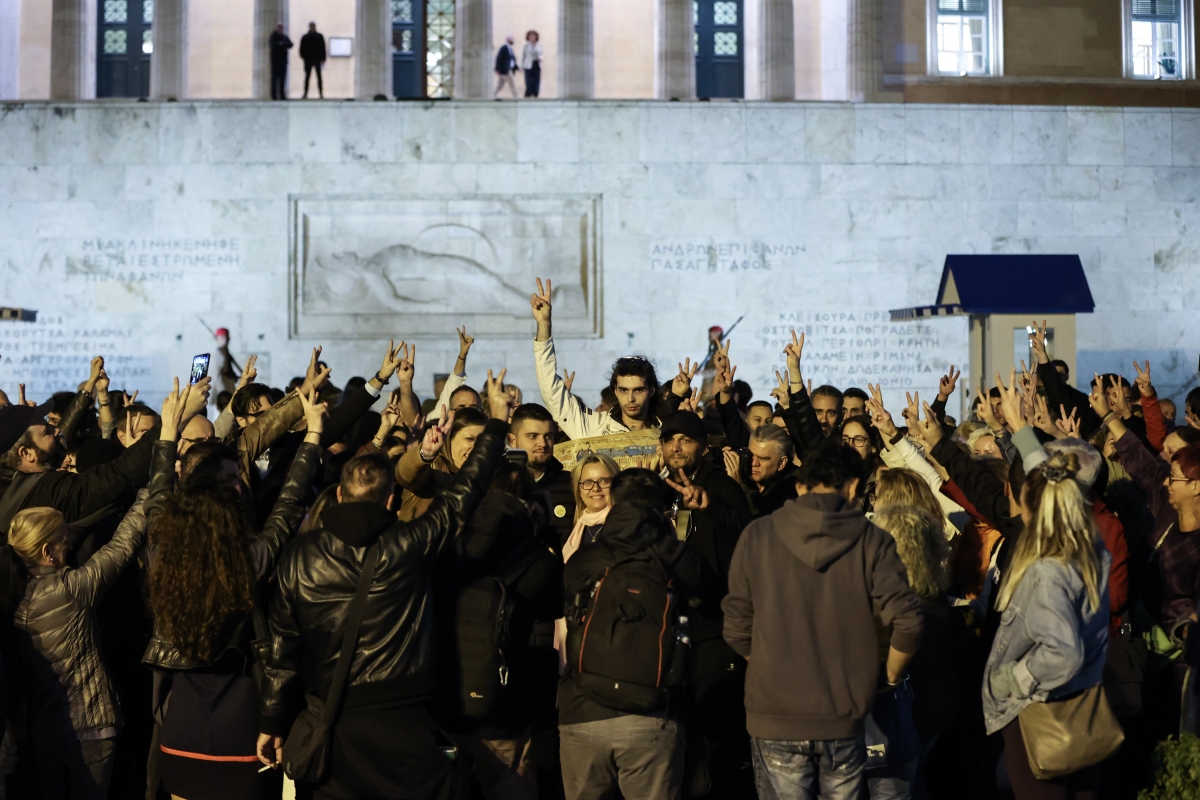
Aris Oikonomou / SOOC
Commentary by Thanos Kamilalis
(For international readers: Syntagma is Athens’s central civic square, directly facing the Hellenic Parliament and the Monument to the Unknown Soldier in front of it. Panos Routsi went on hunger strike requesting the exhumation and toxicological and biochemical tests for his son, Dennis, who died at the Tempe train collision. New Democracy is Greece’s governing party.)
The Monument to the Unknown Soldier serves as the pretext, the fig leaf behind which the government hides its resentment of citizens’ mobilisations. It is no coincidence that this sudden ‘concern’ for the monument arrived immediately after a rare victorious protest. Managing this political defeat also involves pandering to far-right audiences inside and outside New Democracy, which are licking their wounds after Mr Rutsi’s breakthrough, alongside intra-party manoeuvres and a heavy dose of anti-democratic reflexes.
In his Sunday message, Mitsotakis offered a formal nod to Routsi’s vindication, then announced the government’s intention to ensure that such a victorious mobilisation would not happen again. He did not address the causes of the protest. The problem, for the prime minister, is the consequence of the injustice: a demonstration directly in front of Parliament. After speaking of ‘disruption for days in the centre of Athens’, he declared that he would ‘assign the exclusive responsibility for the protection and proper functioning of the Unknown Soldier where it belongs, to the Ministry of National Defence’.
Within two hours came ‘clarifications’. The government said that the prime minister did not mean the army would be involved and that public order would remain the responsibility of the Hellenic Police. The Defence Ministry would handle ‘protection, maintenance and cleaning’ of the monument. It is hard to believe the prime minister’s staff had not foreseen the need for this clarification from the outset. The announcement appeared calibrated to allow a discreet implication to circulate, feeding daydreams among far-right audiences inside and outside New Democracy of army intervention against demonstrators outside Parliament next year, in the style of Donald Trump’s moves in the United States. During Routsi’s protest, that audience fulminated about the ‘desecration of the monument’. Those were the mild reactions. Several spoke in vulgar terms about a father who lost his child in the Tempe crime. This is the constituency to which the Mitsotakis government renders accounts, and from the beginning it has treated the Tempe victims’ families as its enemies.
After the clarifications, Mitsotakis’s chief lieutenants, the self-described ultra-liberals Kostis Hatzidakis and Akis Skertsos, emerged to justify the decision, and were clearer than their leader.
The deputy prime minister, Hatzidakis, professed ‘surprise’ at reactions from the opposition to New Democracy’s left, while seeking approval from critics on the ‘right’ such as Samaras, Velopoulos, the far-right parties Nike and and Latinopoulou: ‘I am amazed by the reactions of the opposition parties and some analysts. I expected them to show more restraint and less partisan fanaticism. However, we expect those who do not miss any opportunity to demonstrate their… patriotic feelings to take a clear position. Or is it that for them it is not patriotic at all when the government does it? We will find out soon.’
The minister of state, Skertsos, explained that the decision ‘defines as a protected area the monument itself as well as the 4,500 sq m area in front of it’. Citizens should not worry, he said, because the remaining space under Amalias Avenue, beyond the Parliament building, ‘is five times larger’. The point is not the size of the space, which in any case the government does not ‘grant’ to citizens. The point is the visibility of the protest.
This is the space where citizens have historically mobilised to claim rights and resist government practices and decisions. The most central locus is directly outside Parliament, in front of a symbol of democracy. The same space hosted demonstrations backed by New Democracy, such as ‘We Remain in Europe’ during the week of the 2015 referendum and the rallies against North Macedonia keeping its Greek name. No current minister raised concerns about ‘protecting the monument’ then. On the contrary, most participated, as was their right.
Today the government presents its latest authoritarian slide as ‘obvious’ and ‘self-evident’, as if a consensus already existed that demonstrations should not be held directly outside Parliament and it is now rushing to satisfy this supposed universal demand. It falls back on vague invocations of ‘the nation’, ‘symbols’ and ‘the homeland’, while forgetting citizens. Patriotism is pressed into service for this purpose.
The government spokesman invoked the ‘silent majority’ to justify the decision. Invoking a majority in anything related to the Tempe crime is outrageous. If there has been a strong majority in recent weeks, it has been on the side of Panos Routsi, the man whom government-aligned trolls accused of ‘defiling the space’. As Elena Olga Christidi has stated, it is characteristic of the global far right first to construct a problem and then to propose an authoritarian solution. The same pattern appears in the scare over the ‘woke agenda’, in claims by the Trump administration about rising crime in Democrat-governed states, and in the fixation on ‘the terrorist organisation Antifa’.
Citizens are being schooled in authoritarianism, with the help of supposedly liberal, ultra-centrist apologists. At the same time, the discussion is diverted from real social questions, such as why a man who lost his child had to starve himself for 23 days to secure a basic request.
It is telling that this ‘interest in the monument’ comes after one of the very few victorious protests in recent years. This is Mitsotakis’s attempt at revenge. It targets the vast majority of society that supported Routsi, physically or emotionally, and it targets the defence minister, Nikos Dendias, who took a position in favour of satisfying the hunger striker’s demands. The aim is to ensure that any future vindication achieved through protest becomes even more difficult.
Mitsotakis’s supposed concern for the ‘sanctity’ of the Monument of the Unknown Soldier is folded into intra-party manoeuvres. The monument becomes a pawn and the minister becomes its custodian. That minister will be responsible for the ‘cleanliness’ of the space, which means deciding what to do about the monument to the 57 Tempe victims that society itself has created in Syntagma Square.
Because in reality this is the prime minister’s problem. A society that reacts, persists, struggles, takes to the streets and shouts about the real issues, such as the Tempe crime. It is entirely logical that he seeks to change the subject to a vague discourse about ‘symbols’, which are ‘protected’ only when it suits his government.
If we are to talk about symbols, the fact that the prime minister wants to move citizens away from the space directly in front of Parliament, and to push them further back where they will be less visible, is itself a potent symbol.
______________________________________________
Are you seeking news from Greece presented from a progressive, non-mainstream perspective? Subscribe monthly or annually to support TPP International in delivering independent reporting in English. Don’t let Greek progressive voices fade.
Make sure to reference “TPP International” and your order number as the reason for payment.
Σε χρειαζόμαστε
Το ThePressProject είναι το μοναδικό μέσο ανεξάρτητης, ερευνητικής και αποκαλυπτικής δημοσιογραφίας που στηρίζεται αποκλειστικά στις μικρο-δωρεές των επισκεπτών του. Πιστεύουμε ότι η πληροφορία πρέπει να είναι διαθέσιμη σε όλους και για αυτό δεν κλειδώνουμε κανένα κομμάτι της ύλης αλλά για να παραχθεί το πρωτογενές υλικό που θα βρείτε εδώ χρειαζόμαστε την υποστήριξή σου. Αν δεν πληρώσουμε εμείς για την ενημέρωσή μας, θα την πληρώσει κάποιος άλλος (και αν δεν είσαι ο Μαρινάκης μάλλον δεν έχεις τα ίδια συμφέροντα). Μάθε πώς
Σχόλια
- Κάνε κλικ για να σχολιάσεις
Πολιτική Σχολιασμού