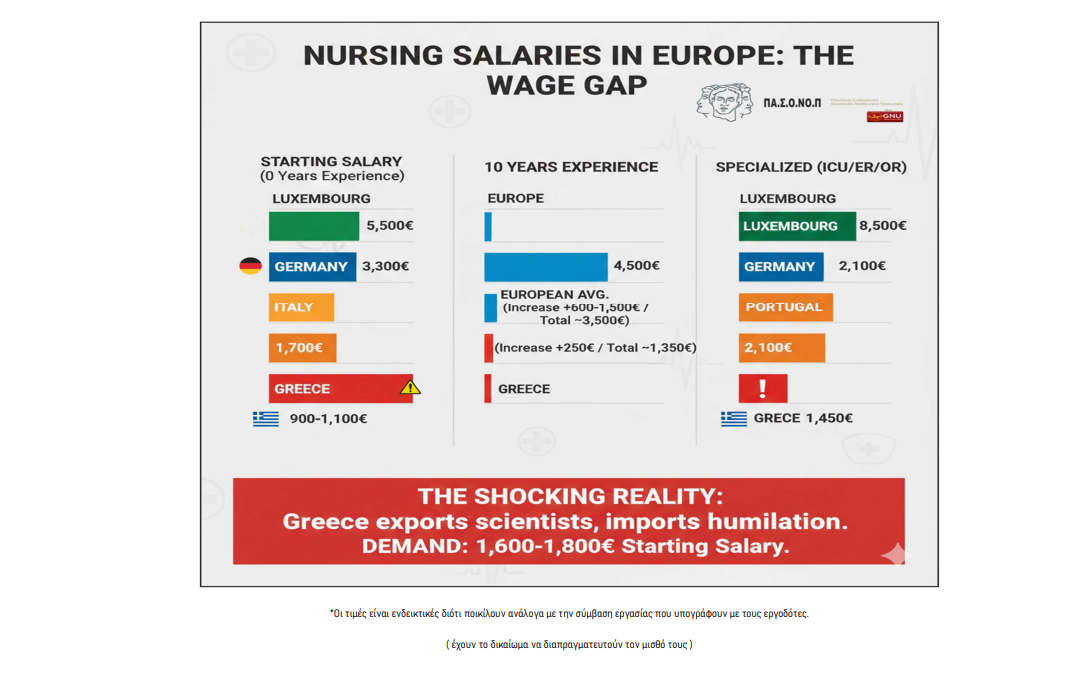
The survey, published last week by PASONOP, includes a comparative table of nurses’ monthly gross salaries across Europe, alongside an assessment of the best countries to work in based on pay, demand and working conditions. It presents an analysis of salaries and living costs across EU countries in order to show which are most economically advantageous for nurses.
Commenting on the findings, PASONOP states that ‘in Luxembourg, the average monthly gross salary of a nurse is approximately €5,000 to €6,300, while the cost of living index is among the highest in Europe (approximately 80 to 85 in European comparisons, where the EU average is around 100 as a relative index). Despite the high cost of living, employees’ purchasing power remains particularly high due to strong incomes and the country’s robust welfare state.
‘Similarly, in Switzerland, nurses receive approximately €5,800 to €7,900 per month, while the cost of living is the highest in Europe (cost of living index above 100 in European comparisons). Despite the increased costs, the country offers high net earnings and strong purchasing power.’
It adds that ‘in Belgium, the Netherlands and Germany, monthly salaries range from approximately €2,900 to €4,600. The cost of living in these countries is considered high, but proportionately balanced in relation to salaries (cost of living index of approximately 65 to 75). The income-to-expenditure ratio allows for a stable standard of living and relatively high job security.
‘In the UK and France, average salaries for nurses are lower than in northern Europe, at around €2,500 to €3,800 per month, while the cost of living remains high, particularly in metropolitan areas. The mismatch between income and expenditure, mainly due to high housing costs, limits workers’ purchasing power.’
By contrast, in southern and eastern European countries such as Italy, Greece and Lithuania, nurses’ salaries are significantly lower, at around €900 to €2,700 per month. ‘Although the cost of living is lower (index around 45 to 60), purchasing power remains limited due to low wages, which is associated with increased professional mobility and the migration of nursing staff to countries with higher salaries,’ the report’s authors note.
Greece: basic living costs absorb most of nurses’ income
In Greece, the report says, nurses’ working conditions differ significantly from those in northern and central European countries, mainly in terms of pay levels and career prospects. Public sector nurses earn on average between €1,000 and €2,100 per month, depending on experience and employment level, while private sector salaries may vary but are not significantly higher. Although the cost of living is lower than in many western European countries, basic living expenses such as housing, energy and food absorb a large share of income, sharply limiting workers’ purchasing power.
Contrary to the picture presented by Health Minister Adonis Georgiadis, the survey again finds that the Greek health system is marked by heavy workloads, staff shortages and limited opportunities for professional development compared with other European systems. These conditions, combined with relatively low pay, have contributed to the migration of a significant number of Greek nurses to northern and central Europe, where higher salaries and better working conditions are available. The report links this to the broader ‘brain drain’ affecting the staffing and operation of the national health system.
The report says Greece does offer some comparative advantages, including a lower cost of living than higher-income countries, the social and cultural environment, and the possibility of professional stability in the public sector. It notes, however, that the New Democracy government has repeatedly expressed its intention to revise the constitutional article concerning the permanence of public employees. Overall, it concludes that nursing work in Greece is characterised by limited financial reward compared with other European countries, affecting both job satisfaction and the mobility choices of health workers.
Most respondents would not recommend nursing to young people
Illustrative of the pressures facing workers in the sector is the fact that 72.7% of respondents said they would not recommend the nursing profession to a young person, expressing strong concern and dissatisfaction with current conditions.
‘This response is likely linked to issues such as understaffing, low pay, burnout and lack of professional recognition. This finding indicates the need for substantial interventions to make the profession more attractive and sustainable for younger generations,’ the study’s authors comment.
______________________________________________
Are you seeking news from Greece presented from a progressive, non-mainstream perspective? Subscribe monthly or annually to support TPP International in delivering independent reporting in English. Don’t let Greek progressive voices fade.
Make sure to reference “TPP International” and your order number as the reason for payment.