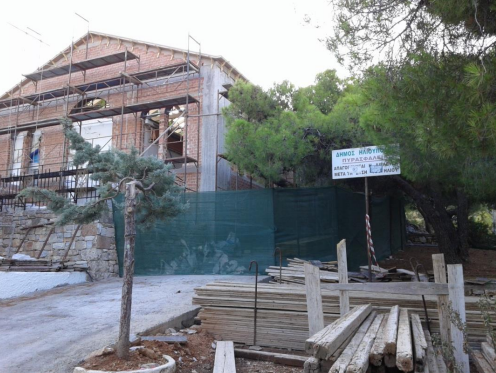
In 2022 the Athens Urban Planning Department declared the structure unauthorised and subject to demolition. Yet the decision has still not been implemented.
TPP spoke with members of the Ilioupoli Open Circuit Assembly, an open collective active on issues of public space, the environment and solidarity, which has been involved in the case throughout.
For the assembly, the chapel of Prophet Elias is not just a case of illegal construction. It is a small but revealing struggle over whether the mountain, green areas and public spaces will remain common goods or slowly be surrendered to profit and private interests.
‘Here, it is not only the unauthorised structure that is at stake. There is much hidden behind it. There are development plans for the mountain, which will be disastrous for the region,’ members of the assembly told TPP.
From a place of memory to a church business
The chapel of Prophet Elias, perched on Hymettus, has been a point of reference for Ilioupoli residents since the 1950s. Integrated into the natural landscape, it was for decades a meeting place for the neighbourhood, for worship, recreation and local traditions such as the Clean Monday gatherings known as Koulouma, as well as school trips and personal memories.
Its character as a small chapel within the forest area was preserved for years, until gradual interventions began to alter it.
In 2019 the situation changed. The chapel roof needed repairs. According to the assembly, priest Stylianos Karpathiou, who had gathered a group of fervent supporters around him, sought to turn the chapel into a venue for weddings, baptisms, talks and other events, despite the existence of two parish churches nearby.
‘In other words, they tried to make a business out of it,’ a member of the assembly said.
This new use created new demands for mass access and parking. According to residents, an illegal makeshift car park was created in the forest area of Hymettus, while a barrier that had prevented cars from entering the existing road was removed, with uncontrolled consequences.
‘There was a fanatical audience around the priest, who obviously defended tooth and nail whatever he said,’ members of the assembly said.
They described the works as taking place at night, with municipal tolerance. ‘The priest and his supporters, after hiring a contractor, and without any reaction from the then acting mayor, went up every night with trucks and built on the chapel. The municipality had placed someone to guard the site all night, preventing anyone other than the trucks from entering,’ they said.
They also claimed that the priest had the backing of Archimandrite Seraphim. ‘The priest also had the support of Archimandrite Seraphim, who has a lot of power, and in this way he “holds” the municipal factions and “upgrades” mayors. In a sense, the municipal factions are afraid of the political cost from Seraphim,’ they said.
The structure declared illegal and subject to demolition
Residents of Ilioupoli, seeing the chapel being altered and converted into what they describe as a profitable event space, began to organise.
‘Those who took it on then were residents of the neighbourhood, especially older residents. They took it to court, they organised protests. It all started with the Ilioupoli Citizens’ Movement and Ms Dimitriou, whom we unfortunately lost a few years ago. They took it to court,’ members of the assembly said.
Protests, rallies, open residents’ assemblies and every available form of pressure were used in an effort to reclaim the mountain.
During one protest at the chapel, Archimandrite Seraphim appeared at the site. At the time, priest Stylianos was holding a service, which, according to residents, he repeated continuously in order to prevent any intervention by those gathered. The situation soon escalated and incidents followed, with residents facing police repression and physical violence.
‘They were protecting those who were building illegally,’ a member of the Open Circuit of Ilioupoli Assembly said.
The case did not begin now. In 2022, after pressure from residents, the Athens Urban Planning Department carried out an inspection report, found the structure to be unauthorised and declared it subject to demolition. Responsibility for the demolition lay with the Decentralised Administration of Attica.
The priest, as the alleged owner of the site and the person who commissioned the works, was held responsible for the illegal interventions and fined €150,000. It emerged that there was no permit from either the Forestry Department or the Archdiocese. The only permit that existed concerned repairs to the roof of the traditional chapel and had, according to the residents, been improperly signed by the priest’s daughter, who is a civil engineer.
The priest appealed against the decision. The appeal was examined by the competent Council for Urban Planning Issues and Disputes and rejected. He then appealed to the Administrative Court of Appeal, again seeking to overturn the sanction. That appeal was also rejected, confirming the legality of the administrative acts.
As a result, the demolition decision has been final since 2022. No events other than services are now held there.
Municipal inaction and residents’ pressure
The Decentralised Administration of Attica, initially responsible for the demolition, remained inactive and requested the municipality’s assistance. The Municipality of Ilioupoli was therefore obliged to take the necessary action.
The Building Department of the municipality’s Technical Services Directorate, in compliance with that obligation, with Municipal Council decision 185/2023 and under the relevant legal framework, initiated the procedure for hiring and funding a contractor to demolish the unauthorised structure.
Four years after the demolition decision, however, nothing has changed. Despite repeated requests and pressure from residents, the municipality continues to maintain what they describe as a stance of inaction and indifference, citing a lack of funds while spending large sums on festivities and events.
This year, residents again intervened on Clean Monday, when people from across Ilioupoli traditionally go up the mountain for Koulouma.
‘We made an intervention this year on Clean Monday regarding the issue outside the chapel, because it is customary for the whole of Ilioupoli to go up the mountain on that day, as the Koulouma are traditionally held there. Then, in the same week, the criminal court was held, where the priest responsible for the unauthorised structure was sentenced to four years in prison with a suspended sentence and his daughter to two years,’ members of the assembly said.
The assembly has also submitted written requests to both the municipality and the region. According to residents, the municipality, which is required under protocol to respond within three days, has not replied.
‘It is completely disgraceful, there is no political will,’ residents complained.
They say they have repeatedly raised the issue at municipal council meetings. ‘We have gone to the municipal council many times and asked, with the mayor giving no answer. In fact, the last time, people from the municipality kicked us out, swearing at us and saying that we were insulting the municipality. The municipality claims it has no money, at a time when it held a very large Christmas event costing €160,000,’ they said.
The municipality never responded institutionally, despite residents’ requests. ‘The reason is obvious: it is being blackmailed by church figures and does not want to lose the voters who support the unauthorised structure,’ they said.
In the municipal council, Deputy Mayor for Civil Protection Ch Kalarritis, a long-serving elected official, was the only one to vote in favour of the unauthorised structure, according to residents. He was also present at the mobilisation at City Hall and, when some citizens accused him of voting in favour, he replied: ‘And I did the right thing!’
The deputy mayor did not respond to TPP’s repeated requests for comment.
‘What remains is for the answers we are waiting for to be given’
A residents’ assembly was held on 28 March, with significant participation from citizens, local bodies and city collectives. Those present decided to mobilise at Ilioupoli City Hall on 3 April to request a meeting with the mayor and demand the implementation of the court decision, which was issued four years ago and has so far been disregarded.
TPP was outside Ilioupoli City Hall during the citizens’ intervention. Residents gathered at the entrance, seeking access to the building and requesting a meeting with the mayor. The difficulties were evident from the start, as City Hall employees did not allow citizens to enter and also prevented journalistic coverage of the protest.
After residents and TPP eventually entered the building, the municipality proposed that only four citizen representatives should attend the meeting. The residents rejected this, insisting that the process should be open and that everyone should be able to attend.
This gathering had a different tone. Behind the tension, what stood out was the fatigue and persistence of people who have been trying to be heard for a long time. As they said among themselves, they have ‘worn out their shoes’ going from service to service, without receiving clear answers.
The discussion eventually led to an agreement for a scheduled, open meeting with the mayor. Citizens set their conditions from the outset: anyone interested should be allowed to attend, rather than being selectively represented, so that their voice could be heard directly and without mediation.
Above all, they are demanding transparency. Not general assurances, but concrete answers: a clear timetable, a public commitment and specific dates for the demolition of the unauthorised structure.
Despite their disappointment, they also recognise what they have already achieved. The issue has been highlighted, it has gained publicity and the illegality has been recognised.
‘What remains is for the answers we are waiting for to be given,’ they said.
The meeting with Mayor Stathis Psyropoulos was marked by tension, as no clear commitments were given on the next steps regarding the demolition. Residents demanded political commitment and concrete action. The mayor condemned the unauthorised construction, but once again shifted responsibility back to the Decentralised Administration of Attica, despite the legal framework defining the municipality as competent, according to residents.
In its latest response to repeated pressure, the municipality presented residents with a document from the Decentralised Administration assigning the demolition to a contractor and stating that the unauthorised structure would be demolished by 31 December 2026.
This came despite the fact that the Building Department of the Municipality of Ilioupoli’s Technical Services Directorate, following a request by the Decentralised Administration of Attica and after a long period of inactivity, had already been required to take the necessary action.
The municipality was already obliged, on the basis of Municipal Council decision 185/2023 and under article 94, paragraph 7 of Law 4495/2017, to initiate the procedure for assigning and funding a contractor to carry out the demolition.
Citizens, who said they ‘have been asking for explanations for a year now, which they are not getting’, say they ‘no longer have any trust’ in the promises being made.
‘They issue papers from time to time so that the issue is forgotten,’ they added.
Will the municipality’s latest response and this ‘commitment’ mark a final victory for residents, or another denial of responsibility?
‘The tip of the iceberg’
When the discussion turns to Prophet Elias, it does not stay there for long. Members of the Open Circuit of Ilioupoli Assembly say that ‘there are three issues’ at stake: ‘the protection of cultural and environmental heritage, Hymettus itself, the unauthorised construction and encroachment on the mountain and the city’s free spaces as a whole, and finally, the way decisions are made’.
This is where the phrase repeated almost naturally by residents appears: ‘It is the tip of the iceberg.’
For them, this is not just one project or one specific intervention, but part of a broader direction they fear is taking shape: illegal settlements, planned or discussed expansions and pressures that could gradually transform Hymettus into something different from the mountain they know.
‘The issue may seem small, but it is not,’ they said, explaining that the chapel has become a gathering point for all these concerns.
‘It is something we can win,’ they added.
The discussion also turns to the way local administration operates. ‘It is not only the decisions, but also how they are implemented or not implemented,’ they said.
‘We have suffered many defeats and we must be able to celebrate our victories’
Through the mobilisations, residents say a first victory has already been achieved: the issue has been brought to light, has moved beyond the narrow limits of the neighbourhood and has begun to be discussed. For them, this is no small matter.
‘It is very important to win the case, to have such small victories. It is not just symbolic. As a movement, throughout the country, we have suffered many defeats and we must highlight our victories and be able to celebrate them,’ members of the assembly said.
‘For us, it is a matter of honour and dignity for the city. Why? Because here we see how the electoral system works, that is, clientelism, how they build clienteles, how they create electoral mechanisms, which is shameful for the city, and we want to highlight it. It is impossible for this crime to happen in our city and no one to speak out. They are trespassers, it is a situation that stinks from every side,’ they said.
In this context, the chapel of Prophet Elias ceases to be merely an incident of illegal construction and becomes something broader: a test of what a local community can defend and how far it is willing to go for it. It has become a symbol of the meaning of public space and of the future of Hymettus.
Through this conflict, a deeper concern emerges: profit and the logic of ‘development’ are expanding into every available piece of land, even in protected areas.
‘The issue may seem small, but it is not,’ residents stressed, insisting that something wider is at stake behind this specific site: whether the mountain, greenery and public spaces will remain common, public goods, or gradually give way to profit for the few, through expansions, legalisations of illegal acts and investment plans.
______________________________________________
Are you seeking news from Greece presented from a progressive, non-mainstream perspective? Subscribe monthly or annually to support TPP International in delivering independent reporting in English. Don’t let Greek progressive voices fade.
Make sure to reference “TPP International” and your order number as the reason for payment.