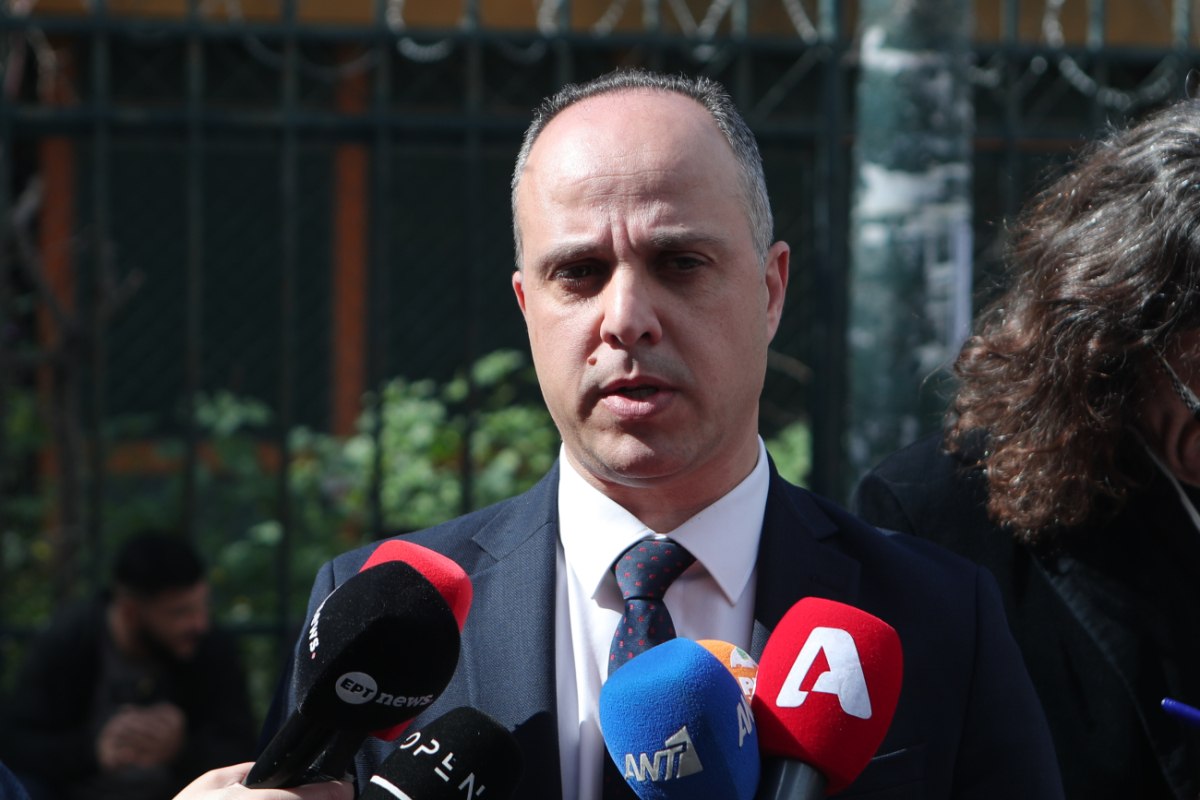
In a post on X, Kesses spoke of a departure from the order of seniority and institutional neutrality. He claimed that Bakelas has become the person who ‘monopolises every critical issue’ in the case through assignments, while describing the overall process as resembling a ‘relay race of predetermined roles and decisions’.
According to Kesses, this creates the impression of a mechanism whose aim is not to reveal the truth, but to control developments.
Kesses questions the choice of Bakelas to handle all key aspects of the wiretapping investigation, stressing that he is neither the most senior nor the most experienced among the prosecutors of the Supreme Court.
He claims that this practice departs from the usual logic of seniority and institutional neutrality, while stating that Bakelas, through formal or informal assignments from Konstantinos Tzavellas, is alleged to have exclusively undertaken the handling of critical aspects of the case.
At the same time, Kesses published relevant documents, speaking of a ‘photographic’ departure from the standard practice of the Supreme Court and the principle of seniority.
Kesses attributes central responsibility for the management of the case to the Supreme Court Prosecutor’s Office, describing a system with predetermined roles in which Bakelas appears to have had an active and coordinating role even before the official assignments were made.
In conclusion, he argues that these facts create the image of a mechanism that does not aim to reveal the truth, but rather to control and manage developments surrounding the wiretapping case.
His post in full:
‘The Supreme Court Prosecutor’s Office bears central responsibility for the cover-up in the wiretapping case. Its operation now resembles a relay race of predetermined roles and decisions.
‘The current holder of the “baton” is Deputy Prosecutor of the Supreme Court E. Bakelas, who appears to know about, coordinate and handle critical issues in the case even before they are officially assigned to him.
‘E. Bakelas has become, through informal or formal assignments from K. Tzavellas, the person who monopolises every critical issue concerning the wiretapping case.
‘On 24 April 2026, a few hours after the application I submitted to K. Tzavellas, I was summoned by E. Bakelas to the Supreme Court, although he had not been officially assigned any competence on the issue.
‘During this meeting, I personally informed him about new confidential information, new lawsuits, the risk faced by specific individuals, and the need for the secure and confidential filing of documents.
‘He himself agreed that the statute of limitations for offences should be avoided, that there was a possibility of directly referring to trial the nine accomplices of the four already convicted individuals without sending the case file back to the Supreme Court, and that the acts had been incorrectly attributed as consecutive rather than serial.
‘At the same time, he even expressed an opinion on the issue of K. Tzavellas’s self-recusal, assuring me that he expected the case to be assigned to another prosecutor of the Supreme Court, which turned out to be untrue.
‘Immediately after our discussion, and while we were outside K. Tzavellas’s office, E. Bakelas entered his office, conveying what had preceded. A few hours later, K. Tzavellas’s well-known unacceptable order was issued, ruling that there was no reason for further investigation, while at the same time the file was closed so that no new documents could be filed.
‘On 7 May 2026, K. Tzavellas directly assigned to E. Bakelas:
‘the new request submitted by Ch. Spirtzis to reopen the archived case file;
‘as well as the application for K. Tzavellas himself to be recused.
‘E. Bakelas has been chosen to handle all critical aspects of the case, despite the fact that he is neither the most senior nor the most experienced among the serving prosecutors of the Supreme Court. This constitutes a direct departure from the traditional logic of seniority and institutional neutrality.
‘Although the request to reopen the archived case file has been assigned since 7 May 2026, to date he has taken no substantive action.
‘All of the above creates the image of a mechanism that operates not with the aim of seeking the truth, but of controlling and absorbing every critical development in the wiretapping case.
‘I am attaching the relevant documents proving the problematic assignment of the applications exclusively from K. Tzavellas to E. Bakelas, with a photographic bypassing of the current practice of the Supreme Court and the order of seniority.’
______________________________________________
Are you seeking news from Greece presented from a progressive, non-mainstream perspective? Subscribe monthly or annually to support TPP International in delivering independent reporting in English. Don’t let Greek progressive voices fade.
Make sure to reference “TPP International” and your order number as the reason for payment.