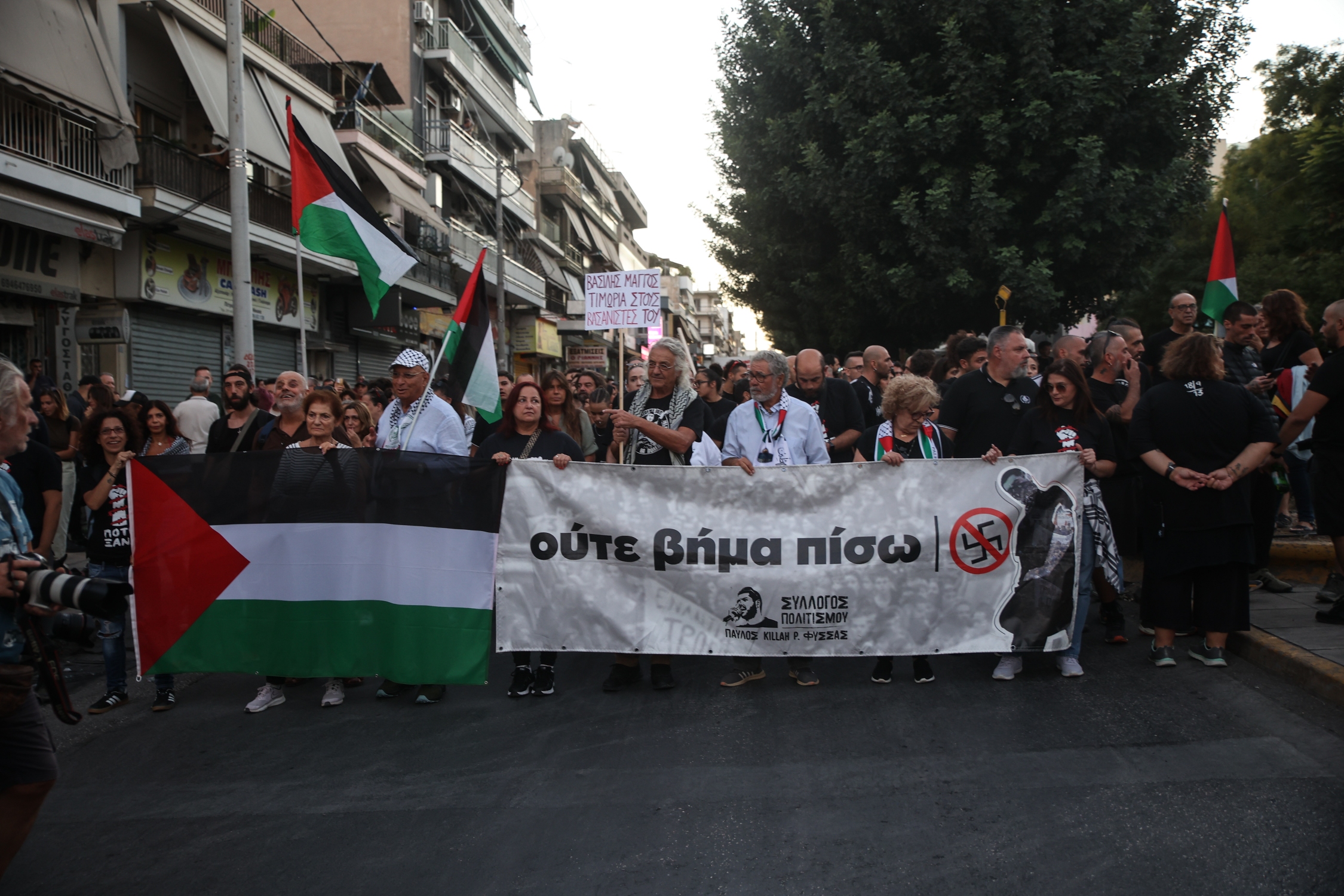
Thousands gathered yesterday in Keratsini for a memorial rally and march to the historic Kokkinia blockade site. Demonstrations also took place in Thessaloniki and in cities across Greece, including Patras, Chania, Kavala, Ioannina, Heraklion, and Alexandroupoli.
“Not a step back”
The day began with flowers laid at Fyssas’ monument in Keratsini. His mother, Magda Fyssa, visibly moved, caressed and kissed the relief of her son before leading the march. Wearing a Palestinian scarf and holding a banner that read “Not a step back”, she addressed the crowd:
“For us, nothing has changed. They plunged our family into mourning. Pavlos, you may see him as a hero, but for us he was our child… Today I will not dedicate my day to the murderer of my child. Today we will carry Pavlos on our shoulders and lay him where he deserves: in Kokkinia Cemetery.”
Outrage at release of Golden Dawn leader
This year’s commemoration coincided with widespread anger at the decision of the Lamia Appeals Court to release Golden Dawn leader Nikos Michaloliakos on “health grounds”. Michaloliakos, sentenced to 13 years in prison as head of a criminal organisation, will serve the remainder of his sentence under house arrest with monthly reporting obligations.
Fyssas’ family and their lawyers denounced the release as “scandalous” and “an insult to the collective memory of democratic society”. They warned that Golden Dawn has not been eradicated but continues under new names and forms. Civil lawyer Kostas Papadakis described Michaloliakos’ preferential treatment as “a challenge to society and the anti-fascist movement”, noting that the former leader had not been held in prison continuously but spent years in hospitals and rehabilitation centres.
The Piraeus Labour Centre stressed that “the conditions that gave birth to and armed the hand of the fascists not only remain, but are strengthening”. It condemned the release as “a real challenge to the people, who with their struggle sent Nazi criminals to prison”.
A nationwide mobilisation
Trade unions, student associations, and anti-fascist groups turned out in large numbers. In Athens, police closed metro stations along the demonstration routes. The rallies were joined by relatives of other victims of state and far-right violence.
Yiannis Maggos, father of Vasilios Maggos, who died after police violence in 2020, declared: “We are here to show that our cases are common. There are political causes. We are demanding justice.”
Anastasis Manioudakis, son of 58-year-old Kostas who died during a police check in Chania earlier this month, said: “They were not accidents, but murders: Fyssas, Pylos, Tempi, Vasilios Maggos, Afratis, the murder of my father. We will not stop being all together as one fist.”
“Fascism will not die on its own”
Political leaders also attended. Dimitris Koutsoumbas, Secretary General of the Communist Party of Greece (KKE), stated:
“Fascism is a product of the capitalist system, born in its womb. It will not die on its own – it must be crushed. These words are more relevant today, when Michaloliakos has been released, when Kasidiaris is preparing for release, and when the state is failing to act against these scum of history.”
Other groups, including KEERFA (United Against Racism and the Fascist Threat), linked the fight against fascism to struggles against systemic racism and government complicity. They called for no cover-up of state crimes, from Fyssas’ murder to the drowning of hundreds of refugees in Pylos.
Twelve years after Fyssas’ assassination, his memory continues to galvanise mass resistance. As banners in Keratsini declared: “We do not forget. We do not forgive.”
______________________________________________
Are you seeking news from Greece presented from a progressive, non-mainstream perspective? Subscribe monthly or annually to support TPP International in delivering independent reporting in English. Don’t let Greek progressive voices fade.
Make sure to reference “TPP International” and your order number as the reason for payment.