Analysis by Panagiotis Papadomanolakis
According to a Wall Street Journal report published in January, Donald Trump is pursuing ‘regime change’ in Cuba before the end of the year. Shortly afterwards, the US president formally designated Cuba an ‘unusual and extraordinary threat’ to national security, accusing the government in Havana of aligning ‘with international terrorist groups and malign actors hostile to the United States, including the government of the Russian Federation, the People’s Republic of China, the government of Iran, Hamas and Hezbollah’.
The designation invokes the International Emergency Economic Powers Act (IEEPA) of 1977, establishing a legal framework for new secondary sanctions on goods imported into the United States from any country supplying oil to Cuba, directly or indirectly. Trump applied a comparable measure against Venezuela in March 2025, laying the groundwork for subsequent action against that country.
The ‘new Monroe doctrine’
Trump’s stated justifications do not correspond to any demonstrated security threat to the United States comparable to the 1962 missile crisis, when Washington came close to using nuclear weapons in response to the installation of Soviet missiles in Cuba. There is no credible evidence that Cuba maintains anything beyond political, economic, and lawful defence relations with US adversaries. Cuba does not permit foreign military bases on its territory; the only foreign military installation on the island is the US base at Guantánamo, which the Cuban government regards as an illegal occupation. Cuba does not possess weapons capable of striking US territory, and its military cooperation with China and Russia is limited to air defence systems and joint personnel training for deterrence purposes.
The broader strategic logic is articulated in the latest US National Security Strategy, which states: ‘We will deny non-hemispheric competitors the ability to station forces or other threatening capabilities, or to possess or control strategically vital assets in our hemisphere.’ This formulation, which treats even peaceful economic presence by US adversaries in the Americas as a threat, has been described by analysts as a revived and expanded Monroe doctrine. Taken to its logical conclusion, it would render any country in Asia that sought economic ties with the United States a target of Chinese objection by equivalent reasoning.
Energy dependence and the oil squeeze
According to the International Energy Agency, Cuba relies on fossil fuels for more than 90% of its energy, with almost two-thirds imported. Oil accounts for 83% of energy production and 56% of total energy consumption. Domestic production covers roughly 40% of demand, but this is a heavy, sulphur-rich crude that cannot be refined into motor fuel and is used solely for electricity generation.
Venezuela and Mexico together supplied around 75% of Cuba’s oil imports prior to the current escalation, with Russia accounting for a smaller share. In 2025, Venezuela met approximately 34% of Cuba’s total oil demand. However, following Maduro’s removal and the imposition of a US naval blockade on Venezuela, Washington effectively severed that supply route: Cuba’s closest regional ally is now unable to dispatch an oil tanker without the risk of interception and seizure by the US fleet in the Caribbean.
Mexico supplied 44% of Cuba’s crude oil imports in 2025, but has since come under US pressure to halt those shipments. Mexico’s president, Claudia Sheinbaum, rejected the ultimatum, citing her country’s sovereign right to conduct its own trade relations. Two Mexican navy ships subsequently delivered humanitarian aid to Cuba. Mexico is attempting to balance solidarity with the island against Trump’s threats of military intervention, framed publicly as action against drug cartels.
By January 2026, Cuba had recorded zero oil imports for the first time in a decade.
Attempts to stabilise the grid
With Chinese financing and equipment, the Cuban government has launched a programme to install 55 solar parks with a combined capacity of 1,200 MW, to be completed between 2024 and 2025, with a further 37 planned by 2028. With peak electricity demand estimated at 2,500 MW and current shortfalls reaching up to 1,300 MW, this renewable capacity could substantially reduce dependence on imported fossil fuels, according to reporting in Granma, the Cuban Communist Party newspaper, in November 2025.
Cuba is also working with Russia on engineering support for maintenance and efficiency improvements to the existing fossil fuel network, aiming to increase supply by 850 MW. In a separate development, the tanker Sea Horse is en route to Cuba carrying approximately 200,000 barrels of Russian diesel, in an attempt to provide immediate relief and break the blockade.
The intensity of the crisis has prompted questions about Washington’s broader intentions. Asked recently whether he was considering the forcible removal of Cuban president Miguel Díaz-Canel, as was carried out against Maduro, Trump replied: ‘I don’t want to answer that. Why would I answer that if I wanted to? It wouldn’t be a very difficult undertaking, as you can imagine, but I don’t think it would be necessary.’
The logic and cost of the blockade
Western media coverage has reflected the human toll. Headlines including ‘No fuel, no tourists, no cash’ (the Guardian) and ‘No food, no fuel, no tourists’ (CNN) point to the deliberate mechanism of the blockade: creating scarcity as a tool of economic warfare intended to produce ‘regime change’. Trump has described Cuba as a ‘failed nation’, stating: ‘There’s no oil. There’s no money. There’s nothing.’ Critics argue that what he attributes to Cuban governance is in large part the product of more than six decades of US economic siege.
Despite the blockade, Cuba has achieved internationally recognised advances in public health and education, including the elimination of illiteracy, significant reductions in infant and maternal mortality, increased life expectancy, and a civil protection system that has drawn international attention. Cuban medical and teaching missions have operated across the global south. The scale of what has been achieved under sustained economic pressure is, by comparative regional standards, considerable.
The stated objectives of the blockade are documented in UN General Assembly Resolution 79/7, renewed in 2025, which describes a campaign designed to ‘harm tourism and travel by Americans and other countries, sabotage international medical cooperation and fuel supplies, impede the flow of family remittances, and intimidate foreign direct investment and trade, as well as disrupt Cuba’s economic and cooperative relations with third countries’.
The resolution translates the annual cost of the blockade into concrete terms. A selection of the equivalences it sets out:
The cost of four months of blockade equals the funding required to purchase the buses needed by the public transport system ($2,850,000,000). The cost of two months equals the fuel required to meet normal electricity demand ($1,600,000,000), and separately, the funding needed to provide the annual food basket for families ($1,600,000,000). The cost of 16 days equals the funding required to meet the national list of essential medicines ($339,000,000). The cost of 14 days equals the financing needed to increase renewables in the energy mix from 24% to 26% ($300,000,000). The cost of 12 days equals annual funding to maintain the national power generation system ($250,000,000, excluding fuel and investment costs). The cost of six days equals the import of medical supplies and reagents needed by the national health system for one year ($129,000,000). The cost of two days equals the annual maintenance required for public transport ($40,000,000). The cost of 21 hours equals the replacement of outdated technological resources in education ($18,133,050). The cost of 14 hours equals the insulin needed for a year ($12,000,000). The cost of five hours equals toys and teaching aids needed in all kindergartens ($4,500,000). The cost of two hours equals medicines for psychiatric, neurological, and cardiac conditions, as well as food for children with genetic deficiencies and endocrine metabolic diseases ($1,400,000). The cost of 19 minutes equals the electric and conventional wheelchairs required for special education ($280,506). The cost of 17 minutes equals the drug Nusinersen for annual treatment of childhood spinal muscular atrophy ($250,000). The cost of 10 minutes equals funding for hearing aids for children and adolescents with disabilities in special education ($142,966.82).
The blockade’s intent was set out plainly in a classified State Department memorandum written by official Lester Mallory in April 1960: ‘To cause starvation, despair, and the overthrow of the government.’
US secretary of state Marco Rubio has more recently described the current campaign as one of ‘maximum pressure’, aimed at cutting off all external sources of income for the Cuban government in order to force ‘political and economic liberalisation’, by which he means the end of the socialist system. ‘This is a regime that has survived almost entirely on subsidies, first from the Soviet Union and then from Hugo Chavez,’ Rubio said.
Cuba’s response
Cuban authorities have characterised Washington’s escalation as a ‘total blockade’ and accused the United States of waging economic warfare against the Cuban people. An article in Granma paid tribute to children with physical disabilities unable to access medicines or wheelchairs as a result of the blockade.
Conditions on the island have been compared by Cuban officials and commentators to the ‘special period’ that followed the USSR’s collapse, when new US measures, the Torricelli Act of 1992 and the Helms–Burton Act of 1996, contributed to a severe contraction in GDP, foreign trade, and energy and food availability. That period was eventually stabilised through emergency economic planning, popular mobilisation, and the rise of left-wing governments across Latin America, beginning with the Bolivarian revolution in Venezuela.
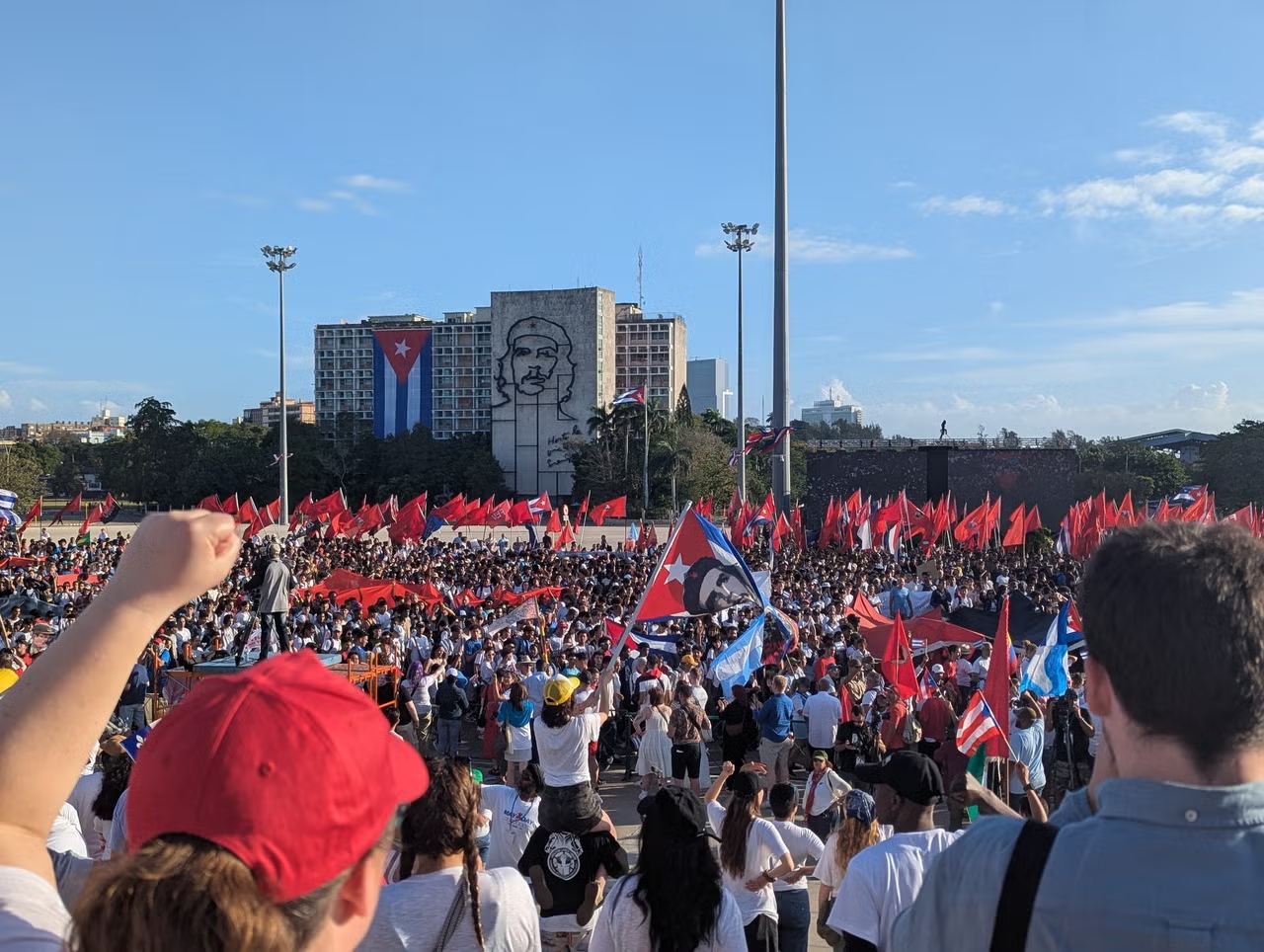
Facing comparable pressures today, the Cuban government has introduced a new emergency programme, shifting education and other activities to distance or hybrid formats in order to conserve energy as power cuts worsen. Díaz-Canel has addressed mass rallies, reiterating that ‘Cuba is not a terrorist country nor does it pose a threat to the security of the United States’ and expressing willingness to engage in dialogue, while insisting that ‘dialogue under pressure is not dialogue’.
As a BRICS+ partner state, Cuba is also seeking to use multilateral frameworks to circumvent the blockadeSolidarity from across Latin America, the global south, and citizens in western countries is, the article argues, not incidental but essential to resist Washington’s campaign.
______________________________________________
Are you seeking news from Greece presented from a progressive, non-mainstream perspective? Subscribe monthly or annually to support TPP International in delivering independent reporting in English. Don’t let Greek progressive voices fade.
Make sure to reference “TPP International” and your order number as the reason for payment.