MEP Arvanitis: Stop the abuse of SLAPP lawsuits by the Greek judiciary
SYRIZA MEP Costas Arvanitis stated that the recent rejection by Greek courts of punitive lawsuits against Stelios Kouloglou and other journalists offers “breathing space to a suffocating democracy”. As he stressed, the interruption of what he described as the “production line” of abusive SLAPP lawsuits filed by Grigoris Dimitriadis is a reminder that freedom of expression and investigative journalism cannot be silenced, “even in the Greece of New Democracy and the cover-up”.
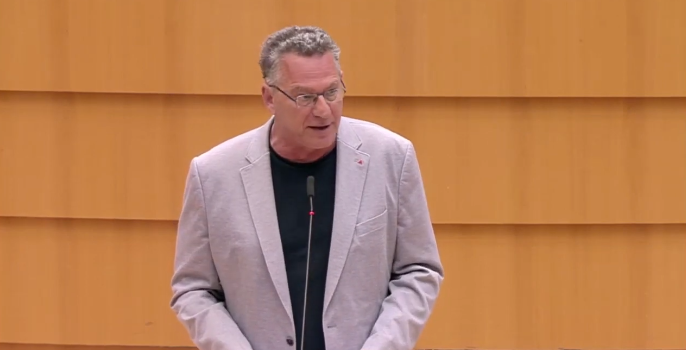
According to Arvanitis, Greece has in recent years witnessed the emergence of a full-fledged lawsuit industry: a systematic abuse of the judicial system aimed at intimidating, financially exhausting and discouraging those who investigate, criticise or simply ask questions. “We are no longer talking only about ‘annoying journalists’,” he noted. “We are talking about ‘annoying MPs and MEPs’, ‘annoying citizens’.” In this climate, he said, media outlets and journalists such as Documento, TVXS, Reporters United, the Editors’ Journal, journalist Thanasis Koukakis, Thodoris Chondrogiannos, Stelios Kouloglou and himself were targeted.
He added that at the same time major scandals, including the wiretapping affair, were systematically covered up. Instead of holding accountable those who organised the illegal surveillance of politicians, journalists and citizens, those who revealed the truth were persecuted. Arvanitis recalled earlier cases, such as the prosecution of journalist Yianna Papadakou in the Lagarde list affair, Stavroula Poulimeni in the Hellenic Gold case, Eleni Iliopoulou and others.
“This situation is not compatible with European democracy or with the rule of law,” he stressed.
Referring to the court ruling in favour of Kouloglou, Arvanitis underlined that it confirms political and journalistic criticism is not a criminal offence, and that SLAPP lawsuits cannot replace public debate or function as a tool of political and communicative self-protection for those in power.
He recalled that in the European Parliament he fought for the adoption of the EU directive against SLAPP lawsuits, a battle that Kouloglou supported from the outset. “Today’s Greek court decision confirms that we were right: abusive lawsuits are not about the ‘protection of honour’, they are a weapon used to silence and manipulate public discourse,” he said.
Arvanitis called on the government to align itself with the European acquis, protect investigative journalism, guarantee pluralism and transparency, and put an end to the criminalisation of criticism and scrutiny of power.
As the European Parliament’s rapporteur on the rule of law in the EU for 2025, he noted that he will have the institutional responsibility to assess, on the basis of evidence, whether member states – including Greece – respect press freedom, the separation of powers and the protection of those who exercise democratic oversight. “Today’s case shows that Greece still has a long way to go,” he concluded.
“Democracy lives by the light. And as long as some insist on silencing, we will insist on truth, accountability and control.”
______________________________________________
Are you seeking news from Greece presented from a progressive, non-mainstream perspective? Subscribe monthly or annually to support TPP International in delivering independent reporting in English. Don’t let Greek progressive voices fade.
Make sure to reference “TPP International” and your order number as the reason for payment.
Σε χρειαζόμαστε
Το ThePressProject είναι το μοναδικό μέσο ανεξάρτητης, ερευνητικής και αποκαλυπτικής δημοσιογραφίας που στηρίζεται αποκλειστικά στις μικρο-δωρεές των επισκεπτών του. Πιστεύουμε ότι η πληροφορία πρέπει να είναι διαθέσιμη σε όλους και για αυτό δεν κλειδώνουμε κανένα κομμάτι της ύλης αλλά για να παραχθεί το πρωτογενές υλικό που θα βρείτε εδώ χρειαζόμαστε την υποστήριξή σου. Αν δεν πληρώσουμε εμείς για την ενημέρωσή μας, θα την πληρώσει κάποιος άλλος (και αν δεν είσαι ο Μαρινάκης μάλλον δεν έχεις τα ίδια συμφέροντα). Μάθε πώς
Σχόλια
- Κάνε κλικ για να σχολιάσεις
Πολιτική Σχολιασμού