The constitutional revision process requires two successive Parliaments. The current Parliament proposes the articles of the Constitution to be revised. The next Parliament, formed after the next elections, revises those specific articles. If an article is approved for revision with 180 votes, the next Parliament will need 151 votes to revise it, and vice versa.
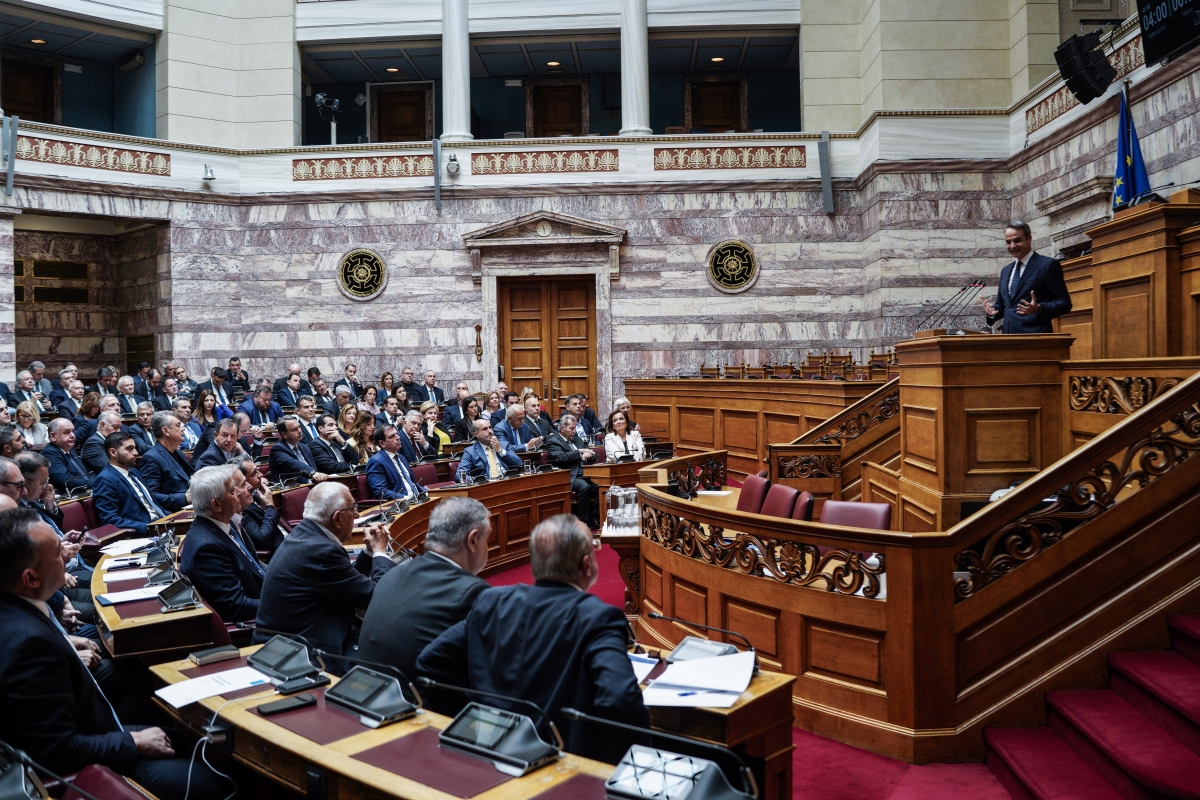
‘A wave of reform is being unleashed so that by 2030 we will have eradicated pathologies that we have sometimes dealt with sporadically, on a case-by-case basis,’ the prime minister claimed, noting that many areas still require the removal of the remnants of a peculiar old-style partisanship.
‘The new Charter, an institutional rupture and a flight forward, is coming to oppose the remnants of old-style partisanship,’ Mitsotakis stressed, speaking of ‘a single set of rules that will apply to everyone, excluding deviations, and a road map with many individual compasses that will lead public life and the political system into the new era. That is why it will be one of our central pre-election commitments.’
The prime minister accused the opposition of embarrassment and silence over the constitutional revision, claiming that it ‘does not care about the country’s future’ and is ‘exclusively concerned with constructing scenarios to undermine the government’s credibility and the ethos of New Democracy.’
Opposition reaction
PASOK press spokesperson Costas Tsoukalas, commenting on Mitsotakis’ speech to the New Democracy parliamentary group, said that ‘the prime minister’s speech today is the personification of tactical manoeuvring and adventurism. What he says he will revise, he has already violated.’
‘New Democracy is entering the debate on constitutional revision with zero credibility and anti-social intentions,’ SYRIZA said in a statement, describing the text of the proposals distributed to ruling party MPs as ‘a political paradox, if not a farce.’
New Left denounced the constitutional revision promoted by the ‘Mitsotakis regime’ as a ‘last attempt to change the agenda’ away from scandals, while arguing that it remains a spearhead for imposing reactionary strategic choices leading to the ‘constitutionalisation of neoliberalism and the further authoritarianisation of the state.’
The Greek Communist Party (KKE) accused Mitsotakis of ‘going beyond any limit of provocation’ by presenting himself and the government as victims in the OPEKEPE scandal, when ‘in reality they are the perpetrators and the guilty parties.’ Instead of apologising for the ‘orgy of clientelism,’ the party said, Mitsotakis is escalating the cover-up, refusing a preliminary investigation and pre-emptively exonerating his officials, whom he is even rewarding with places on the ballot.
New Democracy’s proposals
The text distributed to New Democracy MPs, setting out the articles proposed for revision as a basis for discussion on the constitutional revision process, states:
‘With his letter of 2 February 2026 to all members of the parliamentary group, the prime minister and president of New Democracy, Kyriakos Mitsotakis, presented a set of thoughts regarding the basic guidelines of New Democracy’s proposal for the revision of the Constitution, while inviting members of the parliamentary group to co-formulate the proposal by sending their relevant proposals and observations. In this letter, he highlighted the constitutional acquis that has been shaped over the 50 years since the 1975 Constitution, while also outlining the new challenges arising in 2026 and highlighting the need for a bold and substantive constitutional revision aimed at a functional democracy for today and tomorrow.
‘In the three months that have passed, your response has exceeded all expectations. Your innovative and content-rich proposals, the product of thorough research and documentation, were not limited to a simple specialisation and completion of the initial thoughts, but highlighted new themes and challenges that need to be enshrined in our constitutional charter. At the same time, your observations fundamentally enriched the initial proposals. Therefore, today, as a basis for further discussion, a body of 30 constitutional provisions is being formed, the revision of which is considered to be of key importance. Subsequently, the specific provisions are specialised and the proposed direction of the revision is determined.’
The proposals include:
- Article 5, Article 5A or new Article 5B
Artificial intelligence must serve individual freedom and the wellbeing of society, so that risks are mitigated and the advantages it offers are used.
- Articles 14 and 15
‘Purification’ and rationalisation of the press, television, radio and internet.
Protection of journalists against their employers.
- Article 16
State care for the protection, cultivation and dissemination of the Greek language.
Protection of the Greek flag as a symbol of the Greek nation and Greek culture.
Compulsory education may not last fewer than 11 years, instead of the current nine.
Provision of higher education by university-level legal entities, which may be public or non-state and non-profit in nature, with full self-administration, under the supervision of an independent authority and subject to ensuring a high level of studies.
- Article 17
Simpler wording.
Protection not only of property, but also of assets, including shares, bonds, intellectual and industrial property, and trademarks.
Compensation for restriction of use without expropriation.
Possibility of transferring building coefficients as a form of dynamic urban planning.
Use of abandoned buildings for social purposes.
- Article 21
State provision for affordable housing.
Consideration of intergenerational justice and solidarity.
- Article 24
Measures to address climate change, manage water resources effectively, strengthen renewable energy sources, ensure environmental balance in every state intervention and protect animals.
- Article 29
Political parties must be organised and operate democratically.
A law will define the conditions for the establishment and operation of a political party.
The Supreme Special Court under Article 100 will check whether the conditions for a political party’s participation in elections have been met.
- Article 30
A six-year term for the President of the Republic, with a transitional period for the serving president.
- Article 41, paragraphs 2 and 5
Abolition of the dissolution of Parliament on grounds of a matter of national importance. Dissolution would instead take place by government proposal and parliamentary decision for the renewal of the popular mandate, amounting to self-dissolution of Parliament.
- Article 44, paragraph 2
Introduction of rules for the proper conduct of referendums. The question must be formulated in a way that is clear and comprehensible to citizens. A sufficient period of at least 20 days must elapse between the announcement and the holding of the referendum.
- Article 51, paragraph 4
Possibility of exercising the right to vote by postal vote for voters located within Greece.
- Article 54, paragraphs 1 and 3
The electoral system should ensure reasonable proportionality and the governability of the country.
The law may provide for the division of the territory into smaller and larger regions.
- Article 55, paragraph 1
Eligibility to stand for election from the age of 21.
Suspension of military service for the duration of a parliamentary term.
- Articles 56 and 57
Abolition of the detailed list of impediments and incompatibilities. Establishment of general principles and authorisation of a law for implementation from subsequent elections, or immediately with a two-thirds majority.
- Article 60
Protection of the institutional role of MPs in exercising their legislative and oversight authority and in communicating with their constituency, in accordance with the Constitution and Parliament’s Rules of Procedure.
- Article 73, paragraph 1
Constitutional enshrinement of the principles of good lawmaking, including adequate pre-legislative consultation, evaluation of the implementation of laws and measures to codify legislation.
- Article 78, paragraphs 2 and 6
A tax or any other financial burden cannot be imposed by a law with retroactive effect.
Incentives for a stable tax regime may be provided for strategic private investments in the national economy.
- Article 79
The budget must ensure fiscal balance between revenue and expenditure and sustainable fiscal operation.
Submission and publication of an annual report by bodies financed, directly or indirectly, from the state budget.
- Article 81, paragraph 2
Possibility of providing by law for a functional incompatibility between the roles of MP and minister, and for temporary replacement.
Possibility of appointing vice-presidents of the Council of Ministers and non-ministerial officials.
- Article 82
Rules for the proper functioning of government.
- Article 86
Abolition ‘without delay’ of Parliament’s competence to conduct a preliminary examination.
A preliminary examination by a prosecutor at the Court of Appeal and a proposal to prosecute by a prosecutor of the Supreme Court. Alternatively, a preliminary assessment of ministers’ criminal liability by a mixed judicial-political body.
Prosecution by decision of Parliament, with an absolute majority of the total number of MPs, by roll-call vote.
- Article 89
The assignment of special administrative duties to judicial officers by decision of Parliament will be permitted under an implementing law.
Judicial officers will not be allowed to participate in government in any capacity, be appointed to political positions or be placed in independent authorities for at least three years after retirement.
- Article 90, paragraph 5
Promotions to the posts of senior judges by a special parliamentary committee from among the most senior judges, without government intervention, from a list of three judges for each position proposed by the relevant plenary sessions.
- Article 100
Composition of the Supreme Special Court with a three-year term, consisting of nine judges: the three presidents of the supreme courts, two judges elected by the plenary sessions of the Council of State and the Supreme Court, and two full-time professors of law selected by the other members.
Competence for preventive review of the constitutionality and compatibility with EU law of a passed bill, except for bills exclusively concerning the ratification of international treaties, at the request of the President of the Republic, the Council of Ministers or Parliament, up to twice in each parliamentary session.
A finding of unconstitutionality or conflict with EU law prevents the adoption of the law. A finding of constitutionality binds the courts after the adoption of the law.
- Article 101, paragraphs 3 and 5
A decentralised system: abolition of the presumption of competence in favour of decentralised administrations. The decentralised system may be implemented either through the existence of a decentralised state structure and/or through decentralised services of ministries and other public sector bodies.
State care for the support of the primary sector and the development of the Greek regions, so as to ensure equal access to public goods throughout the territory.
Principles of good administration, transparency, accountability and meritocracy. Constitutional enshrinement of the National Transparency Authority.
- Article 101A
Selection of the chairs and members of independent authorities by a parliamentary committee from a list of three candidates proposed by a Council of Experts following a public call for expressions of interest. The Council will include, ex officio, the governor of the National Transparency Authority, the president of the Supreme Council for Civil Personnel Selection (ASEP), the governor of the Bank of Greece, the president of the Rectors’ Conference and the head of the collective body representing first- or second-level local authorities.
- Article 102
A law will determine the levels of local government, which may be up to two.
By decision of the competent bodies of local government organisations, local or special taxes or charges of any nature may be imposed.
The budgets of local government organisations will be drawn up following adequate public consultation with residents of the relevant areas and must ensure fiscal balance.
Disciplinary penalties of dismissal or removal from elected local authority bodies will be imposed by decision of the Supreme Special Court.
- Article 103
Redefinition of the concept of permanent status. A law will define the procedure and criteria for evaluating civil servants, as well as the rewards and penalties this may entail, including dismissal, following a decision by the service council. Rewards will be linked to qualifications and performance.
Evaluation of public servants on the basis of the principles of impartiality, neutrality, professional competence and efficiency, with the possibility of ASEP participation.
Evaluation will be two-way, from subordinates to their superiors, as well as from citizens to all public servants.
______________________________________________
Are you seeking news from Greece presented from a progressive, non-mainstream perspective? Subscribe monthly or annually to support TPP International in delivering independent reporting in English. Don’t let Greek progressive voices fade.
Make sure to reference “TPP International” and your order number as the reason for payment.