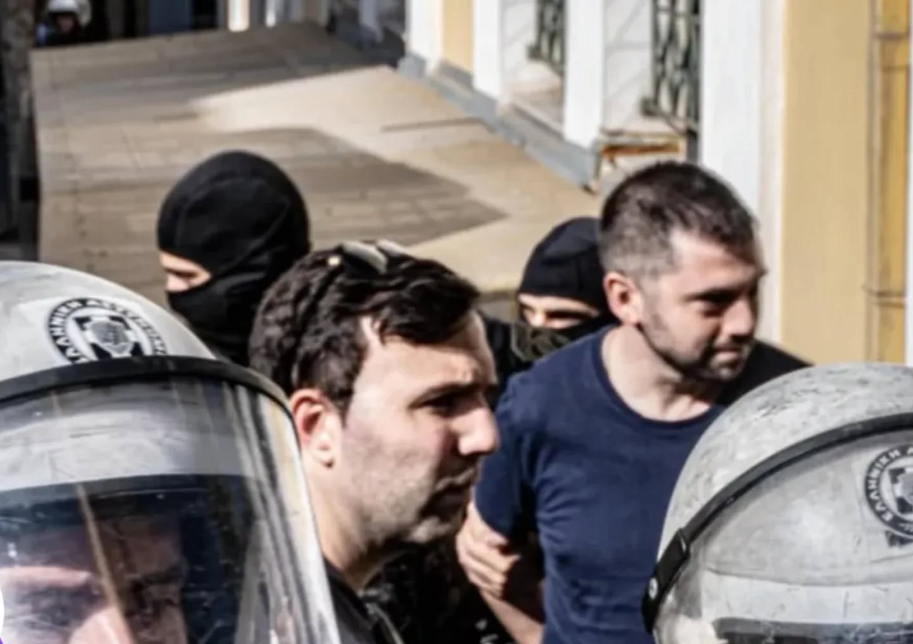
Report by Cynthia Bousiou
Dimitra: ‘The Anti-Terrorism Service violated the presumption of innocence, turning the principle “everyone is innocent until proven guilty” into “all militants are guilty”’
Dimitra Zarafeta was the first to begin her defence. ‘My prosecution is purely related to my political identity and to the fact that I defended personal and friendship relationships. The case was based not on evidence, but on acrobatics that portrayed me as a potential terrorist,’ she said at the beginning of her statement. She then described it as paradoxical that the indictment relied on her studies as an electrical engineer at the Polytechnic in order to justify an alleged technical background for making a bomb.
‘A loss weighs heavily,’ she continued, ‘that of the anarchist Kyriakos Xymitiris. His thoughts and dreams are not material for a judicial judgment. The tarnishing of our comrade’s memory is unacceptable.’ She then declared that she refuses to be politically isolated and exterminated. ‘Whether the Anti-Terrorism Service manages to impose its narrative is in your hands,’ she said, addressing the bench. ‘The Anti-Terrorism Service, in one night, fabricated and drafted a heavy indictment carrying up to 25 years in prison, with the only “element” being the keys together with my comrade Dimitris,’ she added.
Reviewing the content and facts of the case, she said that she came to Greece to clarify her relationship to the case after learning that Marianna Manoura was fighting for her life and that Kyriakos was dead. She added that some of the defendants do not know each other at all and yet they are charged under Article 187A. She stressed that the explosion was not planned, citing the fact that anarchist ideology rejects collateral damage, and that, although this was known, intent was arbitrarily attributed.
She also described the law as vague, arguing that it concerns not only actions but also intentions, without explaining the ‘why’, which she said proves the political nature of the case. She added that the vagueness of Article 187A facilitates repressive mechanisms proceeding with mass prosecutions and leads judges to subjective assessments. She spoke of a regime of generalised exception, a parallel system in which the ‘internal enemy’ is dealt with by all means.
The accused said she is charged with participation under an unknown name and in an unknown action, noting that the relevant charges collapse due to lack of evidence. She focused in particular on the charge of making an explosive device, stressing that, by such logic, every Polytechnic graduate could be considered a potential terrorist. She described Article 187A as a law that operates like an ‘epidemic’, and accused the Anti-Terrorism Service of violating the presumption of innocence, transforming the principle ‘everyone is innocent until proven guilty’ into ‘all militants are guilty’.
She said she returned to Greece voluntarily, believing that this proves she did not attempt to flee and is not guilty. She also argued that her human dignity and protection are being violated, referring to leaks of personal data, such as her photographs and family details, under the pretext of public security.
Dimitra then added that ‘they want to silence what they will never be able to defeat: the passion for freedom. The system trembles when utopia becomes reality, when the spark becomes overthrow.’ She then spoke of the continued tightening of restrictions against those who choose to ‘practice living’ and not simply survive, noting that she is faced with inflated indictments that will lead her to overcrowded prisons. She referred in particular to women prisoners, whom she described as socially marginalised people, on the edge of poverty, abused or drug-dependent, stressing that the prison system operates in a vindictive and ‘dehumanising’ manner.
She complained that her imprisonment serves the need to construct an ‘invisible enemy’ and that she is not the only one, but one of dozens of activists being persecuted not for actions, but for their ideas and their stance towards power. She stressed that anyone who struggles will be confronted with a ‘zero tolerance’ regime, in which legality is set aside when it does not serve the interests of the state. She linked her case to a broader framework of social injustice, citing phenomena such as poverty, scandals, patriarchal violence and repression which, she said, are expressions of a society that reproduces itself through power and fear. ‘Isn’t it terrorism to live in such a world? Is it normal for us to live like this, that no one can dream that we cannot live like this? But in the end, we were baptised terrorists,’ she noted.
She then described the events, saying that, while she was in Switzerland, she received a message from Marianna about the need to find a place to host friends from abroad, and that this seemed reasonable to her because of the rise in accommodation prices. She explained that she herself had hosted friends or friends of friends in the past, and that she spoke with Stefanos about the use of the flat. She said that she came to Greece and stayed at Dimitris’s house, while receiving the keys and the mobile phone for practical communication purposes. She claimed that she transferred the keys and helped Stefanos’s mother search for any bills that might be in the flat, without being aware of any illegal activity.
She described how she was outside Greece on the day of the explosion for her PhD and was informed of the incident through the media, while there was also information about a dead 65-year-old man. She said she was in a state of shock and that, on her return, she was arrested by a large number of Anti-Terrorism officers waiting for her outside the plane. ‘There were 100 vehicles for me, for Kyriaki Griva not one,’ she commented.
‘I refuse to be buried in the cement of the penal system’
Then, visibly moved, she referred to Kyriakos Xymitiris:
‘Thus our case is burdened with a weight more important than any scenario, the loss of comrade Kyriakos. Comrade Marianna Manoura defended his memory with dignity through her presence, she did not deny her political choices and, in the face of this pressure, she stood tall, and I will stand by her side. No repressive mechanism will isolate one from the other.
Comrade Kyriakos is now in double measure with all those who fell fighting. No regime gives up its privileges voluntarily, resistance is the only way. The struggle must be multifaceted, every means of struggle is a self-evidently deeply human act. Armed struggle also falls within this framework. Kyriakos chose to follow this path with a deep faith in justice. Choosing life, he fell fighting, and if today I am here, in front of comrades, and taking a stand, it is because I met him and experienced him in Berlin.
We were connected by a relationship of friendship and comradeship, and together we took part in social and class struggles. It is about transforming mourning into a political act, loss into a bond. The path, the choices and the relationships are recorded as acts of freedom that death does not erase. It is an inspiration for continuing the struggle. The path that unfolds is not always safe, but it is ours.’
Then, addressing the court, she said: ‘The responsibility for whether the Anti-Terrorism Service will be given a blank cheque to fabricate charges lies with you. I refuse to be buried in the cement of the penal system. I will keep the memory of Kyriakos in my heart. For those eyes that we will never betray.’
Dimitra was then asked to answer at length questions from the bench and the prosecution regarding communication through a payphone and applications, noting that the use of a particular device does not in itself imply knowledge of, or participation in, illegal acts. Regarding why she was asked to find a flat in Athens even though she did not live there, she said that Marianna knew that there was a ‘network of friends and comrades’ and that she had approached more than one person over hospitality issues, while clarifying that Stefanos does not belong to the anarchist space. The bench repeatedly stressed that she had concealed from Stefanos and the owner that the flat was not in fact intended for her use, but for Marianna’s. At that point, responding to hints from the court, she stressed that ‘lying is not criminally punishable’ and that these are everyday human errors which should not be interpreted in criminal terms.
Regarding the flat, she repeated that she went there for practical reasons, such as checking bills, without finding any tools or other suspicious objects, describing it as a ‘furnished but closed house’. Regarding her information about the events, she said she learned of the explosion through the media on the 31st of the month and that she subsequently found herself in a state of shock, cutting off communication with Stefanos because, as she said, ‘I was in shock and only spoke to a few people’. In the context of questions about technical matters, telephones and communication applications such as Signal and Viber, she denied that there is any criminal link between ownership of devices and responsibility for their use by others.
Referring to her emergency return to Athens before the incident, Dimitra said this was not related to the case, but to problems with her neighbour in Switzerland, who, as she said, was mentally ill and aggressive. In relation to her trip and stay in Athens, she said that her parents were aware she was there and that she had informed them of her movements through communication. Finally, in response to questions from the court as to why she did not immediately return to Corinth or to her family, she replied that she preferred to stay with her partner and friends. Overall, she said there is no criminal connection between her actions and the offences attributed to her, insisting that the case is based on interpretations and not on evidence.
‘You cut me off from my life, you threw me in prison. And then? Will anyone give it all back to me?’
Concluding, Dimitra added, moving the audience:
‘What I have to say is that, as far as I am concerned, in relation to the criminal aspect, I am not connected to anything criminally punishable in the case file. It has been said that justice functions properly, while there have been references to witnesses who were imprisoned and acquitted, even cases of hunger strikes, people who put their bodies in danger. I wonder: what does “after” mean? What does one and a half years of confinement mean? You cut me off from my life, you “threw” me in prison. And then? What will I do after that? Will anyone give me all this back?
‘The civil justice system, which you say works, in practice does not work. If it did, I should have been released. Spend a day in prison to see what confinement means. All of us witnesses addressed Kyriakos. For us, 31 October is not just pages in a case file. It is the day we lost the anarchist, armed fighter, our comrade and friend, Kyriakos. We did well to speak out and not remain silent about him before you, so that he may pass into revolutionary memory.’
Dimitris: ‘I completely deny all the charges’
It was then the turn of her partner, Dimitris. In his statement in defence, he said: ‘I am very sorry to be in a case that cost the life of a friend of ours and caused suffering to people. I have nothing to do with these things, I had no intention of doing what I am accused of. I completely deny all the charges.’ He then clarified: ‘I am sure that you will not find anything. Dimitra and I met in Patras at university. Through her I also met Marianna and Kyriakos at the bar where she worked. We never met the other two defendants except in prison.’
He then said that on 11 October Dimitra returned unexpectedly and he accompanied her to meet Stefanos’s mother. ‘The accusation has been made that I contributed to finding a place. That would require communication. I did not contact anyone,’ he added. Regarding Dimitra, he noted that ‘we have had a seven-year long-distance relationship, I did not know the people she told me would be hosted’. ‘She asked me to return the keys to Mrs Dervou. I hesitated. I did not want to return them because I had a very busy schedule,’ he added.
Dimitris continued: ‘The first and last time I used my mobile phone was to speak to the owner during my work break. I spoke to her normally, introduced myself and we agreed that I would meet her in Agia Paraskevi for the keys. After finishing work, I went to the metro to head home and received a message from Dimitra that something important had happened.’
On the day of the explosion, he recalled: ‘I was informed of the explosion by a website. I did not imagine that anything had happened in the flat, as I had the keys in my hand. Then I revisited the website and saw that it was the flat for which I had the keys. Weapons were found, the Anti-Terrorism Service came. My legs gave way, I was terrified, I threw away the SIM card in my panic. It was a mistake, I told the authorities straight away, I hid nothing. I contacted a lawyer. He told me that I could either stay at home or go to the authorities. I went to the police alone, knowing that at that point there was no arrest warrant. From the moment I set foot inside, every criterion of innocence disappeared for me, behaviour, phraseology and so on. I myself disclosed the house, and searches were carried out. Marianna’s laptop was found. It was bought in 2011, it had sentimental value for me, it is not functional.’ ‘You said that I hid my relationship with Marianna and Kyriakos. How did I hide it after I mentioned it?’ Dimitris asked, stressing that he said from the start ‘that my relations are friendly. Marianna visited my house once for coffee, in Dimitra’s presence.’
Regarding the allegation that he knows how to build an explosive device because of his studies, he clarified: ‘I have never had any relationship to such things, these are things foreign to me. My knowledge is at undergraduate level, like all students. I have no specialisation, and that is proven by my elective courses and my thesis in cyber-security.’ Specifically, he explained: ‘My personal, professional and family environment has been affected. My work involves sensitive data. I had proposals from other companies and I consciously chose SPH. I was a network analyst, we monitored customer data, government infrastructure, banks and services. I was assigned to identify security gaps in networks and applications, to act as a malicious user with permission, so that errors could be corrected.’
He then added: ‘It never crossed my mind that I would be here. For 17 months now I have been doing everything in my power to get out of this, whether with certifications, a master’s degree or activities. For 17 months I have been patient. Things have been written and said about me that belong to the realm of imagination. It has been written that I was in the building, a lie. I was at work. They described me as “tough”, “dangerous”, “antisocial”. I am exactly the opposite. I am a person with a legal job and a legal residence, with a clean criminal record. I have only gone to the police station to get an identity card.’
As he noted, he respected the procedures: ‘Even the photographing was done under threat of violence, because I wanted my legal rights to be respected and for the photos not to be given to the press. I waited 10 months for the laboratory results to come out. From my first statement, I said that I have been asked to carry a burden that does not correspond to me. After 10 months, I know that I have told you the truth: I have nothing to do with all this. I was asked to do a favour, none of my actions are illegal. I was asked to give a pair of keys to the mother of a friend of ours, and here I am.’
He stressed that ‘the authorities must thoroughly investigate all the evidence they have in their hands in order to bring those responsible to justice’. ‘Seven months later, no evidence has ever emerged. That week never came. I assure you that I have never had anything to do with this. I have told the truth and I am available for your questions,’ he concluded.
The bench then asked him about the delivery of the keys: ‘Why on the 31st and not later?’ ‘Dimitra told me that she was expecting them on the 31st of the month,’ he replied. Also, when asked whether he met anyone during his work break, Dimitris answered categorically no. Asked about the leaflets found at his house concerning ‘solidarity with comrade Andreas Floros’, he replied that many of them were materials distributed in the street and do not constitute an indication of an organisational relationship or membership of a particular space.
‘I do not know Andreas Floros personally. I only know him as a figure from Patras and through a mutual acquaintance. When the case arose, I contacted this acquaintance, who told me that he believes Floros has been unjustly imprisoned. Influenced by this discussion, I took part in two or three related open discussions on the matter,’ he said. When asked why he had these leaflets, or how their presence could be explained, he said they came from material freely circulated in the street and are not linked to any organised action on his part.
Nikos Romanos: ‘I realised that I would be treated like loot, paraded on the channels as a product of political marketing’
Nikos Romanos then took the floor:
‘I am here after 18 months of unjust detention. I ask for the restoration of the truth. The reason I am here is my past. I repeat that I have nothing to do with the case, I have done nothing of what is attributed to me, the accusations are the result of revenge. Since my release in 2019, I have had an active social and political life. The difficulties for a person who comes out of prison after years are many, I had moral obligations towards my family, who supported me from the first moment. While I was in prison, I tried to fulfil them in many ways.
‘A person who comes out of prison after years experiences a “frozen time”: prison is like a fridge, and when you get out you are faced with a world that has changed rapidly. You have to catch up with it. I tried to adapt. It was a difficult and painful process. I found a job, I built social relationships that gave me joy and pleasure, I had a family, a partner, friends, plans and plans for my life.
‘I also had a public political life: cultural, political and social events, raising awareness about prisoners’ rights, demonstrations. The most important moment of this social activity of mine was the restoration of the monument to my friend Alexandros Grigoropoulos. An effort was made to restore a monument that had been left to decay, in order to keep alive the symbol of the memory of people who lost their lives unjustly.
‘This was violently interrupted. It was like a déjà vu: my arrest from my parents’ house like a trauma that reopens and repeats itself. A bad experience. After a while, I realised that I would be treated like “loot”, I would be paraded on the channels as a product of political marketing. I was aware that all this would happen when I understood what was being charged against me.
‘I am here because of this choice, which was not my own. On the contrary, in the past I have defended my choices not only to a friend but also publicly, in courtrooms, laying out my historical and social context. These things are part of my existence. I have been in court for things I have not done, and there have been many. I was not asking for better criminal treatment, because that was already severe, but for the restoration of the truth, so that everyone takes responsibility for their own actions and actions I have not done are not attributed to me.
‘I am in a Kafkaesque situation, a tragic incident in which Kyriakos lost his life and Marianna was seriously injured. The case has been politically instrumentalised from the very beginning. My own case is the “icing on the cake” of this instrumentalisation. I wonder how much discussion can be had over a bag. I repeat that, for what I have done, I take responsibility and face the law.
‘I am here to “prove that I am not an elephant”, over a bag with many different prints. I cannot know when I came into contact with a bag, it would be hypocritical to claim such a thing. Probabilities remain probabilities. These are only hypotheses and scenarios. I cannot remember when I came into contact with a bag.
‘It would be more honest if someone told me that I would be imprisoned because the state does not like me. It would be more honest. I do not think it is right that I am in prison on the grounds of a bag.’
Moving on to questions, the judge referred to three versions that have been heard regarding the fingerprint on the bag: either it concerns packaging and a possible supply of a weapon to Kyriakos Xymitiris, or the bag that Romanos had used in his daily life may have accidentally ended up in the Ampelokipi flat, or it is a ‘planted’ situation, something the president said he is not afraid to mention, since it has already been implied that Romanos does not enjoy the ‘sympathy’ of the authorities.
Romanos pointed out that, in his own assessment, the possibility of involvement in the transport or supply of a weapon can be ruled out, while the other possibilities can neither be ruled out nor fully confirmed. For this reason, he said, he has taken legal action, processed the data and prepared a technical report.
The president also referred to issues of reintegration and political activity, asking whether there was continuity in his contacts with the anarchist space after 2013, while noting that the indictment attributes a distribution of roles and organised action.
The defendant replied that, during his defence before the investigating judge, he was asked when he had last come into contact with weapons, and he replied: in 2013. ‘Dimoulidou, as spokesperson for the Greek Police, came out and said that my words and claims have been refuted. She said that I had said I had not come into contact with bags since 2013 and she denied it, whereas I had spoken about weapons,’ said Romanos. He also stressed that he is politically active and that he believes his political activity is being criminalised. ‘I am politically active, I like being politically active, I think it is wrong in this trial to criminalise whether I am in contact with the space,’ he said. He also stated that he had contacts with people from the anarchist, communist and left spaces because of political and ideological agreements.
Regarding relations with the co-defendants, he said that he met Dimitris in prison, that he already knew Argyris, and that he did not even know Marianna, Kyriakos and Dimitra by name. He finally expressed his warm condolences to the family, partner and comrades of Kyriakos, noting that he is facing the loss with respect.
Argyris: ‘I could not imagine that I would find myself involved in such a case’
Finally, Argyris gave his statement in defence, clarifying that he is being accused of things he did not do and that he has no contact with weapons or related objects. He said he is in a state of deep emotional injustice, as he is being asked to prove that he did not commit acts which, he says, he did not commit.
He stressed that he has not come into contact with a weapon and that he has not been involved in the transport of, or connection with, such objects. He described the situation he is experiencing as particularly burdensome, with anxiety, sleep disorders and serious social, financial and emotional consequences for his everyday life, his family and his personal relationships.
As he said, it was initially reported that only his and Nikos’s fingerprints were found on the bag. Different findings then emerged, however, since it was a shared object. He said he was confident that, after this clarification, the truth would be established and he could return to normality. ‘I thought that after this I would be vindicated and go home,’ he said, stressing that he did not expect to find himself in this situation.
Then, when asked about his acquaintances among the co-defendants, he replied that he did not know anyone other than Romanos. His relationship with the anarchist space, as he explained, is limited to his participation in a student hangout at the Athens University of Economics and Business, where he took part in demands to defend students’ rights. From there, he said, came his first involvement with the justice system, over an incident that has now been downgraded from a felony to a misdemeanour.
Referring to the bag, he also stressed that it is an everyday object and that its contents had obviously changed after the moment he touched it, without him knowing anything about it. When the incident occurred, he said, he was informed by the media, while, when Nikos was arrested, he was in a state of shock. He said he tried to inform himself about the case and to stand by Nikos, whom he believed needed support, without having any knowledge of what had preceded it. ‘I could not imagine that I would find myself involved in such a case,’ he noted.
In closing, he said that ‘as far as the terrorist organisation is concerned, we have a case without an undisputed factual incident, it is a matter of interpretation’.
The hearing ended with warm applause from the audience, while the next hearing, which will be crucial as the prosecutor’s proposal is to be announced, was set for Tuesday 21 April 2026.
______________________________________________
Are you seeking news from Greece presented from a progressive, non-mainstream perspective? Subscribe monthly or annually to support TPP International in delivering independent reporting in English. Don’t let Greek progressive voices fade.
Make sure to reference “TPP International” and your order number as the reason for payment.