Novartis scandal: Whistleblower turned defendant stands by her claims
The former protected witness known by the code name ‘Aikaterini Kelesi’ appeared in court yesterday, this time as a defendant in the Novartis scandal trial. Her protection status was lifted last year. In her statement she repeated the allegations she had first made in 2017, naming political figures including Health Minister Adonis Georgiadis, former Prime Minister Antonis Samaras, and former Minister of Labour and Social Security Andreas Loverdos.
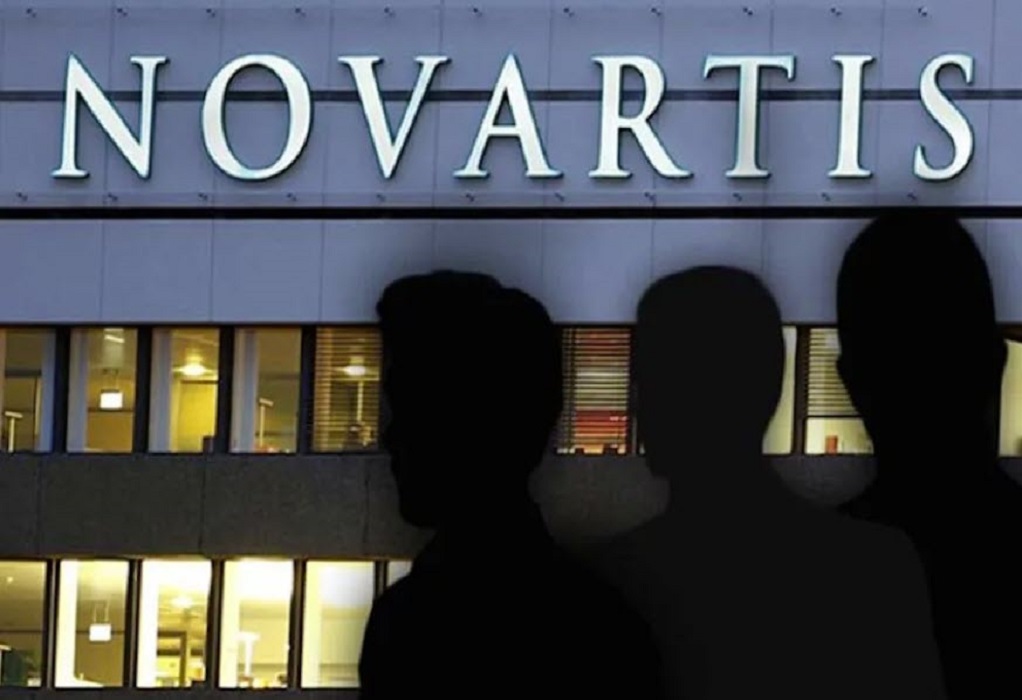
She told the court that, far from protecting her, the state had pursued her. ‘I am unfairly in this position because what I said concerned political figures. The political system must now incriminate someone,’ she said.
During the hearing, she stressed once again that ‘the Novartis case was and is a scandal’, insisting the authorities had sought to ridicule it.
The lifting of witness protection
On 24 October 2024 the Economic Prosecutor’s Office lifted the protection status of both protected witnesses in the Novartis case, ‘Aikaterini Kelesi’ and ‘Maximos Sarafis’. Their unmasking had earlier been demanded by Antonis Samaras, Yannis Stournaras, Adonis Georgiadis and Andreas Loverdos.
Yesterday, visibly emotional, Kelesi stood before the court without retracting any of her previous allegations.
Testimony on Novartis practices
Kelesi, who worked for Novartis until September 2018, described herself as secretary and confidante to the company’s vice-president, Kostas Frouzis. ‘From my position I saw, heard and experienced the company’s unfair practices. Everything I said, saw, heard and experienced was true and has nothing to do with lies,’ she said.
She alleged that money was frequently handled in Frouzis’ office and that transfers reached the heart of government. Referring to one episode in 2013, she recounted preparing a ‘non-paper’ for a meeting between Frouzis and Prime Minister Antonis Samaras. She claimed that when Frouzis arrived at the PM’s office carrying a suitcase, it contained bundles of banknotes, but when it was returned to her afterwards, the cash was gone.
‘When I opened the bag I saw the money. I tried to appear calm, because money was a daily occurrence in Frouzis’ office. The practices with which Novartis achieved its goals were well known,’ she told the court.
According to her testimony, the company’s ‘main goals were to pay off debts and bring new drugs to the market’. She also referred to the so-called Harvard Project, in which Yannis Stournaras was allegedly involved.
Confrontation with the bench
The presiding judge challenged her account: ‘When you testify about a suitcase that reaches the prime minister, it is very serious.’
Kelesi replied: ‘My intention was not to initiate prosecution. I have no grudge against them. I just wanted to say it so they would get off my back.’
She went on to describe meetings involving Adonis Georgiadis. ‘I was an eyewitness to three meetings with Georgiadis. Twice I saw files being delivered at the ministry, and the third time Frouzis entered alone. The files contained bundles of banknotes. It was clearly a money transfer,’ she said. She described this as a ‘win–win relationship’, similar to that which existed with Stournaras.
Political connections
She testified that Novartis influenced ministerial decisions directly. Drafts of health policies under Georgiadis and Loverdos were allegedly sent to the company for review and corrections before publication. ‘The company was like a state within a state. Political decisions came in draft form to us. We checked them before they were released,’ she said.
On Andreas Loverdos, she stated that the relationship ‘was built step by step’, with money allegedly channelled through intermediaries to push drugs onto the market in 2011. She also implicated former Health Minister Marios Salmas, claiming that meetings held in his office involved similar practices; however, their relationship later soured when he aligned with another company.
Finally, she referred to former minister Dimitris Avramopoulos, saying: ‘According to Frouzis, €200,000 was given for the H1N1 vaccines. I was not there, but he told me he delivered it. It was done with a suitcase. For Samaras he did not tell me the amount, but it was enough.’
On her treatment
Kelesi described her decade under scrutiny as ‘ten years of living hell,’ pointing to the bullying her two children suffered because of the scandal. She recalled that in 2017 Novartis staff were warned of investigations by American authorities. Shortly afterwards, she received a summons from the Greek corruption prosecutor’s office, taped to her office door.
‘At the end of October 2017 I went to the prosecutor’s office. They asked me to testify because I was considered a key person. I told them about my fear,’ she said.
______________________________________________
Are you seeking news from Greece presented from a progressive, non-mainstream perspective? Subscribe monthly or annually to support TPP International in delivering independent reporting in English. Don’t let Greek progressive voices fade.
Make sure to reference “TPP International” and your order number as the reason for payment.
Σε χρειαζόμαστε
Το ThePressProject είναι το μοναδικό μέσο ανεξάρτητης, ερευνητικής και αποκαλυπτικής δημοσιογραφίας που στηρίζεται αποκλειστικά στις μικρο-δωρεές των επισκεπτών του. Πιστεύουμε ότι η πληροφορία πρέπει να είναι διαθέσιμη σε όλους και για αυτό δεν κλειδώνουμε κανένα κομμάτι της ύλης αλλά για να παραχθεί το πρωτογενές υλικό που θα βρείτε εδώ χρειαζόμαστε την υποστήριξή σου. Αν δεν πληρώσουμε εμείς για την ενημέρωσή μας, θα την πληρώσει κάποιος άλλος (και αν δεν είσαι ο Μαρινάκης μάλλον δεν έχεις τα ίδια συμφέροντα). Μάθε πώς
Σχόλια
- Κάνε κλικ για να σχολιάσεις
Πολιτική Σχολιασμού