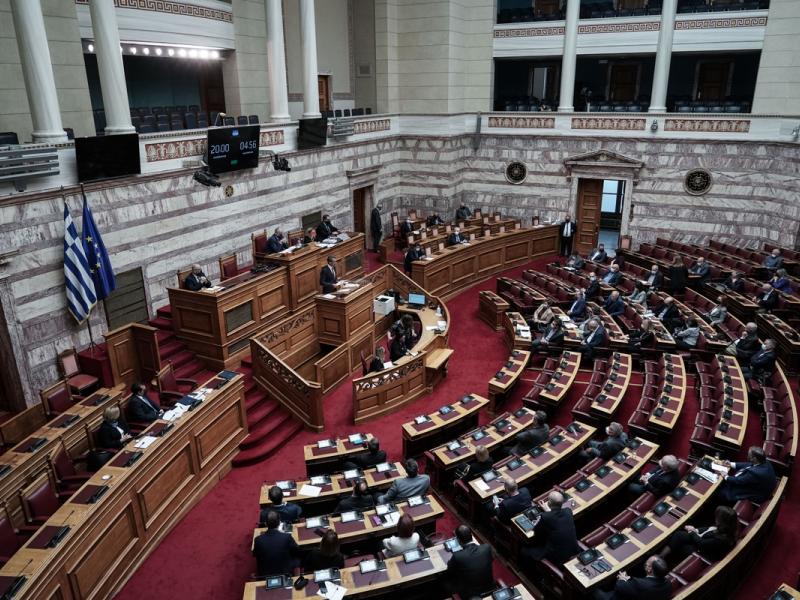
ND voted down the objections, which focused mainly on regulations governing the advancement of non-commissioned officers. The opposition argued that these provisions violate core constitutional principles, including the protection of legitimate expectations, the prohibition of adverse retroactivity, proportionality and the continuity of public administration.
In the plenary debate, Defence Minister Nikos Dendias defended the bill against criticism that it violently overturns the career framework for thousands of lower-ranking officers. He insisted that the government “respects and supports” NCOs, but argued that the new system aims to correct “chronic distortions and injustices” embedded in the current structure.
Dendias questioned the coherence of the existing promotion system, comparing the trajectories of Cadet School graduates with those of officers who rise through NCO ranks. He argued that it is irrational for officers with significantly different training and qualifications to advance at similar speeds and claimed the system requires fundamental rationalisation. He also noted that admission scores for some NCO schools are now higher than for officer academies, even though the latter face the greatest staffing shortages.
Addressing the claim that the bill breaches NCOs’ ‘legitimate expectations’, Dendias challenged the basis of that argument, pointing to evaluation results that rate roughly 97 percent of personnel as ‘excellent’. Such uniformity, he suggested, undermines the credibility of the assessment system.
On pay, the minister denied any hidden reductions, saying that total increases for Ministry of Defence personnel amount to 350 million euros, largely funded through internal savings. He also called the current ratio of NCOs to officers a structural problem that deviates markedly from NATO norms and hampers operational effectiveness.
Dendias rejected accusations that the bill downgrades NCOs, arguing that it strengthens their institutional role by upgrading their schools, creating NCO crisis councils, expanding their participation in decision-making structures and establishing two defined pathways for promotion to officer rank.
On public consultation, he dismissed claims of widespread dissent, arguing that many negative comments were repetitive and came from a limited segment of the NCO corps. According to him, no comparable reaction emerged from officer ranks.
Closing his remarks, Dendias also responded to criticism over international law following the prime minister’s controversial statement that “this is not the time” to address the legality of the US operation in Venezuela. He insisted that Greece remains fully committed to the UN Charter and international law, which he described as a constant pillar of Greek foreign policy.
______________________________________________
Are you seeking news from Greece presented from a progressive, non-mainstream perspective? Subscribe monthly or annually to support TPP International in delivering independent reporting in English. Don’t let Greek progressive voices fade.
Make sure to reference “TPP International” and your order number as the reason for payment.