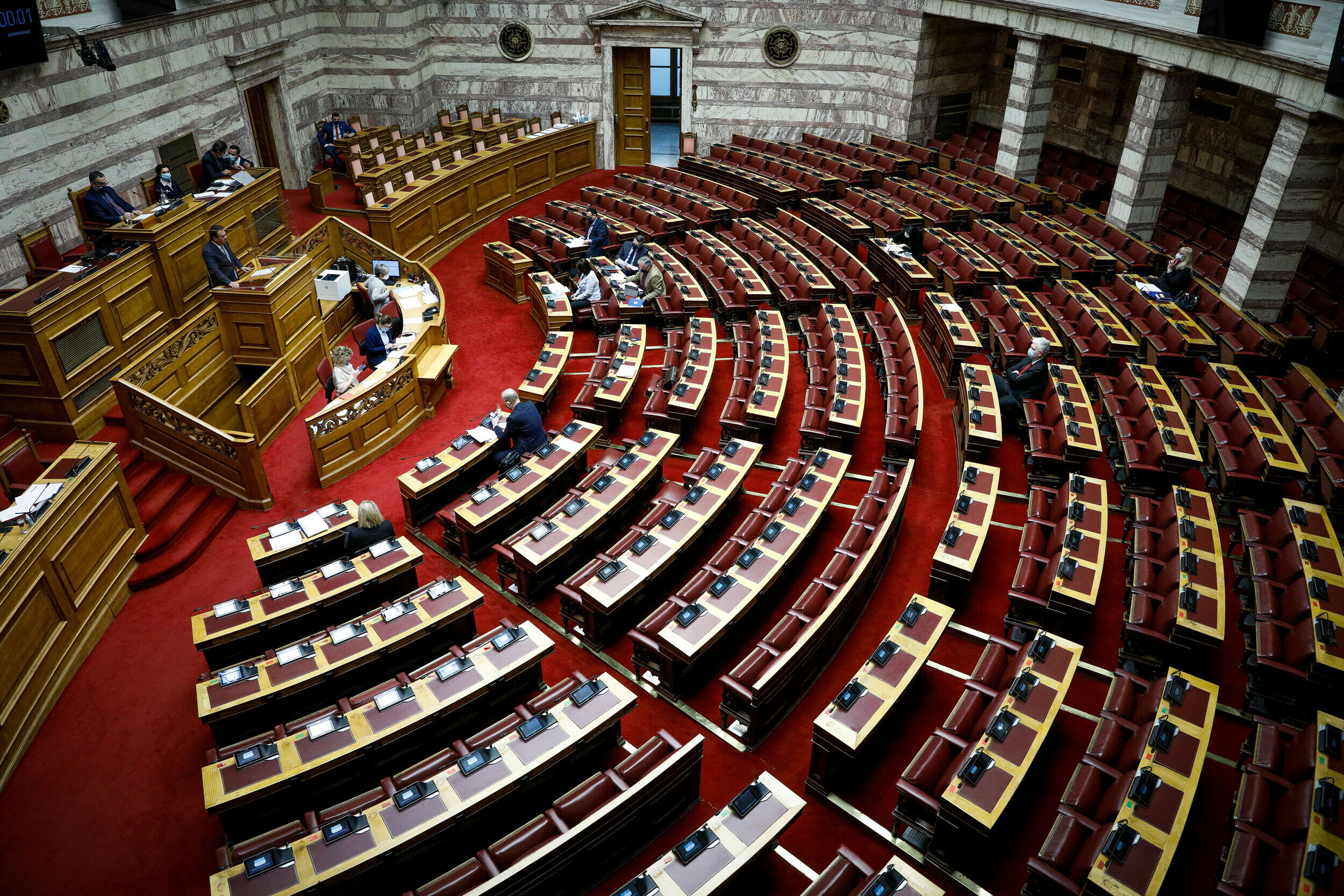
Prime Minister Kyriakos Mitsotakis announced an increase to €920 gross (€772 net) per month from 1 April, speaking to the Council of Ministers. Citing selective data and ignoring the steep rise in the cost of basic goods and housing, Mitsotakis hailed the ‘sixth consecutive increase in the minimum wage, which we received in 2019 at €650’. The announcement came just one day after Eurostat published preliminary data on GDP per capita in purchasing power parity, placing Greece last in the EU alongside Bulgaria.
PASOK
Pavlos Christidis, head of PASOK’s labour and social affairs committee, said the increase ‘confirms, once again, the failure of the New Democracy government’s policy’. He pointed to Greece’s position as last in the EU in purchasing power alongside Bulgaria, its second-worst ranking for average salary with annual earnings below €18,000, and the introduction of the 13-hour working day even in heavy and unhealthy conditions.
Christidis noted that housing costs had risen by 28% over five years, one in four Greeks was at risk of poverty or social exclusion, one in five could not keep their home sufficiently warm in winter, and 11.3% were unable to afford a regular meal with meat or an equivalent nutritious option.
‘In this environment, the increase in the minimum wage is insufficient and below the circumstances,’ he said, calling for political change that would mean ‘free negotiations with social partners and the determination of the minimum wage through the National General Collective Labour Agreement’, as well as ‘fair development that leads to a reduction in social inequalities and opportunities for all’.
Greek Communist Party (KKE)
The KKE described the announcement as yet another ‘mockery increase’ that ‘condemns hundreds of thousands of workers to make do with €771.67 in net salary per month’, particularly at a time when price rises driven by the effects of the war had already eroded the increase before it was even announced.
‘No one expected anything different from a government that, a few days ago, instead of announcing measures to relieve the people from tax evasion and fraud, announced measures to support and expand the profitability of business groups,’ the party said.
The KKE also challenged the government’s claims about associated benefits, noting that only 13% of the unemployed receive unemployment benefits and that the government had legislated away seniority accrual for the period 2012 to 2023, meaning workers with 14 years of service receive no seniority-based increase. The party further argued that the minimum wage announcement exposed the true nature of the government’s ‘Social Agreement’, signed with employers and the president of the General Confederation of Greek Workers (GSEE), who is under investigation for financial scandals. The KKE said its warnings had been vindicated: the agreement had created a mechanism for dragging sectoral wages down towards the minimum, noting that the much-touted 25% increase in the minimum sectoral gross wage in the food industry amounted to a difference of just €10 from the general minimum gross wage. Despite nominal increases in recent years, the average nominal wage in 2025 remained 4% lower than in 2011, a gap that reached 19% when adjusted for inflation.
The party called for strengthened labour movement action to ‘overturn the policy of war and poverty’, demanding large increases in wages and pensions, a reduction in daily working time to seven hours over a five-day, 35-hour week, and immediate measures against price rises.
New Left
The New Left accused Mitsotakis of ‘mocking society with fraudulent increases’, noting that of the roughly €40 gross increase, only €27 to €30 net reaches workers’ pockets, amounting to €0.92 per day. ‘Not even half a litre of petrol,’ the party said.
It pointed to the mounting pressure on households from rising fuel, energy, and basic goods prices, along with increased transport costs signalling a new wave of inflation. The party noted that even European Central Bank President Christine Lagarde had warned that the full effects on energy prices were yet to be felt.
‘Without collective agreements, without real increases, and with policies that keep wages low, society is being led to permanent impoverishment,’ the New Left concluded, demanding real wage increases, the reinstatement of collective bargaining, and substantial support for workers. ‘No one lives better with €0.92 more per day.’
______________________________________________
Are you seeking news from Greece presented from a progressive, non-mainstream perspective? Subscribe monthly or annually to support TPP International in delivering independent reporting in English. Don’t let Greek progressive voices fade.
Make sure to reference “TPP International” and your order number as the reason for payment.