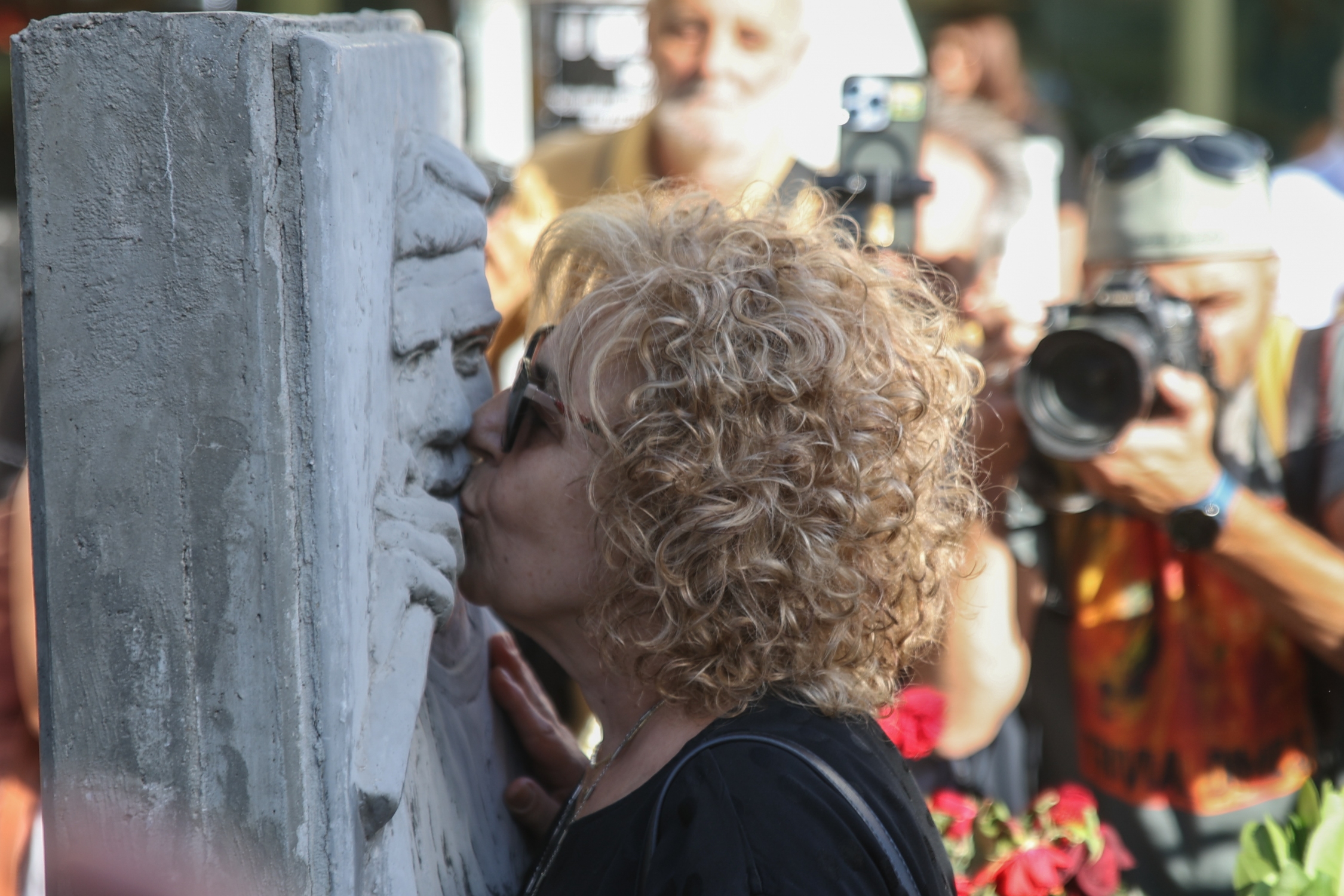
Speaking before the court and in the presence of Fyssas’s mother, Magda Fyssa, the prosecutor described in detail the actions of the Golden Dawn assault battalion. She stressed that Giorgos Roupakias attempted to flee calmly in his car, while Fyssas, still alive, indicated him to the police.
Stefanatou began with a character outline of Fyssas, noting that his “not at all flattering” lyrics were known to the defendants, as evidenced by telephone conversations in the case file. “When someone listens to songs that are not to their liking, then they consider themselves entitled to beat them,” she remarked. Although such a justification may seem “exaggerated or absurd”, she argued it reflects a psychological tactic deployed by the organisation. “Nikos Michaloliakos (the former Golden Dawn leader) is a master of psychology,” she said, explaining that when the truth sounds improbable, “others consider it more reasonable to lie”.
She argued that Golden Dawn demanded not respect but absolute submission, citing the order by MP Giorgos Germenis who commanded journalists to “stand up” during the press conference where the election results were announced. She also stated that the organisation’s Nikaia offices in Athens served as a “base for assault battalions”, operating not as political premises but as an operational hub for organised violence.
‘Suitable target because he mocked them with his songs’
Stefanatou said the choice of Fyssas as a victim must be seen in the context of escalating violence intended to provoke a reaction from the Left, “in order for the parastate to intervene”. She noted that within nine months there had been five major cases, including the murder of immigrant Shahzad Luqman, the assault in Paros and finally the murder of Fyssas. “They were no longer retreating,” she said, adding that the crime had a clear purpose.
She argued that Fyssas had not provoked the group and was not a high-profile enemy, but was targeted because he was an anti-fascist who mocked them in his music. Golden Dawn, she said, typically targeted “anonymous members” of society rather than emblematic figures, and killings were executed by the assault battalion collectively, not by lone individuals. “Fyssas was chosen as a suitable target because he mocked them with his songs and it was a matter of time before the assault battalion was mobilised.”
She added that intercepted communications show hierarchical coordination.
‘The victim was calm until the end’
Describing the attack outside the Coralli café, Stefanatou contrasted the behaviour of Fyssas with that of the Golden Dawn members, who she said appeared “implacable, armed with clubs and batons, repeating threats”. She detailed how the group confronted Fyssas and his friends, chased them in the presence of police officers, and continued to advance despite police being on the scene.
“They systematically did not change their behaviour due to the presence of police officers and continued to approach the Fyssas group,” she said. Fyssas urged his friends to run to save themselves but did not flee, likely to allow them to escape.
‘Fyssas was alive and pointed at Roupakias who stabbed him’
Stefanatou described the attack as a coordinated raid “with alternating attacks and ambushes”. She argued that the aim was not immediate elimination but to weaken the victim until Roupakias arrived. “If they had wanted to, 50 people could have eliminated Fyssas and his group, but they wanted to delay him and prevented his people from helping him, thus giving Roupakias all the time to inflict the fatal blows.”
She said Fyssas had no time to react before Roupakias, “acting on a plan”, circled around to approach him by surprise. “Everyone was waiting for someone to save Fyssas,” she noted. When Roupakias appeared, the perimeter of Golden Dawn members “opened up and hugged the victim”, enabling the stabbing. Stefanatou described the killing as “completely professional and not at all by chance”, adding: “These were not the 20 blows that we are used to in crimes with personal motives, it was an execution, the performance of a task.”
She then reiterated that Roupakias tried to escape “calm and composed”, but Fyssas, still conscious, identified him to the police. She highlighted the shock of the defendants on realising that someone stabbed in the heart could remain standing and speak. Despite being aware that he was dying, Fyssas “had the deathly worry that the murderer would go unpunished” and therefore lifted his shirt to show the fatal wounds. “Pavlos Fyssas did the dissection of his murder all by himself,” she concluded.
______________________________________________
Are you seeking news from Greece presented from a progressive, non-mainstream perspective? Subscribe monthly or annually to support TPP International in delivering independent reporting in English. Don’t let Greek progressive voices fade.
Make sure to reference “TPP International” and your order number as the reason for payment.